
Summary
When a business needs equipment for getting onto a truck, most people think of a ladder first. Standard ladders are easy to buy, easy to price-compare, and cover ordinary climbing up and down.
But loading and unloading is more than climbing. Workers step onto the truck bed, stand near the edge, receive or pass cargo, and step down again. Each of these moments happens in a position a ladder is usually not designed to serve.
Hasegawa has a different answer to this problem, but few people know it because it is not part of the ready-made range. It is the suspended work platform, an Order Made product designed for each site.
This article explains what it is, why the two-level height is worth noting, how it differs from a standard ladder, and what information to prepare before ordering.
What is the suspended work platform?
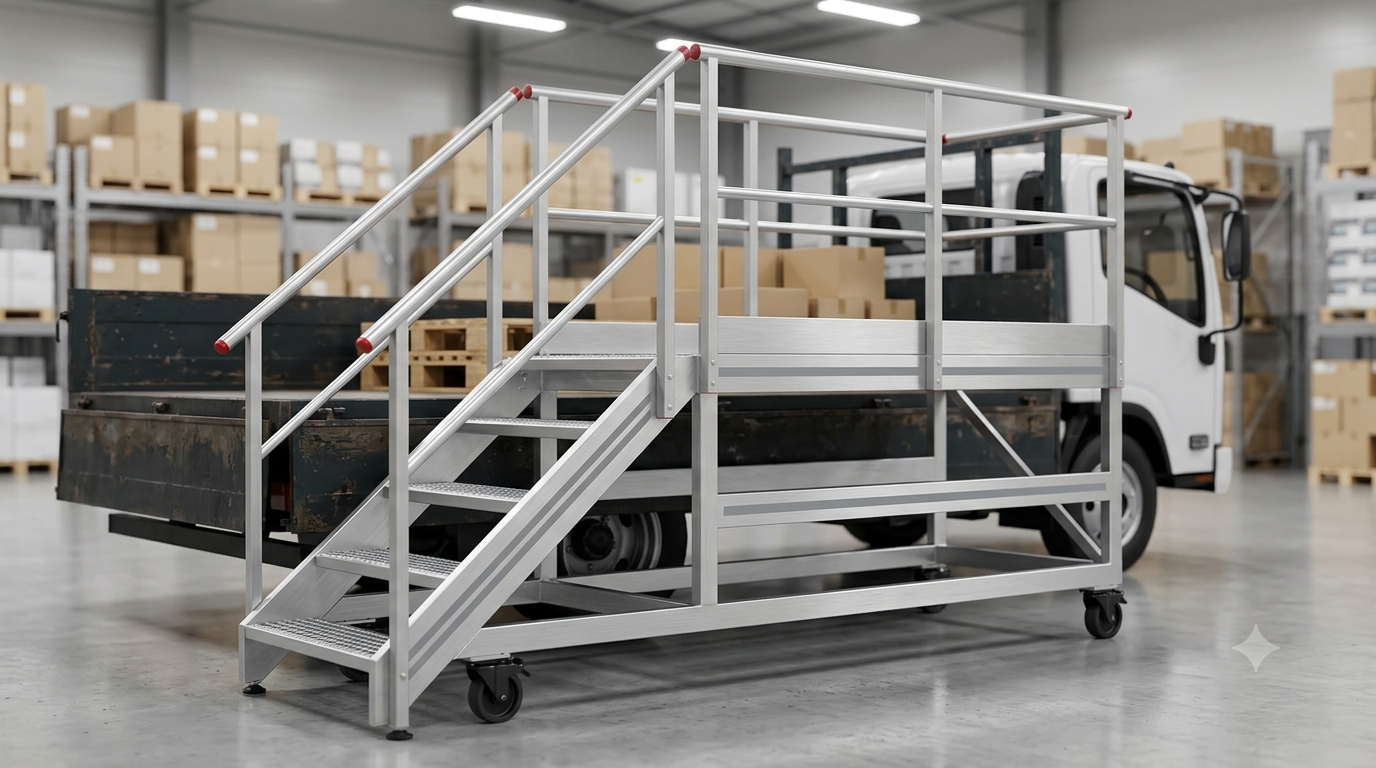
According to the Hasegawa Vietnam catalogue, the suspended mobile work platform is “used to fix and hang cargo onto a freight truck. It prevents falls and ensures stable footing during loading and unloading, and its height can be changed to 2 levels depending on the type of work.”
The product belongs to the Hasegawa Order Made range, under freight transport. Illustrations in the catalogue show platforms with handrails and an access stair, mounted on casters next to a truck bed.
A note on naming: the catalogue says “work table”, while this article uses “work platform” for clarity. It is the same product.
About specifications: the catalogue does not publish dimensions, load capacity or the height-change mechanism for this product. This is because Order Made has no fixed specifications. They are defined during survey and design, based on each customer’s actual vehicle and work.
Where do falls happen during loading and unloading?
Falls from height are a notable cause of workplace accidents in Vietnam. According to Notice 4162/TB-LĐTBXH of the Ministry of Labour, Invalids and Social Affairs on workplace accidents in the first six months of 2023, falls from height accounted for 22.9% of all cases and 22.51% of all deaths. This figure covers all industries, not only transport.
A road-freight safety document from Japan’s Ministry of Health, Labour and Welfare (Vietnamese edition) also describes workers losing their balance and falling while handling cargo on a truck bed.
From how the work is actually done, three risky moments can be identified. This is a situational analysis, not statistical data.
- Climbing onto and stepping down from the truck bed. The foothold is often unstable, especially when the hands are carrying cargo.
- Standing near the edge to pass cargo. Workers lean out and shift their weight outward.
- Securing or hanging cargo. Workers reach, pull ropes or push packages while standing on a narrow surface.
All three moments need stable footing. That is exactly the purpose the catalogue states for this product.
For the general risks of cargo handling at ports and warehouses, see our article on safe loading and unloading. Fall-accident figures by industry are in this data analysis.
Two height levels: why is this the differentiator?
Each loading task requires a different standing position. If a platform has only one height, workers must either reach up or bend down. Both postures reduce stability.
According to the catalogue, the product’s height can be changed to 2 levels depending on the type of work. This is a distinctive feature, since standard ladders usually have one height or an adjustment range at the legs.
To picture it, consider two hypothetical kinds of work. This example is for illustration only and is not a product specification.
- Work that needs standing close to the truck bed to pass cargo at a low level.
- Work that needs standing higher to handle stacked cargo or secure cargo above.
With two height levels, one product can serve both kinds of work. The exact value of each level is set during design.
Comparison with the standard DZB truck ladder
Hasegawa also offers the standard DZB ladder for getting on and off trucks. The table below distinguishes the two approaches.
| Criteria | Suspended work platform | DZB-180 ladder |
|---|---|---|
| Product type | Order Made | Standard, ready-made |
| Main purpose | Stable footing during loading, fall prevention | Getting on and off a truck |
| Height | 2 levels depending on the work | 1.41–1.85 m |
| Load capacity | Defined during design | 100 kg |
| How to order | Survey, design, quotation | Buy by product code |
DZB-180 fits when the main need is climbing up and down. The suspended work platform fits when workers must stand and work on the truck for some time and need firm footing.
The two products do not replace each other. They solve two different parts of the same loading process.
What about freight wagons?
The catalogue mentions only freight trucks, not railway freight wagons. Applying the product to wagons therefore needs a separate survey and should not be assumed.
The wagon environment adds requirements on the structure gauge. Vietnam’s QCVN 08:2018/BGTVT on railway operation defines the clearances that equipment near the track must not intrude upon.
If you need loading work on wagons, state the wagon type, the work position and the rules of the line operator when you get in touch. The technical team will assess the design feasibility.
Information to prepare when contacting us
Because this is an Order Made product, prepare the following to make the survey more effective:
- Vehicle type: truck, bed dimensions and bed floor height.
- Cargo type: packages, pallets, boxes and typical weight.
- Working position: where workers stand and how many at once.
- Loading frequency: number of trips per day or per shift.
- Site conditions: floor area, travel routes and where the equipment is kept when not in use.
Hasegawa’s Order Made process has 6 steps: research, design, quotation, order, production and delivery. Orders can start from a single unit.
When to consider the suspended work platform
An Order Made product is not for every site. It fits best when standard ladders are already in use but a gap remains in footing during loading. Consider it if you see any of the following signs:
- Workers stand on cargo or on the truck bed edge to work. This is the clearest sign that a fixed place to stand is missing.
- Ladders are in place, but loading still relies on improvisation. A ladder helps with getting up and down, but it does not always provide a place to stand and work.
- The work needs two standing positions at two different heights. The 2-level height change matters most in this case.
- The loading area is used steadily every day. High frequency makes dedicated equipment worth the investment over time.
If the need is only to get on and off a truck, a standard ladder such as the DZB-180 may be enough. When unsure, send us your site details and the technical team can advise which direction fits better.
Frequently asked questions
What load can the suspended work platform carry?
The catalogue does not publish a load capacity for this product. It is defined during design based on actual needs.
Can it be used for freight wagons?
The catalogue mentions only freight trucks. Wagons need a separate survey that takes the structure gauge under QCVN 08:2018/BGTVT into account.
How is it different from the DZB ladder?
DZB is a standard ladder for getting on and off trucks. The suspended work platform is an Order Made product focused on stable footing during loading.
Can I order just one unit?
Yes. According to the catalogue, Order Made can be supplied from a single unit.
Conclusion
The suspended work platform is a little-known Order Made product from Hasegawa. According to the catalogue, it helps prevent falls and provides stable footing when loading and unloading cargo on a truck.
Its most notable feature is a height that can be changed to 2 levels depending on the work. This sets it apart from standard ladders, which focus on getting up and down.
As an Order Made product, its specifications are defined during survey and design, and orders can start from a single unit. For freight wagons, a separate survey is needed because the catalogue mentions only trucks.
If your workers are standing on cargo or on the truck bed edge, start by recording the vehicle type, the cargo and the standing position. These are the first three pieces of information Hasegawa needs to propose a suitable solution.
———————————————————————
This article is based on the official Hasegawa Vietnam catalogue and public documents of government agencies. It is for general reference; specific specifications must be confirmed during survey and design.
Does your truck bay need safer footing for loading?
Send us your vehicle type, bed height and actual loading tasks. The Hasegawa Vietnam team will survey and propose a suitable Order Made solution, from a single unit.