
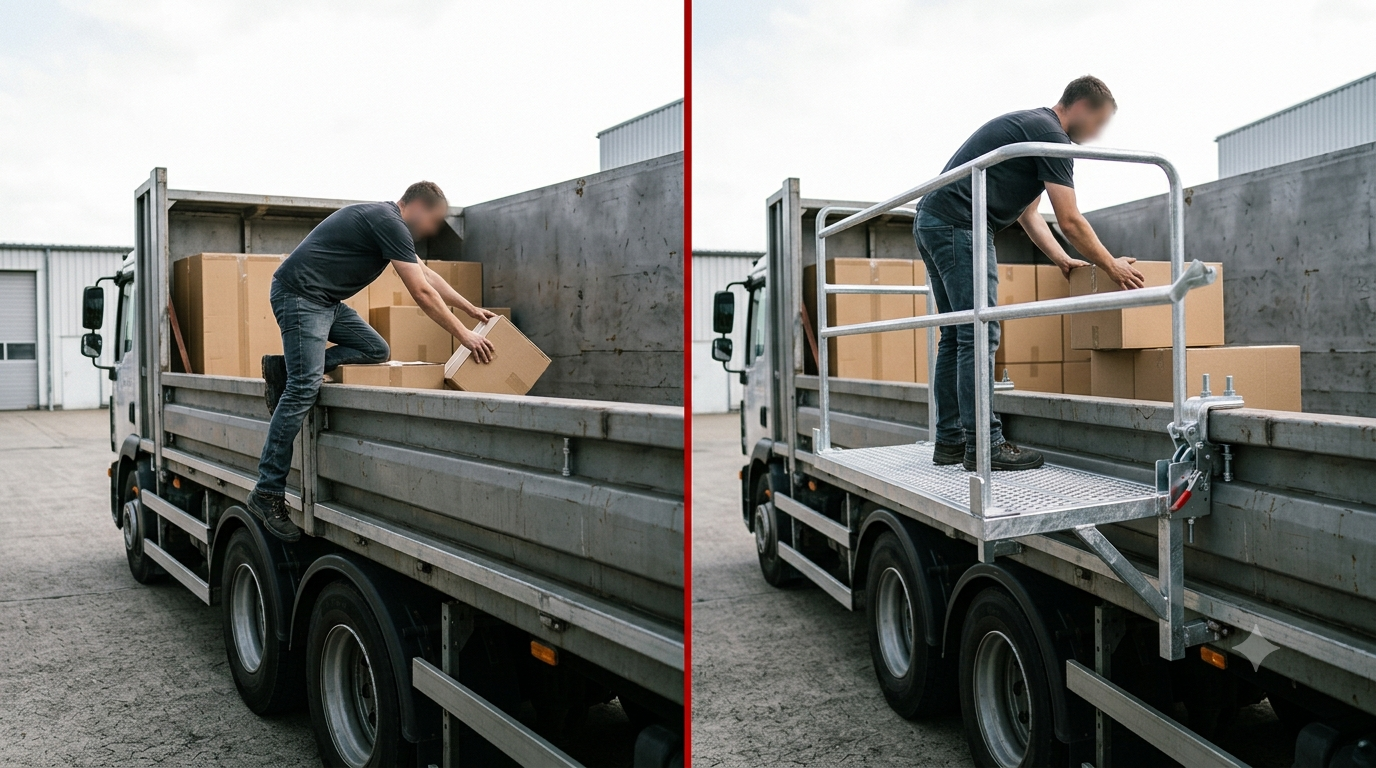
Cargo loading and unloading is one of the most commonly underestimated fall-risk jobs, because the working height keeps changing depending on the type of truck, container, or cargo — unlike a factory environment with a fixed work position. This article analyzes the specific risks of loading and unloading cargo at ports and warehouses, and introduces one of Hasegawa’s Order Made solutions: a suspended work platform, fixed to a delivery truck, adjustable between two height levels to suit different tasks.
Very little cargo loading work happens at a fixed height. One truckload might sit higher or lower depending on the order, a container might be fully loaded or only partly filled from one trip to the next, and a package might sit near the floor of the truck bed or stacked close to the roof. This constant variation is exactly why workers tend to improvise — standing directly on cargo, jumping down from the truck bed, or using whatever’s nearby as a makeshift foothold.
This is why loading and unloading cargo, despite looking like a simple task at a glance, carries a fall risk that’s not far behind other specialized work-at-height jobs. This article breaks down the specific risks of the port and warehouse environment, and introduces an Order Made solution Hasegawa delivered for loading cargo onto trucks.
Why Is Cargo Loading a High Fall-Risk Job?
Unlike maintenance work at height in a factory, cargo loading has three characteristics that make equipping the right safety gear harder. In a factory, the work position is usually fixed, and equipment can be prepared for it in advance.
- The working height isn’t fixed. Each load, container, or package can require a different working height, so a “one height fits all” device struggles to cover every real-world situation.
- Time pressure. Loading and unloading is often tied to tight shipping schedules, which tempts workers to skip the step of setting up safety equipment to save time.
- An unstable work surface. Cargo, truck beds, and container surfaces aren’t designed to bear a person’s weight for extended periods, unlike a purpose-built work platform.
Together, these three factors mean that loading and unloading cargo still carries a meaningful fall risk in day-to-day operations. This holds true despite it not being “work at height” in the conventional sense, like roof maintenance or overhead power line work.
Risks Specific to the Port and Warehouse Environment
Beyond the three factors above, the port and warehouse environment has a few additional characteristics of its own:
- Multiple types of vehicles with different bed heights operate in the same loading area, making it hard to install a single fixed device that fits them all.
- High loading frequency means risk accumulates with every repeated operation, day after day.
- Loading areas are often crowded and busy with vehicle traffic, which raises the stakes if a worker falls or loses balance.
The Challenge Behind Hasegawa’s Order Made Project: A Suspended Work Platform
According to Hasegawa Vietnam, one of the Order Made solutions developed for cargo transport is a mobile suspended work platform, used to secure and suspend equipment onto a delivery truck during loading and unloading.
This design targets the core problem described above directly. Instead of letting workers stand temporarily on cargo or the edge of a truck bed, the platform is fixed directly to the truck, creating a stable footing throughout the operation. The second notable feature is that the height can be changed between two levels depending on the task, letting a single piece of equipment cover multiple loading situations instead of needing a separate setup for each height.
Two Key Design Elements
A Mounting Mechanism Fixed to the Truck — More Stable Than a Makeshift Solution
When a work platform is fixed directly to the truck instead of being placed loose on the ground or leaned temporarily against the truck bed, a worker’s footing no longer depends on how stable the cargo or the truck bed surface happens to be. This is a key difference from the makeshift solutions common at many warehouses, where workers find their own footing on a pallet, a cardboard box, or the edge of the truck.
Two Adjustable Height Levels — Adapting to Different Vehicle Types
Because truck bed height and cargo position vary from one load to the next, a device with only a single fixed height quickly becomes inconvenient or gets skipped in practice. Being adjustable between two height levels makes the suspended work platform more flexible, suited to a wider range of tasks without needing separate equipment for every situation.
General Principles for Choosing Safe Loading Equipment
Not every port or warehouse needs an Order Made solution, but a few general principles apply when evaluating existing loading equipment:
- Prioritize a fixed footing independent of the cargo. Workers shouldn’t have to stand directly on cargo or a pallet to do their job.
- Add handrails or guardrails at any edge with a fall risk — especially important when working near the edge of a truck bed or container.
- Use an anti-slip surface. Loading areas are often prone to becoming wet from weather or leaking cargo.
- Look for adaptability across multiple working heights, rather than a device suited to only one specific type of vehicle or container.
When Should a Port or Warehouse Invest in Specialized Loading Equipment?
You might consider investing in specialized loading equipment if you find yourself in one of these situations:
- Workers currently stand on cargo, pallets, or the edge of a truck bed to do their job, due to the lack of a fixed footing.
- Your loading area handles multiple types of vehicles with different bed heights, and a single fixed-height device doesn’t cover them all.
- Loading happens frequently enough at the same location that investing in specialized equipment offers more long-term value than continuing with a makeshift solution.
Frequently Asked Questions
Why is cargo loading considered a high fall-risk job, when it’s usually not as high as roof maintenance?
The risk doesn’t come from absolute height alone. It also comes from unstable footing (standing on cargo or the edge of a truck bed) and time pressure that leads workers to skip safety equipment.
Does the suspended work platform fit every type of truck?
The two adjustable height levels make it suitable for a wider range of vehicles than a single fixed-height device, but exact fit depends on the specific vehicles used at your operation.
Do I need a separate Order Made unit for each type of truck?
Not necessarily. If the height difference between vehicle types falls within the device’s adjustment range, a single product can cover multiple situations. If the difference is too large, it’s worth discussing with the technical team to find the right approach.
Does a small port or warehouse with low loading frequency still need specialized equipment?
That depends on weighing accumulated risk against the cost of investment. At low frequency, it may be worth reviewing your current operating procedure first, before deciding to invest in new equipment.
This article was prepared based on Hasegawa Vietnam’s official introductory materials, combined with common occupational safety principles for work at height. The content is general reference material; each warehouse or port needs to be assessed individually based on actual conditions.
———————————————————————————————————————–
Hasegawa Vietnam’s sales team offers free consultation, proposing a stable loading platform tailored to your actual vehicle types and tasks.