
Order Made is Hasegawa Vietnam’s service for designing and manufacturing ladders and work platforms to a customer’s own specifications, for work positions where a standard product doesn’t fit or doesn’t perform the function needed. The process follows 6 steps: Survey, Design, Quotation, Order, Production, and Delivery. The minimum order quantity is just one unit, making it practical even for a factory that needs a single specialized piece of equipment for one specific position.
Not every work position in a factory matches the shapes and sizes listed in a standard product catalogue. A conveyor with an unusual height, a train car that needs maintenance from the roof, or a loading area with an irregular shape — these are all situations where a ladder or work platform that’s merely “good enough” doesn’t really solve the problem. Sometimes it creates new risk, because the worker ends up improvising a way to use it that fits the situation.
This is why Hasegawa Vietnam maintains two parallel product tracks: a standard line with published specifications, and an Order Made service — designed around the exact position, the exact task, and the exact real-world purpose. The sections below walk through the 6-step process, along with several industry examples Hasegawa has delivered.
What Is Order Made? When a Standard Product Isn’t Enough
Order Made, put simply, is an order format where the product is designed and manufactured specifically for each customer, rather than chosen from existing catalogue models. It’s the reverse of a standard purchase: instead of the customer adjusting their needs to fit an available product, the manufacturer adjusts the product to fit the customer’s actual needs.
A few signs that a standard product may not be enough:
- The work position’s size or shape doesn’t match any standard model.
- The task requires a specific action (such as suspending cargo, mounting permanently on a particular vehicle, or working within the confined space of a specific machine) that a general-purpose product isn’t designed for.
- The working environment has special material requirements (corrosion resistance, heat resistance, food contact) beyond the range of standard materials.
Hasegawa’s 6-Step Order Made Process
The entire process, from when a customer has a need to when they receive the product, is carried out by Hasegawa Vietnam in the following 6 steps.
1. Survey
This step involves understanding the actual problem at the point of use: the space’s dimensions, the nature of the work, how often it’s used, and relevant environmental factors (humidity, temperature, chemicals, food contact, and so on). This step shapes the entire design direction that follows, so the more accurate the information gathered, the closer the final product will match real-world needs.
2. Design
Based on the survey findings, the technical team develops a design plan: selecting suitable materials, calculating dimensions, and laying out functional parts (steps, handrails, wheels, height-adjustment mechanisms, and so on) to match how the user will actually operate it.
3. Quotation
Once a specific design plan is ready, Hasegawa sends the customer a detailed quotation. This is also the stage where both sides can discuss adjustments to the design to fit a budget or additional requirements.
4. Order
Once the customer confirms the design and quotation, the order is officially placed and moves into production.
5. Production
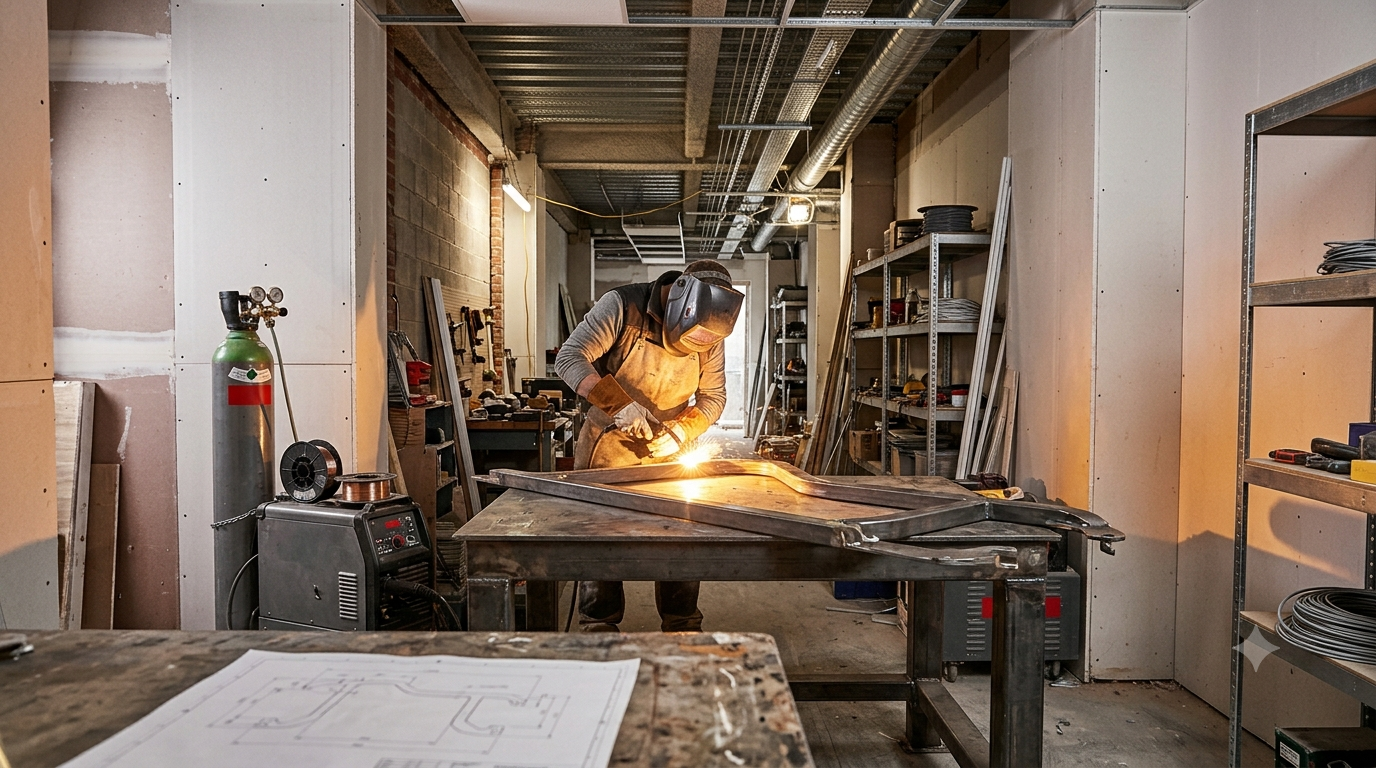
The product is fabricated according to the agreed design. For Order Made orders, most of the assembly work is carried out through manual welding by a skilled engineer, rather than mass assembly on a standard line.
6. Delivery
The finished product is inspected and delivered to the customer. Depending on the request, Hasegawa can also provide additional guidance on installation or use at the job site.
A Standout Welding Approach: What Does It Mean for One Engineer to Weld an Entire Product?
In mass production, a product is typically assembled through several stages on a line, with each worker handling a fixed part of the job. For Order Made orders, Hasegawa takes a different approach: a single engineer can be responsible for welding an entire product for one order, rather than splitting the work across multiple people.
This approach suits the nature of custom-ordered products better — each order usually has a different shape and structure, unlike the repeated, identical units of standard production. Having one engineer follow the product from start to finish helps keep the structure consistent, rather than risking misalignment as the piece is handed off between multiple stages.
Minimum Order Quantity: Just One Unit
One notable aspect of the Order Made service is that the minimum order quantity is just one unit. This has real practical value for factories that only need one specialized piece of equipment for one specific position, without having to place a large order to get a reasonable price — a requirement common with many other custom fabrication services on the market.
Real-World Applications by Industry
Below are several Order Made applications Hasegawa has introduced, illustrating how the 6-step process applies to specific situations.
When Is Order Made the Right Choice?
You might consider the Order Made service if you find yourself in one of these situations:
- You’ve checked the standard catalogue, but no model matches the actual size or shape of your work position.
- The task involves a specific action — such as suspending cargo, mounting permanently on a vehicle, or working within the confined space of a particular machine — that falls outside general-purpose use.
- You only need a small quantity (even a single unit) for one special position, with no plan to replicate it elsewhere.
- The working environment requires special materials outside the range of your existing standard product lines.
Frequently Asked Questions
Is Order Made significantly more expensive than a standard product?
Cost depends on the complexity of the design and the materials used. The Quotation step in the 6-step process exists precisely so you know the actual cost before deciding to place an order.
Can I order just a single unit through Order Made?
Yes. The minimum order quantity for the Order Made service is one unit.
How long does the process take, from survey to delivery?
The timeline depends on the design’s complexity and the scope of production, and is usually longer than purchasing an available standard product. The specific timeline is confirmed at the Quotation step, after the survey and design are complete.
Does Order Made cover both work platforms and scaffolding?
Yes. The Order Made service applies to many of Hasegawa’s product groups, including ladders, work platforms, and scaffolding, as long as it fits within actual production capability.
This article was prepared based on Hasegawa Vietnam’s official introductory materials. The specific process, timeline, and cost may vary by order; please contact the sales team for details tailored to your actual needs.
— — — — — — — — — — — — — — — — — —
Hasegawa Vietnam’s sales team offers free consultation, from an on-site survey to a design tailored to your actual working position.