
Introduction
“Stepladders” are an essential tool for high-altitude work in Vietnam’s manufacturing plants, construction sites, and logistics warehouses. Because they are equipment used on a daily basis, their selection and safety inspection are extremely critical tasks that directly affect occupational safety and health (OSH) on site. However, at many sites, stepladders are selected solely based on “height” or “price,” and the quality of the “joints,” which bear the most load, tends to be overlooked.
In this article, expert editors from Hasegawa Vietnam will thoroughly explain the structural importance of “welding” and “riveting,” which determine the lifespan and safety of stepladders. Incorporating Vietnam’s latest occupational accident data and quality standards (TCVN, JIS), we will teach site supervisors and purchasing managers “how to identify good products through visual inspection” that can be put into practice starting tomorrow. Please utilize this as a bible to protect employees’ lives and strengthen your company’s safety management system.
Challenges and Background
Market Data
In recent years, Vietnam’s industrial sector has been undergoing rapid modernization, and along with this, ensuring occupational safety has become an urgent issue. According to recent occupational accident statistics released by the Ministry of Labour, Invalids and Social Affairs (MOLISA), the construction, manufacturing, and logistics sectors account for 55.3% of all fatal occupational accidents nationwide. Furthermore, in all of these industries, “falling from heights (Ngã từ trên cao)” consistently ranks among the top three causes of occurrences, currently accounting for approximately 34.2% of all fatal accidents.
Many fall accidents during high-altitude work are caused by inappropriate scaffolding or the use of deteriorated or insufficiently strong stepladders. Currently on domestic e-commerce websites and at local hardware markets (such as Chợ Dân Sinh) in Vietnam, extremely cheap locally made stepladders priced at around 300,000 VND to 500,000 VND (approx. 12 to 20 USD), as well as counterfeit products with fake brands, are circulating in large quantities. Most of these have an extremely thin aluminum wall thickness of less than 1.0 mm, and furthermore, the processing of the “welding” and “rivets” to support the load is extremely poor, failing to meet safety standards for industrial use.
Risk Presentation
Continuing to use stepladders with defective joints on site creates immeasurable risks for a company. If the joint between a step (rung) and a side rail of an aluminum stepladder suddenly breaks during work, the worker will lose their balance and fall vertically onto the concrete floor from a height of over 2 meters. This results in serious occupational accidents (Tai nạn lao động) leading to complex fractures, head injuries, or in the worst-case scenario, death.
Under Vietnam’s Law on Occupational Safety and Health (Law No. 84/2015/QH13), in the unlikely event that a serious injury or death occurs due to the use of equipment that does not meet standards, the company and its site managers will be held strictly legally responsible. Specifically, there are risks of administrative fines of up to 200,000,000 VND, suspension of operations for up to 3 months, and even criminal liability (imprisonment) if deemed serious negligence. Moreover, medical cost compensation for the affected worker, suspension of site operations due to accident response, and financial losses from the decline in corporate brand value will return to hit the company at hundreds or thousands of times the small purchasing cost saved by introducing cheap stepladders.
Product & Service Introduction
-
Percentage of “falls from heights” among all fatal occupational accidents in Vietnam: 34.2% (Source: MOLISA Statistics)
-
Japanese national industrial standard regulating the safety of stepladders and ladders: JIS S1121 (Source: Japanese Industrial Standards Committee)
-
Standard value set by Hasegawa as the maximum load capacity for industrial stepladders: 100 kg to 130 kg (Source: Hasegawa Kogyo Specification Sheet)
-
Average aluminum wall thickness of inferior low-priced stepladders circulating in the local market: 0.8 mm to 1.0 mm (Source: Local Market Sample Survey)
-
Aluminum wall thickness of main structural parts used in Hasegawa’s professional stepladders: 1.2 mm to 1.5 mm (Source: Hasegawa Product Data)
Source: MOLISA Labor Accident Report & Hasegawa Product Specifications
Features
The aluminum stepladders provided by Hasegawa Vietnam are produced by directly introducing the advanced “joining technology” that Japan’s Hasegawa Kogyo has developed over a history of more than 80 years into its own factory in Vietnam (Binh Duong Province). The two major elements that determine the strength of a stepladder are “aluminum welding” and “high-strength riveting.”
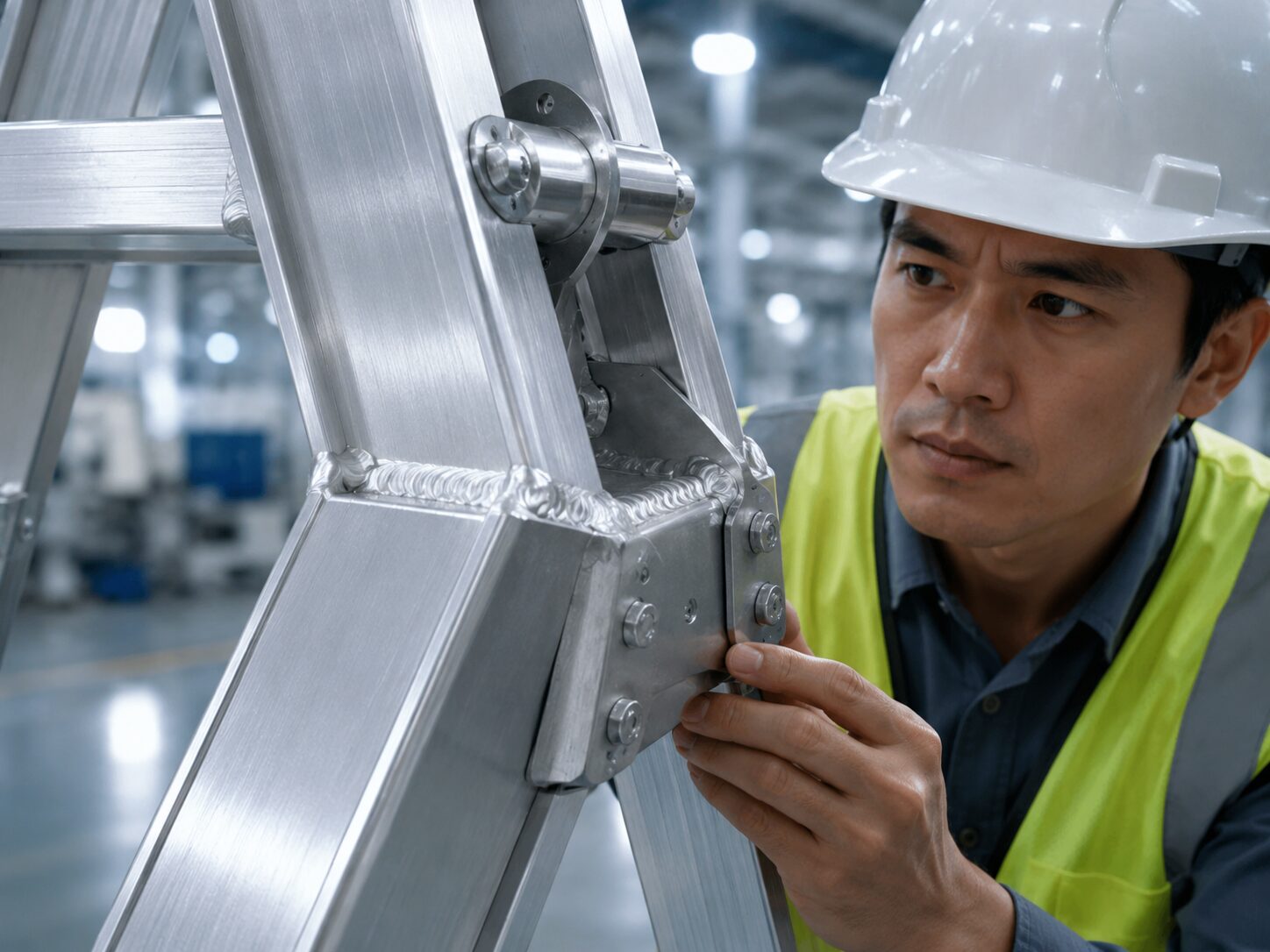
First, in aluminum welding, highly educated certified welders and precise automated welding robots are combined. Compared to iron, aluminum has an extremely high thermal conductivity, making temperature control during welding exceptionally difficult. At Hasegawa, the current and speed are strictly controlled so that a “beautiful wavy pattern (welding bead)” is uniformly formed on the weld joint. This prevents bubbles (blowholes) from generating inside the weld, unifying the metal structure and achieving overwhelming structural strength that does not budge even when a load of 100 kg or more is repeatedly applied.
Next is the placement and “crimping technology” of the rivets that connect the steps and side rails. Hasegawa’s professional stepladders utilize high-strength rivets fastened at multiple thoroughly calculated points so that optimal load distribution is achieved for a single joint. Because crimping (compression) is performed under precise torque management using hydraulic cylinders, the rivets will not loosen and the surrounding aluminum holes will not deform to cause “wobbling,” even under long-term use or impacts from rough transportation on site.
Case Study (Before → Action → After)
We introduce an actual improvement case study at a large automotive parts manufacturing plant (foreign-owned enterprise) in Dong Nai Province, Vietnam.
-
Before (Challenges prior to implementation): This plant had introduced about 30 locally made aluminum stepladders purchased from a local distributor at 450,000 VND per unit, using them for daily equipment maintenance and line inspections. However, just 6 months after implementation, when a large worker (weighing approx. 80 kg) climbed up and down while holding tools, the rivet holes supporting the steps expanded, causing left-to-right wobbling of over 5 cm across the entire ladder. Complaints erupted from workers saying, “I’m too scared to stand on it,” and part of a step actually detached, causing a worker to lose their balance, resulting in more than 3 “near-misses (Suýt ngã)” per month.
-
Action (Measures implemented): To prevent occupational accident risks beforehand, the plant’s Environmental Health and Safety (EHS) manager decided to scrap all the cheap stepladders. They consulted with a representative from Hasegawa Vietnam and completely replaced them with industrial high-strength stepladders (models with top plate heights of 1.2 m to 1.8 m) that comply with JIS standards. At the same time, Hasegawa’s expert staff visited the plant and conducted a “Stepladder Correct Usage and Safety Inspection Training” for 20 on-site workers.
-
After (Effects after implementation): Now, 3 years after introducing Hasegawa’s stepladders, the number of near-misses and occupational accidents caused by stepladders at the plant has remained at “0.” Despite being used every day in harsh 3-shift maintenance operations, no cracks in the welded parts or wobbling due to loose rivets have occurred at all. The purchasing manager highly praised its economic efficiency and safety, stating, “The initial purchase cost was about three times that of the locally made ones, but since we used to replace them once every six months, looking at the total cost of ownership (TCO) over three years, Hasegawa products ended up reducing expenses by about 40%.”
Hasegawa’s Reliability
Quality Control and Certification
The biggest reason why Hasegawa Vietnam’s products stand apart from common cheap stepladders lies in our uncompromising quality control system. Our products are designed and manufactured to meet the strict standards of “JIS S1121 (Stepladders and ladder-type stepladders)” based on Japan’s Industrial Standardization Act.
In the testing room inside our factory, we constantly conduct harsh quality tests such as the following on stepladders randomly sampled from production lots:
-
Static Load Test: Applying a gravitational force equivalent to 2 to 3 times the specified value (approx. 300 kg) to the top plate and steps to measure if there is any deformation or damage.
-
Repetitive Endurance Test: Continuously applying a load (100 kg) mimicking the movement of a person climbing up and down to the joints over 50,000 times to verify that no loosening of rivets or fatigue failure of welding occurs.
At our own factory in Vietnam, from the receiving inspection of raw materials—aluminum alloy (6000 series high-strength aluminum)—to the “100% visual and tactile inspection” by specialized inspectors at final shipment, we have established exactly the same quality gates as our mother factory in Japan (Hyogo Prefecture). This brings the initial defect rate infinitely close to zero.
Customization and Support System
We do not simply sell off-the-shelf stepladders; we provide solutions for the specific challenges faced by local sites in Vietnam. For example, in response to requests such as “I want a special work platform with steps that perfectly matches the height of our existing production line” or “We need a narrow safety stepladder that does not interfere even in tight aisles,” Japanese engineers from Hasegawa Vietnam and local engineers can jointly design and quickly manufacture and deliver “custom-made” products at our own factory.
Furthermore, as after-sales support after delivery, we provide a “Stepladder/Ladder Daily Inspection Checklist (Vietnamese/Japanese version)” free of charge, which is useful during on-site safety patrols. Even in the unlikely event that a strong impact is applied during on-site use and parts need to be replaced, we constantly maintain stock of spare parts (rubber feet, spreading lock brackets, etc.) within Vietnam, allowing us to respond with replacements as early as the next day to minimize downtime at the customer’s site.
Summary
Ensuring occupational safety in Vietnam’s manufacturing, construction, and logistics sites is a matter of top priority for the sustainable growth of enterprises. When choosing a stepladder, judging solely based on the cheapness of the immediate purchase price (initial cost) could expose employees to the danger of serious fall accidents and result in the company shouldering massive legal and economic risks.
The key to identifying a safe and excellent stepladder lies in the “uniformity of welding” and the “crimping precision of rivets” that support the load. With technological strength backed by Japan’s strict JIS standards, Hasegawa Vietnam’s products promise overwhelming quality in all of these joints.
If you are a safety manager who feels even the slightest “wobbling” or “anxiety” regarding the stepladders currently used on your site, or a purchasing manager considering a renewal of your equipment, please feel free to contact Hasegawa Vietnam. We will propose the most suitable safety solution tailored to your site. Product catalog downloads and loans of demo units to experience the actual strength firsthand are also available at any time.