
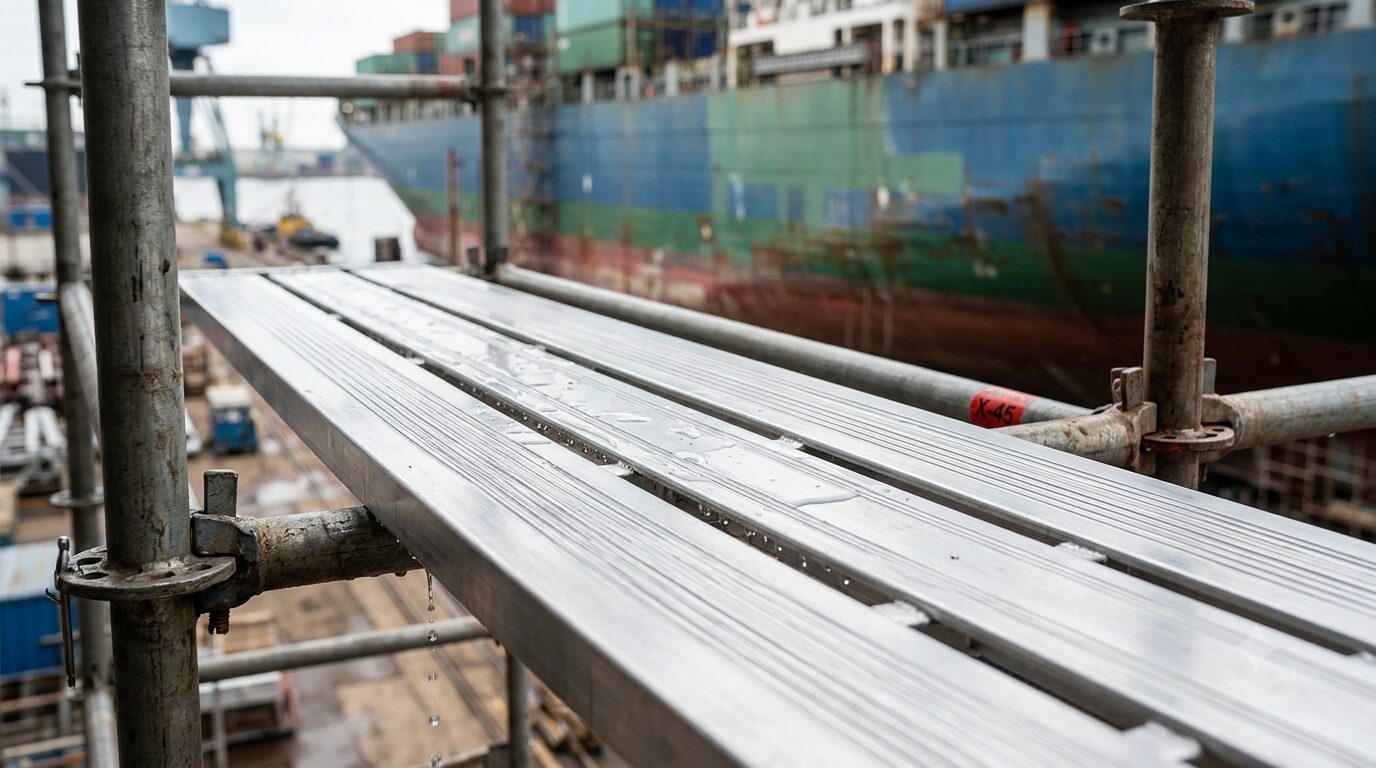
NNS is Hasegawa’s scaffold plank, made from aluminum with fully welded, sealed corners, and a load capacity of 200kg. Its defining feature is a surface of anti-slip ribs combined with 28mm drainage gaps between them. Available in three lengths (2m, 3m, 4m), it’s built for shipbuilding scaffolds, ship painting, and outdoor construction regularly exposed to water.
If you’ve ever stood on a scaffold while it was raining, or noticed a scaffold plank glazed with water after a night of dew, you already understand that the risk of slipping doesn’t come from the height itself — it comes from the surface you’re actually standing on. For extended outdoor work, especially shipbuilding, where seawater and moisture are present for almost the entire shift, an ordinary scaffold plank can become the single biggest safety weak point in the whole system, no matter how sturdy the scaffold frame is.
This is the problem Hasegawa’s NNS anti-slip scaffold plank is designed to solve directly. Rather than relying only on raised ribs for grip like many products on the market, NNS actively drains water right where it collects the most — on the very surface where workers place their feet. The sections below go into how this design works, along with the product’s specifications and real-world applications.
What Is the NNS Scaffold Plank?
NNS is a long, narrow scaffold plank, 30cm wide, laid horizontally between two support points (a scaffold frame or supporting structure) to form the surface workers walk and work on. It’s a familiar component in scaffolding systems, commonly known as a “scaffold board” or “walk board.”
Unlike the steel or hot-dip galvanized scaffold planks common on the market, NNS is made from aluminum and has fully welded, sealed corners — meaning the joints at each end of the plank are welded shut, with no gaps, which helps keep water and debris out of the plank’s hollow internal structure.
Drainage Design: What Do the 28mm Gaps Mean?
NNS’s surface isn’t a single flat sheet — it’s made up of several raised ribs running in parallel, with a 28mm gap between them. This isn’t a manufacturing flaw; it’s an intentional design choice.
When working outdoors or in a damp environment (rain, sea spray, industrial wash-down water), water tends to pool on any flat surface. Standing water increases the risk of slipping, and can also accelerate the deterioration of a metal surface over time. The 28mm gaps between the raised ribs let water drain away immediately, instead of collecting on top of the plank.
According to Hasegawa Vietnam, this drainage design was originally intended for snow-prone regions in Japan, where meltwater needs to drain quickly from work surfaces. Vietnam doesn’t get snow, but the same drainage principle works just as well for heavy rain, high humidity, or sea spray in a shipbuilding environment.
Anti-Slip Surface: How Do the Raised Ribs Work?
The raised ribs don’t just create drainage gaps — the ribbed surface itself also increases friction underfoot. Compared with a smooth flat surface, a ribbed surface gives a worker’s footwear better grip, especially when the plank is wet or has oil residue on it.
Welded, Sealed Corners: Why This Small Detail Matters
Many scaffold planks have a hollow internal structure (box-shaped or pressed-rib design) to save weight. If the ends of the plank aren’t properly sealed, water and debris can get into that hollow space, eventually leading to standing water inside, internal corrosion, or extra weight from absorbed moisture.
NNS addresses this with welded, sealed corners that keep water and debris out of the internal structure. It’s a detail that’s easy to overlook just by looking at the product, but it has a direct impact on long-term durability — particularly in a shipbuilding environment where the plank is regularly exposed to seawater.
Aluminum: How It Compares to Standard Steel or Galvanized Sheet
Most scaffold planks on the market are made from steel or hot-dip galvanized sheet, which is cheaper and familiar to many contractors. However, steel has the downside of being heavy, and can corrode if the galvanized coating gets scratched during use.
NNS uses aluminum instead, which:
- Reduces the plank’s weight, making it easier to carry and install multiple units by hand.
- Resists corrosion better than standard steel in damp or seawater environments, since aluminum naturally forms a protective oxide layer on its surface.
Full Specifications for All 3 NNS Models
| Model | Width W (cm) | Length D (cm) | Rib Height H (cm) | Weight (kg) |
|---|---|---|---|---|
| NNS-302 | 30 | 200 | 6 | 7.4 |
| NNS-303 | 30 | 300 | 6 | 11.0 |
| NNS-304 | 30 | 400 | 6 | 14.5 |
All three models share the same width (30cm) and the same rib/drainage design; the only difference is length, letting you choose based on the actual distance between your scaffold’s support points.
Shipbuilding Application: Ship-Painting Scaffolds
One real-world application Hasegawa highlights is a scaffold for painting ships. When painting or maintaining a hull, workers stand on tall scaffolding surrounding the ship, constantly exposed to sea spray, dripping paint, and changing outdoor conditions.
In this setting, NNS’s features prove their worth clearly: the drainage gaps keep seawater and paint from pooling on the surface, the welded sealed corners limit seawater seeping into the hollow structure, and the aluminum construction helps reduce the overall weight of the tall scaffolding surrounding the hull.
Other Applications: Outdoor Construction, Damp Environments
Beyond shipbuilding, NNS also suits other outdoor construction situations — particularly in Vietnam, where heavy rain and high humidity occur year-round:
- Scaffolding for exterior building work during the rainy season.
- Outdoor industrial equipment wash-down areas, where water regularly runs across the work surface.
- Coastal construction sites, where humidity and salt exposure are higher than inland areas.
NNS vs. PLANK — How Does It Differ from Hasegawa’s Other Plank Product?
Hasegawa also has another long, aluminum plank-style product called PLANK, which can be easy to confuse with NNS just by appearance. Here’s the main difference:
- NNS: focused on drainage and anti-slip performance, with a 200kg load capacity. Used as the walking surface for a fixed or semi-fixed scaffold (such as a shipbuilding scaffold).
- PLANK: can be combined directly with an A-frame ladder to form a flexible, mobile scaffold. It has a higher load capacity (227kg), and an adjustable-length version (Adjustable Plank) is also available.
If you need a fixed walking surface between existing support points, especially in a wet environment, NNS is the better fit. If you need a flexible scaffold solution that sets up quickly with an A-frame ladder, PLANK is the better choice.
Frequently Asked Questions
Do the 28mm gaps on NNS’s surface get in the way of placing small tools?
They can, for very small or thin items. For typical construction tools, the gaps don’t cause a problem, and the drainage benefit outweighs the minor inconvenience.
What load capacity does NNS support?
A maximum of 200kg, consistent across all three models: NNS-302, NNS-303, and NNS-304.
Is NNS suitable for areas with less rainfall?
Yes. While the drainage design shows its clearest benefit in wet conditions, the anti-slip surface and the durability from the welded sealed corners still provide value under ordinary construction conditions.
What’s the biggest difference between NNS and steel scaffold planks?
NNS is made from aluminum, so it’s lighter and more corrosion-resistant than standard steel in damp or seawater environments. It also has a dedicated drainage-gap design that many flat steel planks don’t have.
This article was prepared based on Hasegawa Vietnam’s official technical documentation. Specifications may be updated in newer catalogue versions; please confirm with the sales team before placing an order.
Hasegawa Vietnam Sales Department — +84 905 996 010 — sales1@hasegawa.com.vn