
Summary
DUK is Hasegawa’s aluminium platform ladder with handrails. It carries 150kg, folds, has sliding legs that adjust by up to 40cm, and the models with the letter T have a four-sided guard frame. The Hasegawa Vietnam catalogue states that scaffolding 2m or higher must have safety guardrails under Circular 16/2021/TT-BXD. This article explains that requirement, presents the 6 DUK models with catalogue figures, and points out what to check before buying.
When a job takes a worker above 2m, the first question is no longer “which ladder is convenient”. The better question is whether the person standing there is protected on all sides.
The Hasegawa Vietnam catalogue devotes a page to legal regulations on working at height. It states that scaffolding 2m or higher must be fitted with safety guardrails, according to Circular 16/2021/TT-BXD.
DUK is Hasegawa’s large platform ladder with handrails, and the models with the letter T are fitted with a four-sided guard frame around the person standing.
This article places the legal requirement next to a specific product. We present the figures for the 6 DUK models and state clearly what you need to check yourself so that your purchase truly serves the goal of compliance.
Which regulations apply to work at heights of 2m or more?
The legal section of the Hasegawa Vietnam catalogue summarizes the following:
- Law on Occupational Safety and Hygiene 2015: working at height is a hazard that requires safety equipment and protective means.
- Circular 13/2016/TT-BLĐTBXH: work at height of 2m, mobile work platforms or dangerous precarious positions fall into the group with strict occupational safety requirements, and special control measures must be applied.
- Circular 16/2021/TT-BXD: scaffolding 2m or higher must have safety guardrails and toe boards at work platforms, walkways and stairs.
- Decree 12/2022/NĐ-CP: according to the catalogue, employers who do not provide safety and hygiene equipment as required may be fined from VND 20,000,000 to VND 25,000,000.
Circular 16/2021/TT-BXD promulgates QCVN 18:2021/BXD, the national technical regulation on safety in construction. Under item 1.4.15 of this regulation, a safety guardrail is defined as a guardrail at least 1.1m high with a structure that ensures safety.
An important note: the regulations above are summarized from the catalogue and part of the regulation text. How they apply to a specific piece of equipment and a specific job must be determined from the original documents or by your occupational safety department.
What is DUK?
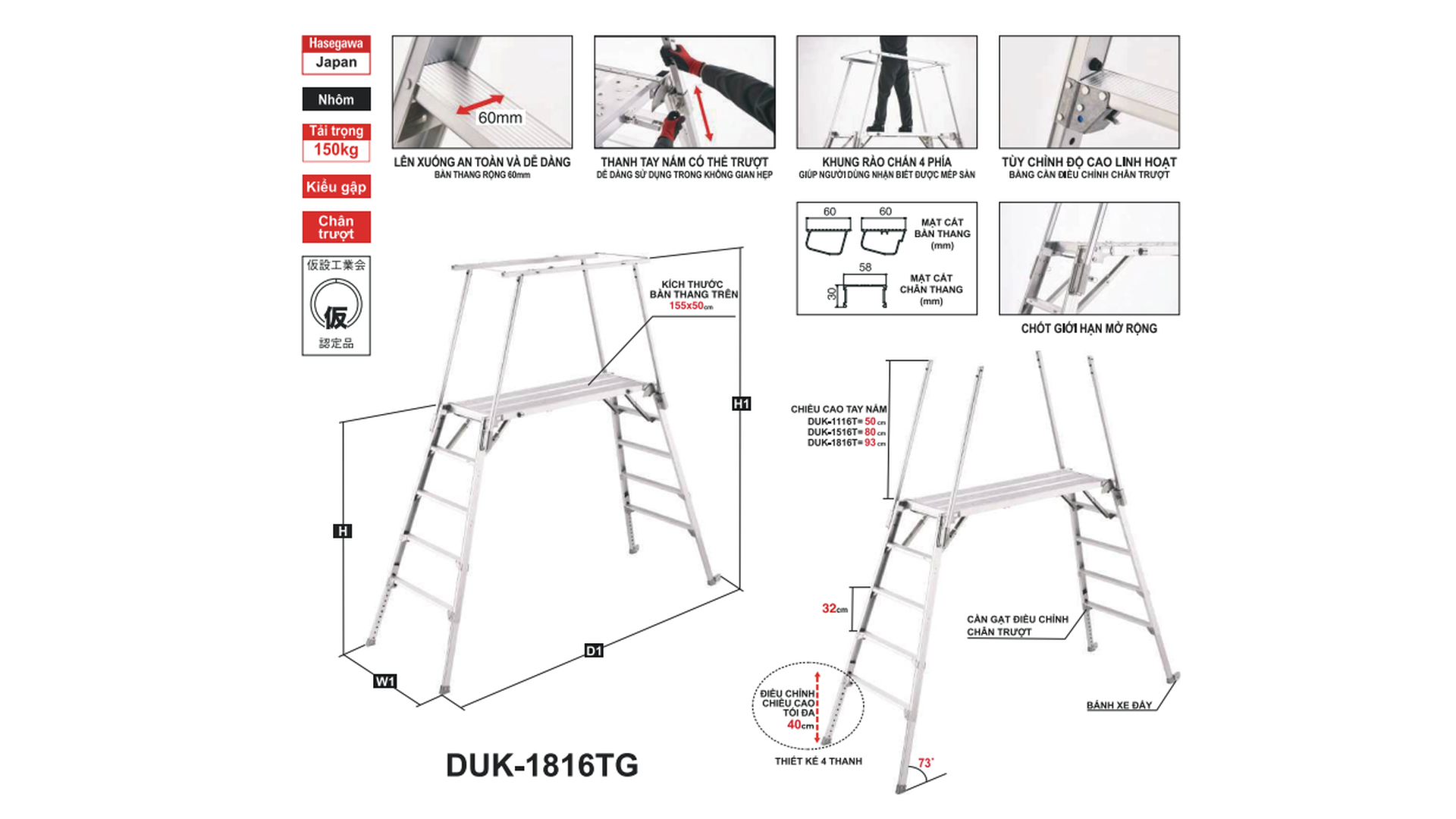
According to the catalogue, DUK is a platform ladder with handrails in the “Hasegawa Japan” group, made of aluminium, with a 150kg load capacity, foldable, with sliding legs. The catalogue also shows a certification mark of the Kasetsu Kogyokai association (Japan).
Features stated in the catalogue:
- 60mm wide steps: for safe and easy climbing up and down.
- Sliding grip bar: easy to use in narrow spaces.
- Four-sided guard frame: helps users recognize the edge of the platform.
- Flexible height adjustment: with a lever for the sliding legs.
- Spread-limiting pin: listed in the catalogue as a component of the ladder.
- 4-rail design, 73° angle: per the catalogue illustration.
- Push wheels: illustrated on the DUK-1816TG model.
The four-sided guard frame: the feature tied to the guardrail requirement
The four-sided guard frame is the main distinguishing feature of the T models in the DUK series. According to the catalogue, it helps users recognize the edge of the platform, that is, how far they are standing from the edge.
The catalogue publishes the grip height of the guard frame for each model:
| Model | Grip height |
|---|---|
| DUK-1116T | 50cm |
| DUK-1516T | 80cm |
| DUK-1816T | 93cm |
These figures should be checked against the guardrail requirement that applies to your job. As noted above, the regulation defines a safety guardrail as at least 1.1m high. The catalogue does not claim that DUK meets QCVN 18:2021/BXD, and neither does this article.
The right way to see it: the four-sided frame of DUK is a protective measure built into the product. Whether it satisfies the legal requirement at a given site must be confirmed by the person in charge of occupational safety.
Six DUK models: catalogue figures
The figures below come from the specification table in the catalogue. Dimensions are in cm, height H in m and weight in kg. All 6 models have a 150kg load capacity.
| Model | H (m) | In use W1×D1 (cm) | H1 (cm) | Folded W2×D2×H2 (cm) | Weight (kg) |
|---|---|---|---|---|---|
| DUK-1116 | 0.73–1.05 | 69–78 × 213–233 | 73–105 | 70×166×15 | 15.2 |
| DUK-1116T | 0.73–1.05 | 69–78 × 213–233 | 123–155 | 79×166×15 | 18.8 |
| DUK-1516 | 1.04–1.44 | 78–88 × 233–257 | 104–144 | 78×167×21 | 17.5 |
| DUK-1516T | 1.04–1.44 | 78–88 × 233–257 | 184–224 | 84×167×21 | 21.9 |
| DUK-1816T | 1.36–1.76 | 86–96 × 252–276 | 229–269 | 90×167×21 | 24.1 |
| DUK-1816TG | 1.36–1.76 | 86–96 × 252–276 | 229–269 | 90×167×21 | 27.1 |
An observation from the table: for models without the letter T (DUK-1116, DUK-1516), the total height H1 equals the platform height H. For models with the letter T, H1 is larger than H, and the difference is the guard frame. This is an inference from the figures, and the catalogue does not explain the letters in the model codes.
The top platform measures 155×50cm per the catalogue illustration.
And what about “above 2m”?
This point needs to be understood correctly. According to the specification table, the maximum standing platform height H of the DUK series is 1.76m (DUK-1816T and DUK-1816TG). The total height including the guard frame, H1, reaches 2.69m.
So “above 2m” in the article title refers to work at heights above 2m in general, where workers need a large standing platform with a protective frame. It does not mean that the DUK standing platform itself is higher than 2m.
How to determine the working height for applying the regulation (from the standing platform or otherwise) must be based on the original documents. Please consult your occupational safety department before deciding.
Sliding legs with up to 40cm adjustment
The sliding legs allow height adjustment with a lever, up to 40cm according to the catalogue illustration. This gives one model a wide height range, for example DUK-1816T from 1.36 to 1.76m, a difference of 0.40m.
The sliding legs also help adapt to uneven floors. See the related articles for more on stable design on uneven and sloped floors.
What to check before ordering
- The guardrail requirement for your job: compare the grip height of the guard frame (50, 80 or 93cm) with the requirement set by your safety department.
- The standing height you need: choose a model with a suitable H range, remembering that the range includes the sliding-leg adjustment.
- Whether the model has a frame: only the models with the letter T have the raised guard frame.
- Floor space: DUK has an in-use length of 213 to 276cm, so enough space is needed.
- Storage when folded: compare with the folded size W2×D2×H2.
- Load capacity: 150kg for all 6 models, so count the tools carried as well.
- Whether it must be moved often: the catalogue shows push wheels on DUK-1816TG.
When to consider DUK
- The job needs a wide standing platform with a protective frame around it, instead of a single ladder.
- The work lasts a while, and the worker must stand in one place using both hands.
- The factory is reviewing its work-at-height equipment against legal requirements.
- The floor is uneven and the height needs adjusting with sliding legs.
If the job only needs a low standing platform, the WD, WDC and WDS series may suit better.
Conclusion
Working at heights above 2m falls into a group of jobs with strict safety requirements according to the catalogue and the circulars it cites. The safety guardrail requirement is one of them.
DUK answers this requirement with the four-sided guard frame on the T models, plus a 150kg load capacity, sliding legs adjustable by up to 40cm and a sliding grip bar.
However, the catalogue does not claim that DUK meets any regulation, and the grip height of the guard frame is only 50 to 93cm. Buying with compliance in mind therefore means checking these figures against the actual requirements of the site before deciding.
Send us your working height, floor plan and safety requirements. The Hasegawa Vietnam team will help you cross-check them against the DUK specification table.
Frequently asked questions
What load can DUK carry?
All 6 DUK models have a 150kg load capacity according to the catalogue.
Which models have the four-sided guard frame?
According to the specification table, the models with the letter T (DUK-1116T, DUK-1516T, DUK-1816T, DUK-1816TG) have a total height H1 larger than the platform height H, meaning they have a raised frame.
Does DUK meet the guardrail requirement of QCVN 18:2021/BXD?
The catalogue makes no such claim. Compare the grip height of the guard frame with the requirement that applies to your job.
How much can the DUK sliding legs adjust?
Up to 40cm according to the catalogue, using a lever for the sliding legs.
How does DUK-1816TG differ from DUK-1816T?
The two models have the same dimensions. DUK-1816TG is 3kg heavier (27.1kg vs 24.1kg) and is illustrated with push wheels. The catalogue does not explain the letter G.
Related articles
- WD, WDC and WDS Platform Ladders: Fixed Legs or Sliding Height-Adjustable Legs?
- Stable design on uneven and sloped floors: optimizing leveler, stabilizer and fixing
- Near-miss case study for work at height: 3 common mistakes on Vietnamese construction sites and how to avoid them
- Analyzing fall accidents through data: priority solutions by industry
——————————————————————————-
This article is based on the official Hasegawa Vietnam catalogue and public documents. Legal content is for general reference only and does not replace the original documents or professional advice. Please check the specifications and legal requirements for each site.
Send us your working height, floor plan and safety requirements. The Hasegawa Vietnam team will cross-check the DUK specification table and suggest a suitable model.