
Summary
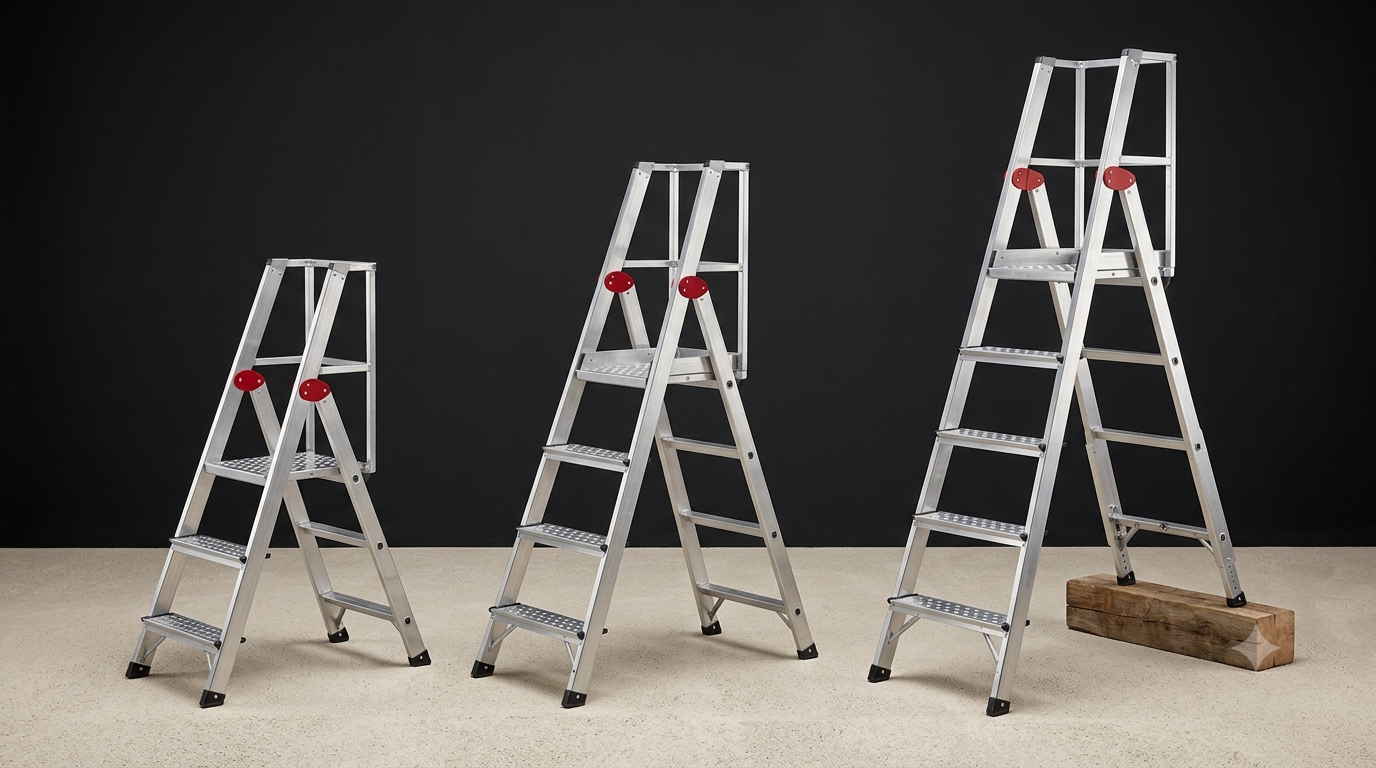
WD, WDC, WDS. Three names that differ by only a few letters, and three products that look almost identical at first glance: all aluminium platform steps, all foldable, all in the same group.
Because they look alike, they are easy to order by mistake. One model carries 100kg and another carries 150kg. One has fixed legs and another has adjustable legs. A single letter in the model code decides which job a product suits.
This article does not stay general. We take the specification tables directly from the Hasegawa Vietnam catalogue, place the 7 models of the three series side by side, and point out the pairs most easily confused.
After reading, you will know when to choose fixed legs, when you need sliding height-adjustable legs, and what information to prepare before ordering.
What do the three series have in common?
According to the catalogue, WD, WDC and WDS are all platform ladders in the “Hasegawa Dongguan” group, made of aluminium and foldable. All three share the following features:
- Opening and closing with a one-touch lever.
- A top platform about 40–47cm wide and about 30cm deep.
- Easy operation close to a wall, with 60° and 84° opening angles shown in the catalogue illustrations.
- Compact folding when not in use, with a folded depth of 15cm (WD, WDC) or 17cm (WDS).
So there is no need to compare how they open and close or their general shape. The differences lie in the specifications below.
Core differences: load capacity, surface and legs
| Criteria | WD | WDC | WDS |
|---|---|---|---|
| Load capacity | 100kg | 150kg | 150kg |
| Legs | Fixed | Fixed | Sliding, up to 24cm adjustment |
| Top platform | 47×30cm | 40×30cm | 40×30.5cm |
| Surface per catalogue | Standing platform fitted with scratch-resistant rubber material | Effectively anti-slip surface | Effectively anti-slip surface |
| Number of models | 2 | 3 | 2 |
| Height H | 0.50–0.75m | 0.50–1.00m | 0.75–1.28m |
For WD and WDC, the catalogue does not list a sliding-leg feature, so this article places these two series in the fixed-leg group.
Full specification table for the 7 models
The figures below come from the specification tables in the Hasegawa Vietnam catalogue. Dimensions are in cm, height H in m and weight in kg.
| Model | Load | H (m) | In use W×D (cm) | Folded H1×W1×D1 (cm) | Weight (kg) |
|---|---|---|---|---|---|
| WD-50b | 100kg | 0.50 | 59×63 | 77×59×15 | 4.2 |
| WD-75b | 100kg | 0.75 | 64×80 | 102×64×15 | 5.2 |
| WDC-50a | 150kg | 0.50 | 55×63 | 77×55×15 | 5.0 |
| WDC-75a | 150kg | 0.75 | 61×80 | 102×61×15 | 6.1 |
| WDC-100a | 150kg | 1.00 | 67×97 | 127×67×15 | 7.6 |
| WDS-75 | 150kg | 0.75–0.99 | 63–67 × 80–96 | 102×63×17.0 | 8.0 |
| WDS-100 | 150kg | 1.04–1.28 | 68–72 × 100–115 | 131×68×17.0 | 10.0 |
For WDS, the in-use dimensions change with the adjusted height, so the catalogue gives them as ranges.
WD: the 100kg series for light work on flat floors
WD has two models: WD-50b (0.50m high) and WD-75b (0.75m high). It has the lowest load capacity of the three series, 100kg, and also the widest top platform, 47×30cm.
The catalogue states that the WD standing platform is fitted with scratch-resistant rubber material. WD is also the lightest of the group: WD-50b weighs 4.2kg and WD-75b weighs 5.2kg.
WD suits light work where the user does not carry many tools and the floor is flat. This is a judgement based on the load capacity in the catalogue, not a recommendation for every case.
WDC: fixed legs, but with 150kg load capacity
WDC has three models: WDC-50a, WDC-75a and WDC-100a, from 0.50m to 1.00m high. All three carry 150kg.
Compared with WD, WDC adds a 1.00m model, and the catalogue describes an effectively anti-slip surface. The top platform is slightly smaller, 40×30cm against 47×30cm for WD.
WDC suits cases where you need more load margin, for example when users carry tools, but the floor is still flat. WDC-100a is the tallest model of the two fixed-leg series.
WDS: sliding legs to adapt to uneven floors
WDS has two models, WDS-75 and WDS-100. The difference is the sliding adjustable legs. According to the catalogue, the sliding legs allow up to 24cm of height adjustment, and the feet adjust to the angle themselves.
The 24cm figure matches the specification table. WDS-75 has an H of 0.75 to 0.99m, a difference of 0.24m. WDS-100 has an H of 1.04 to 1.28m, also a difference of 0.24m.
The catalogue also notes that the foot base grips well, helping stability on many kinds of surface. The illustration shows the feet resting on blocks of different heights.
WDS also has 8.5cm wide steps, 28.6cm between steps, and a 150kg load capacity.
The catalogue gives a maximum working height H2: 2.70–2.94m for WDS-75 and 2.99–3.23m for WDS-100. This is calculated for a person 1.6m tall with a 0.35m arm reach, so it is the reach height, not the height of the standing surface.
In return, WDS is the heaviest of the group: WDS-75 weighs 8.0kg and WDS-100 weighs 10.0kg.
Pairs most easily confused when ordering
Below are the pairs of models with similar specifications that are easy to mix up when looking only at the name or the picture.
| Pair | What they share | What differs |
|---|---|---|
| WD-50b and WDC-50a | Same 0.50m height | 100kg vs 150kg. In-use size 59×63 vs 55×63cm. Weight 4.2 vs 5.0kg |
| WD-75b and WDC-75a | Same 0.75m height, same 80cm depth | 100kg vs 150kg. Top platform 47×30 vs 40×30cm. Weight 5.2 vs 6.1kg |
| WDC-75a and WDS-75 | Same 150kg load | Fixed vs sliding legs. Height 0.75 vs 0.75–0.99m. Weight 6.1 vs 8.0kg |
| WDC-100a and WDS-100 | Same 150kg load | Height 1.00 vs 1.04–1.28m. Weight 7.6 vs 10.0kg |
When ordering, write the full model code, including the final letter, and do not write only “platform ladder 0.75m”. That wording could match WD-75b, WDC-75a and WDS-75 alike.
Choosing by use case
| Situation | Suggestion per catalogue |
|---|---|
| Flat floor, light work, load up to 100kg | WD |
| Flat floor, 150kg load needed | WDC |
| Fixed 1.00m height needed | WDC-100a |
| Uneven floor or height differences | WDS |
| Fine-tuning height within 24cm | WDS |
| As light and compact as possible | WD |
This is a suggestion based on published specifications. Site conditions differ, so an actual assessment is needed before deciding.
Five questions to answer before ordering
- What load is needed? Count the user and the tools carried, then compare with 100kg or 150kg.
- Is the work floor flat? If there are height differences, consider WDS.
- What working height is needed? Choose a model with a suitable H, and remember that WDS has a height range, not a single value.
- Is there enough space for folding and storage? Compare with the folded size H1×W1×D1 in the table.
- Will you work close to a wall? All three series have a design that supports working near a wall.
Conclusion
WD, WDC and WDS belong to the same group of folding aluminium platform ladders, but they cannot replace one another. WD carries 100kg, WDC carries 150kg, and WDS carries 150kg with sliding legs that adjust by up to 24cm.
If the floor is flat and the load is light, WD is the compact, light choice. If you need more load margin, WDC is next. If the floor is uneven or you need to fine-tune the height, WDS is the right series.
The most important thing when ordering is to write the correct and complete model code. When unsure, send us your load, floor condition and required height so we can cross-check.
Frequently asked questions
How does WD differ from WDC?
WD has a 100kg load capacity and a 47×30cm top platform. WDC has a 150kg load capacity, a 40×30cm top platform and an extra 1.00m model. Both have fixed legs.
How does WDC differ from WDS?
Both carry 150kg. WDC has fixed legs, while WDS has sliding legs with up to 24cm of adjustment and is heavier.
How much can the WDS sliding legs adjust?
According to the catalogue, the maximum height adjustment is 24cm. WDS-75 has an H of 0.75 to 0.99m and WDS-100 has an H of 1.04 to 1.28m.
Which series should I choose if I need 150kg?
WDC or WDS. WDC has fixed legs and WDS has sliding adjustable legs.
——————————————————————
This article is based on the specification tables in the official Hasegawa Vietnam catalogue. It is for general reference; please check the specifications when ordering and assess actual conditions of use.
Send us your load, floor condition and required height. The Hasegawa Vietnam team will cross-check the specification tables and suggest a suitable model.