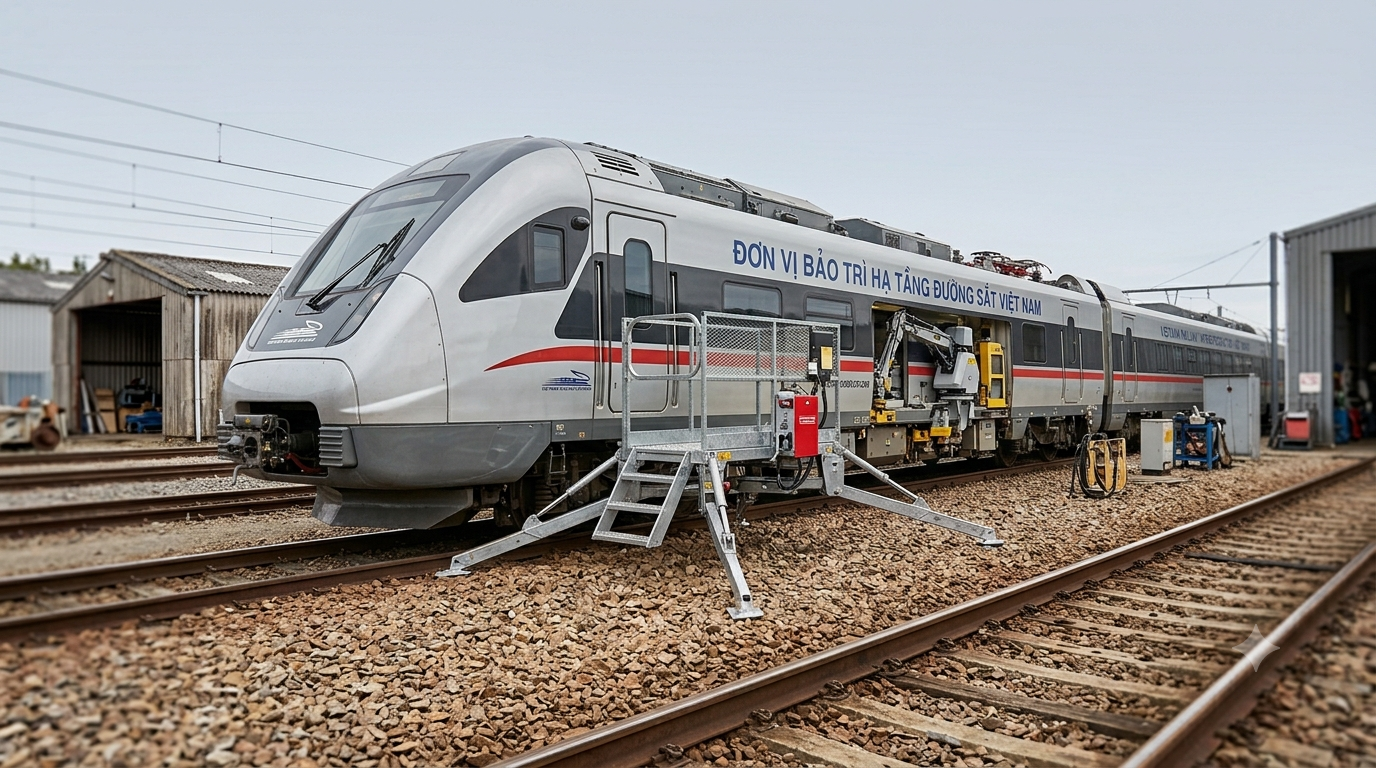
Railway maintenance work comes with constraints that standard ladders and work platforms often can’t meet, most notably, the requirement not to exceed the structure gauge when a vehicle passes through. This article analyzes a real Order Made project Hasegawa delivered for the railway industry: a maintenance work platform with anti-fall outrigger legs and a compact structure that doesn’t protrude beyond the roof of the vehicle, along with lessons other rail operators and maintenance providers can apply.
Maintenance work on the roof of a train car or locomotive is one of the most demanding safety tasks in the railway industry — not just because it’s work at height, but because the working space is constrained by industry-specific technical regulations that an ordinary ladder or work platform isn’t designed to account for. Equipment that’s too bulky can unintentionally breach the permitted clearance around the track, creating a collision risk if another vehicle passes through.
This is exactly the problem Hasegawa Vietnam once solved through an Order Made project built specifically for the railway industry. This article breaks down the industry’s specific technical constraints, how the actual project was designed to meet them, and the lessons that can apply more broadly to other rail maintenance operators.
Why Does Railway Maintenance Need Specialized Equipment?
Unlike maintenance in a factory or warehouse, where the space around work equipment usually isn’t tightly constrained, the rail yard environment is governed by its own technical regulations. The most important of these is the concept of the structure gauge.
Under Vietnam’s National Technical Regulation on Railway Operations (QCVN 08:2018/BGTVT), no part of any structure or equipment — fixed or movable — may encroach on the structure gauge. This is the space surrounding the track defined to ensure rail vehicles can move safely without colliding with anything around them. In addition, Decree 56/2018/NĐ-CP on the management and protection of railway infrastructure also defines a railway safety corridor — the space around railway structures that must be protected to ensure safe operation.
In simple terms: maintenance equipment placed or installed near the track can’t be just any size or shape. It has to be calculated so it doesn’t encroach on the space reserved for vehicle movement, even while the equipment is in use.
This is why standard ladders and work platforms — designed for an ordinary factory or warehouse space — are often unsuitable for direct use in a rail yard without modification.
The Challenge Behind Hasegawa’s Order Made Project for the Railway Industry
According to Hasegawa Vietnam, one of the Order Made products developed for the railway industry is a maintenance work platform, used for maintenance work inside a rail yard. This isn’t a standard product with a light adjustment — it’s a design built from the ground up to suit the specifics of a station and rail-car environment.
The two design requirements Hasegawa highlights in this product are anti-fall outrigger legs and a compact structure that doesn’t protrude beyond the roof of the vehicle. These aren’t arbitrary details — they come directly from two risks specific to this working environment: the risk of slipping while standing on the rail yard’s uneven surface, and the risk of collision if the equipment exceeds the permitted clearance around the vehicle.
Two Key Design Elements
A Structure That Doesn’t Protrude Beyond the Vehicle’s Roof — Complying With the Structure Gauge
When a maintenance platform is placed or extended near a train car, any part of the structure that protrudes beyond the permitted range can create a spatial conflict if another vehicle passes through the same area. The “compact structure, no protrusion beyond the vehicle roof” design addresses this directly — ensuring the equipment always stays within the regulated safety range, whether or not the train car or locomotive is moving during maintenance.
This is fundamentally different from simply “shrinking” a standard product. The challenge isn’t making the equipment smaller, it’s making it fit exactly within a spatial limit defined by railway industry regulations, a constraint that standard products aren’t designed to account for from the outset.
Anti-Fall Outrigger Legs — Responding to an Uneven Rail Yard Surface
Unlike a flat, uniform factory floor, the ground inside a rail yard often includes rails, drainage channels, ballast, and other supporting structures, making the surface far less even than a typical industrial environment. Legs designed for easy anti-fall support in this context play a role similar to the extending outrigger legs on Hasegawa’s other mobile scaffold products: increasing contact area and stability on uneven ground, reducing the risk of the equipment tilting or tipping while someone is working at height on it.
The Lesson Learned: Applying the 6-Step Order Made Process to a Railway Context
This project is a concrete example of how Hasegawa’s Order Made process (Survey, Design, Quotation, Order, Production, Delivery — covered in detail in the previous article) can be applied to an industry with very specific technical constraints. The critical point lies in the initial Survey step: without clearly identifying the structure-gauge constraints and the rail yard’s surface characteristics from the start, the design and production steps that follow will struggle to produce a truly suitable product, no matter how skilled the fabrication.
The lesson here isn’t limited to the railway industry. For any working environment governed by industry-specific technical regulations — aviation, ports, areas with strict fire-safety requirements — the initial survey needs to clarify not just physical dimensions, but the legal and technical constraints unique to that industry.
When Should Rail Operators or Depots Consider a Similar Solution?
Rail operators and maintenance providers might consider a specialized equipment solution if they find themselves in one of these situations:
- Current maintenance equipment needs to be placed near the track or a train car, and hasn’t yet been assessed for the risk of breaching the structure gauge.
- The maintenance area’s surface isn’t level, putting standard equipment at risk of instability during use.
- Maintenance work happens regularly at the same location, making a long-term investment in specialized equipment more valuable than continuing to rely on a makeshift solution.
Frequently Asked Questions
What is the structure gauge?
It’s the space surrounding the track defined to ensure rail vehicles can travel safely without colliding with any surrounding structure or equipment, including movable equipment. This requirement is set out in QCVN 08:2018/BGTVT.
Why can’t standard ladders or work platforms be used for railway maintenance?
Standard products are usually not designed with the railway industry’s specific spatial constraints in mind (the structure gauge, the railway safety corridor), so they may not be suitable for direct use without modification.
Does an Order Made project for the railway industry follow the same 6-step process as other industries?
Yes. The process still follows the same 6 steps: Survey, Design, Quotation, Order, Production, and Delivery. The difference lies in what’s covered during the Survey step, which needs to clarify the railway industry’s specific technical constraints.
Can a small operator that only needs a single unit still order through Order Made?
Yes. As mentioned in the previous article, the minimum order quantity for the Order Made service is one unit.
This article was prepared based on Hasegawa Vietnam’s official introductory materials, combined with information on the structure gauge under QCVN 08:2018/BGTVT and Decree 56/2018/NĐ-CP. The content is general reference material; each project needs to be surveyed and designed individually based on actual on-site conditions.
————————————————————————————————————
Hasegawa Vietnam’s technical team has experience surveying and designing maintenance equipment that complies with structure gauge and railway safety corridor requirements. Get in touch for a free consultation on your specific project.
Email: sales1@hasegawa.com.vn