
Introduction
On electrical work and facility maintenance sites, there are situations where aluminum stepladders and ladders “must not be used.” Because aluminum conducts electricity, using it near power lines or live parts carries a risk of electric shock. This is where FRP (fiber-reinforced plastic) ladders become an option. This article organizes when you should adopt an FRP ladder, and what the “insulation performance” at the core of that decision actually is, from the perspective of electrical work and facility maintenance.
What Is an FRP Ladder: Why Insulation Performance Is Chosen
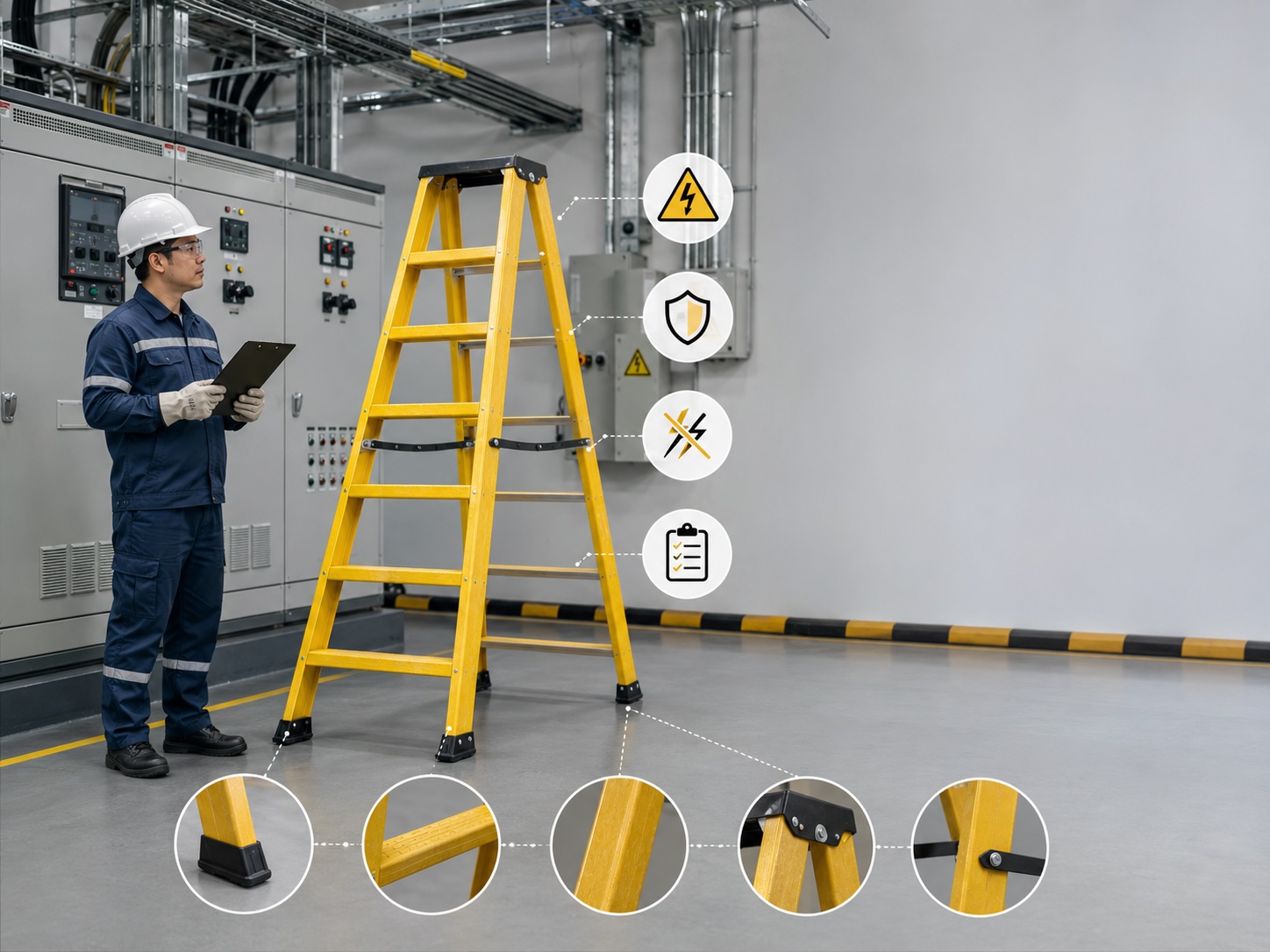
An FRP ladder is made of a material that resists conducting electricity, combining resin with glass fibers and the like. Unlike metal, its rails resist conducting electricity, so even if you happen to approach a live part, the risk of an electric shock through the ladder is reduced. This is “insulation performance,” and it is the biggest reason FRP is chosen on sites that handle electricity.
Situations Where FRP Becomes Necessary in Electrical Work and Facility Maintenance
For work such as the following, consider using an FRP ladder rather than a metal one.
- Work near power lines, distribution boards, or live parts
- Inspection and maintenance around substation equipment and cubicles
- Installing or replacing lighting and electrical wiring
- Maintenance on equipment that cannot be de-energized
In every case, these are situations where a metal ladder risks becoming a current path.
Points for Making the Adoption Decision
Whether to adopt FRP ladders is judged from the following perspectives: whether the work arises near electrical equipment, whether there is close work near live (energized) lines, and whether it is an environment where electric shock would lead to a serious accident. The more these apply, the higher the priority for adopting FRP. On the other hand, for work with no involvement of electricity at all, lightweight and easy-to-handle aluminum is suitable. The realistic approach is to separate uses and deploy FRP to the sites that need it.
| Item to check | Guide for choosing FRP |
|---|---|
| Work location | Near power lines, live parts, or distribution boards |
| Power state | Cannot be de-energized / close to live lines |
| Shock risk | Environment that could lead to a serious accident |
| Non-electrical use only | Aluminum is acceptable |
Cautions for Use and Management to Preserve Insulation Performance
The important point is that FRP’s insulation performance is delivered only in a “clean and dry state.” If the surface is wet, soiled with oil, dust, or metal powder, or has scratches or cracks, the insulating effect drops significantly. Before use, check the surface for dirt, moisture, and damage, and keep it dry and clean—this is essential. Note, too, that an FRP ladder is not an all-purpose safety device and does not replace the principle of de-energizing before work whenever possible.
Conclusion
The decision to adopt FRP ladders becomes clear when you center it on “whether you work near electrical equipment.” On sites with shock risk—near power lines and live parts, or maintaining equipment that cannot be de-energized—an FRP model with insulation performance is the key to safety. That performance, however, presupposes keeping it clean and dry and free of damage. At Hasegawa Vietnam, we propose the selection of FRP and insulated-specification ladders to match your work and electrical environment, along with how to use aluminum models suited to non-electrical applications.