
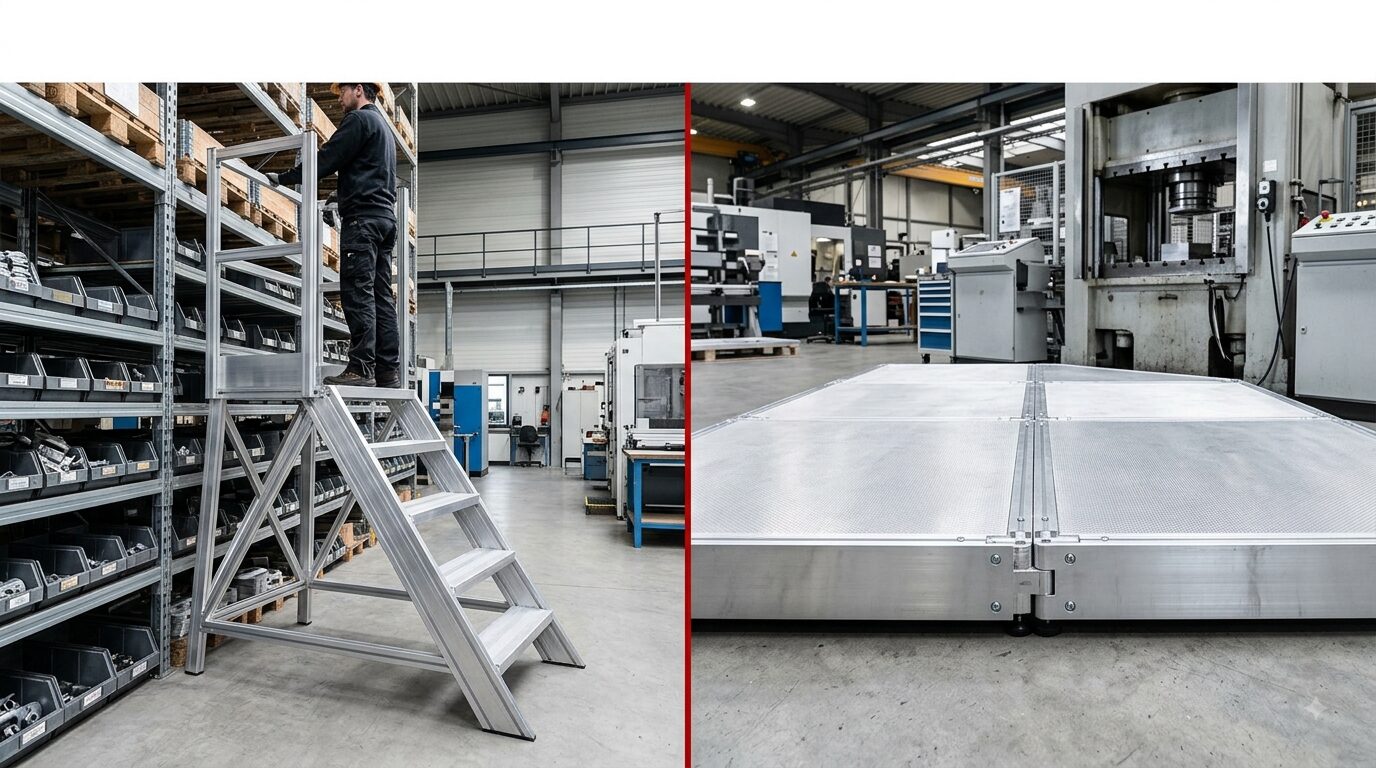
DB and DCS are both aluminum work platforms from Hasegawa, but they serve different purposes. DB is a modular, fully-welded-frame platform with a maximum load capacity of 150kg, available in 1 to 5 steps — suited to a fixed work position above 0.5m. DCS is a connector-style platform with a maximum load capacity of 120kg, only 0.10–0.30m tall, but multiple units can be joined into one continuous work surface.
What DB and DCS Have in Common
Before comparing the differences, it’s worth noting what DB and DCS share:
- Both are made from aluminum, which reduces weight compared with steel or stainless-steel platforms.
- Both use a welded structure for certain load-bearing parts, rather than relying entirely on bolted joints.
- Both belong to Hasegawa Vietnam’s work platform line, and can be ordered together to equip different areas of the same factory.
These similarities lead some buyers to assume the two products are interchangeable. In practice, DB and DCS are designed for two different use cases.
The Core Difference: Modular Assembly (DB) vs. Connector-Style Modules (DCS)
DB — Modular Assembly with a Reinforced Welded Frame
DB is a multi-step stand-type platform, assembled into a single fixed unit for one location. Its side frames are fully welded rather than simply bolted at the joints, which distributes load more evenly and keeps the structure stable over time.
DB is not designed to connect with other DB units to form a continuous surface. It’s meant to be used independently, at one specific work position.
DCS — Connector-Style Modules with a Welded Work Surface
DCS also uses a welded work surface, but unlike DB, it is designed as connectable modules. Each DCS panel has a connection hole and a dedicated connector pin (model DCS-PS, SUS304 material), allowing multiple panels to be joined side by side into a larger, continuous surface.
This makes DCS well suited to areas with an irregular layout, or where the work surface needs to be resized as production needs change.
Load Capacity Compared: 150KG vs. 120KG
This is an important difference to consider when choosing between the two:
- DB: maximum load capacity of 150kg, consistent across all models from 1 to 5 steps.
- DCS: maximum load capacity of 120kg, consistent across all 5 height-based models.
A 30kg gap may not sound large, but it matters in practice when workers carry heavy tools, stand for extended periods, or place additional items on the platform. If your task requires a higher load capacity, DB is the better fit.
Comparing Size and Expandability
DCS Specifications
| Model | Height H (m) | Platform Size (cm) | Usage Dimensions W×D (cm) | Weight (kg) |
|---|---|---|---|---|
| DCS-5310 | 0.10 | 50×35 | 50×35 | 3.0 |
| DCS-5315 | 0.15 | 50×35 | 50×35 | 3.1 |
| DCS-5320 | 0.20 | 50×35 | 50×35 | 3.2 |
| DCS-5325 | 0.25 | 50×35 | 50×35 | 3.3 |
| DCS-5330 | 0.30 | 50×35 | 50×35 | 3.4 |
DCS is available in only 5 height-based models, from 0.10m to 0.30m — much lower than DB’s range (0.25m to 1.5m). DB is designed to lift users up to height. DCS is designed to create a low, floor-level work surface that spans across a work area.
Expandable Coverage Area
DCS panels can be joined side by side using the DCS-PS connector pin, creating a work surface larger than a single unit. DB does not offer this feature — each DB unit is a complete, standalone piece.
Comparing Included Accessories
| Accessory | DB | DCS |
|---|---|---|
| Optional handrail | Yes — mountable at any height | Not applicable |
| Height adjuster (DB-AJ) | – | Yes, 35mm adjustment range, 110g each |
| Connector pin (DCS-PS) | – | Yes, SUS304, 4 pcs per set |
| Removable, replaceable leg base | Yes | Yes |
Quick Comparison: DB vs. DCS
| Criteria | DB (Modular) | DCS (Connector-Style) |
|---|---|---|
| Structure type | Fully welded frame | Welded work surface |
| Max load capacity | 150kg | 120kg |
| Steps | 1–5 steps | No step levels (flat platform) |
| Height | 0.25m – 1.5m | 0.10m – 0.30m |
| Connectable | No | Yes (DCS-PS) |
| Handrail | Optional | Not applicable |
| Best suited for | Fixed position, working at height | Low, expandable work surface |
Which Should You Choose for Your Factory?
If your factory’s layout doesn’t fit either standard product well, Hasegawa Vietnam also offers a made-to-order (Order Made) service for custom work platform designs.
Frequently Asked Questions
1. Can DB and DCS be used together in the same factory?
Yes. Many factories use DB at fixed, elevated work points and DCS to cover a low work surface around machinery.
2. Does DCS support the same load capacity as DB?
No. DCS supports a maximum of 120kg, lower than DB’s 150kg, because DCS is designed to prioritize connectability over concentrated point load.
3. Can multiple DCS panels be joined together?
Yes. DCS panels include a connection hole and connector pin (DCS-PS) that allow multiple panels to be joined into one larger, seamless surface.
4. What accessories are available for DB?
An optional handrail, which can be mounted at any height on the frame.
This article was prepared based on Hasegawa Vietnam’s official technical documentation. Specifications may be updated in newer catalogue versions; please confirm with the sales team before placing an order.