
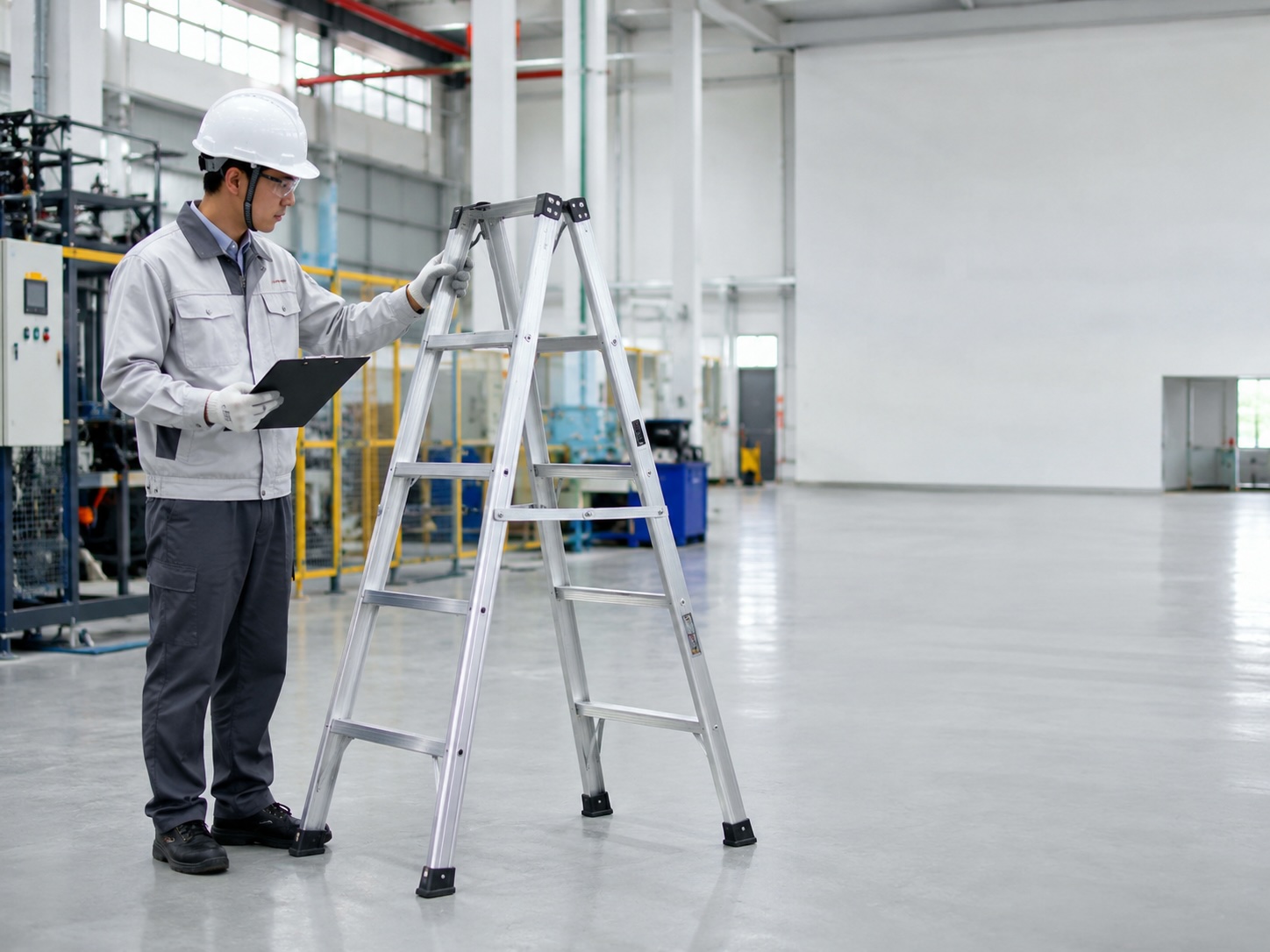
Introduction
A ladder is a convenient tool for reaching heights quickly, yet falls from height still account for a serious share of workplace accidents. With ladder work, the assumption that “it’s fine because I always use it” is exactly what tends to lead to accidents. Risk assessment means a procedure of identifying where hazards lie before starting work, estimating how large they are, and deciding on countermeasures. This article organizes the hazards to confirm before use and their countermeasures for ladder work—in a form anyone can put into practice, even for the first time.
The Basic Steps of Risk Assessment
There’s no need to overthink it. For ladder work, proceed in the following flow.
- Identify the hazards: List what could happen—falls, missteps, electric shock, dropped tools, and so on.
- Estimate the risk: Roughly evaluate how likely each is and how severe the injury would be if it occurred.
- Decide countermeasures: Choose ways to reduce the danger, including the option of not using a ladder at all.
- Carry out and record: Implement the measures and keep a record of inspection results and observations.
Main Hazards to Check Before Use
The hazards most often overlooked in ladder work are as follows.
- Poor setup surface: mud, slope, steps, or a floor made slippery by oil or water
- Wrong leaning angle: too steep risks tipping backward, too shallow lets the feet slide out
- Insufficient securing at the top: the ladder’s upper end shifts, or the support is unstable
- Awkward posture: reaching too far to the side and losing balance
- Electric shock: a metal ladder contacting power lines or live parts
- Defects in the ladder itself: deformed steps, loose hinges, a broken spreader
- Falling tools or materials: climbing while holding items, leaving both hands occupied
Countermeasure List by Hazard
For the hazards you have identified, combine countermeasures such as the following.
| Hazard | Main countermeasure |
|---|---|
| Slippery or unstable surface | Set up on a level, dry surface and use leg-end caps or anti-slip devices |
| Leaning angle | When used leaning, aim for roughly 75 degrees (1 out, 4 up) |
| Shifting at the top | Secure the upper end with rope or fittings and check the strength of the support |
| Awkward posture | Work in front of your body; if you can’t reach, reposition the ladder |
| Risk of electric shock | Use an FRP (insulated) ladder for electrical work |
| Defective ladder | If a pre-use inspection finds any fault, do not use it |
| Falling tools | Carry tools in a bag or by rope, keeping both hands free for climbing |
Pre-Use Inspection and Basics During Work
There are three key points for putting these countermeasures into actual work. When climbing, maintain “three-point contact”—supporting your body with three of your hands and feet—so both hands are never occupied. Do not stand on the top plate or the very top of the ladder; work only within a height where you can stand stably. And if you feel even the slightest deformation, looseness, or wobble, do not use that ladder. These are prerequisites to observe regardless of product performance.
Conclusion
Risk assessment for ladder work can be started without any special knowledge, following the procedure of “identify the hazards → estimate the risk → decide countermeasures → record.” Setup surface, angle, securing the top, posture, electric shock, the condition of the ladder, falling tools—the habit of checking these hazards one by one before use and matching them against a countermeasure list is the surest first step to preventing falls. At Hasegawa Vietnam, we can also advise on product choices that reduce risk, such as insulated ladders and wide-step models, to suit your work and site conditions.