
Summary
When choosing a household ladder, most of us look at two things: height and price. Few people ask: when I am standing on the highest step, where will my hands hold on?
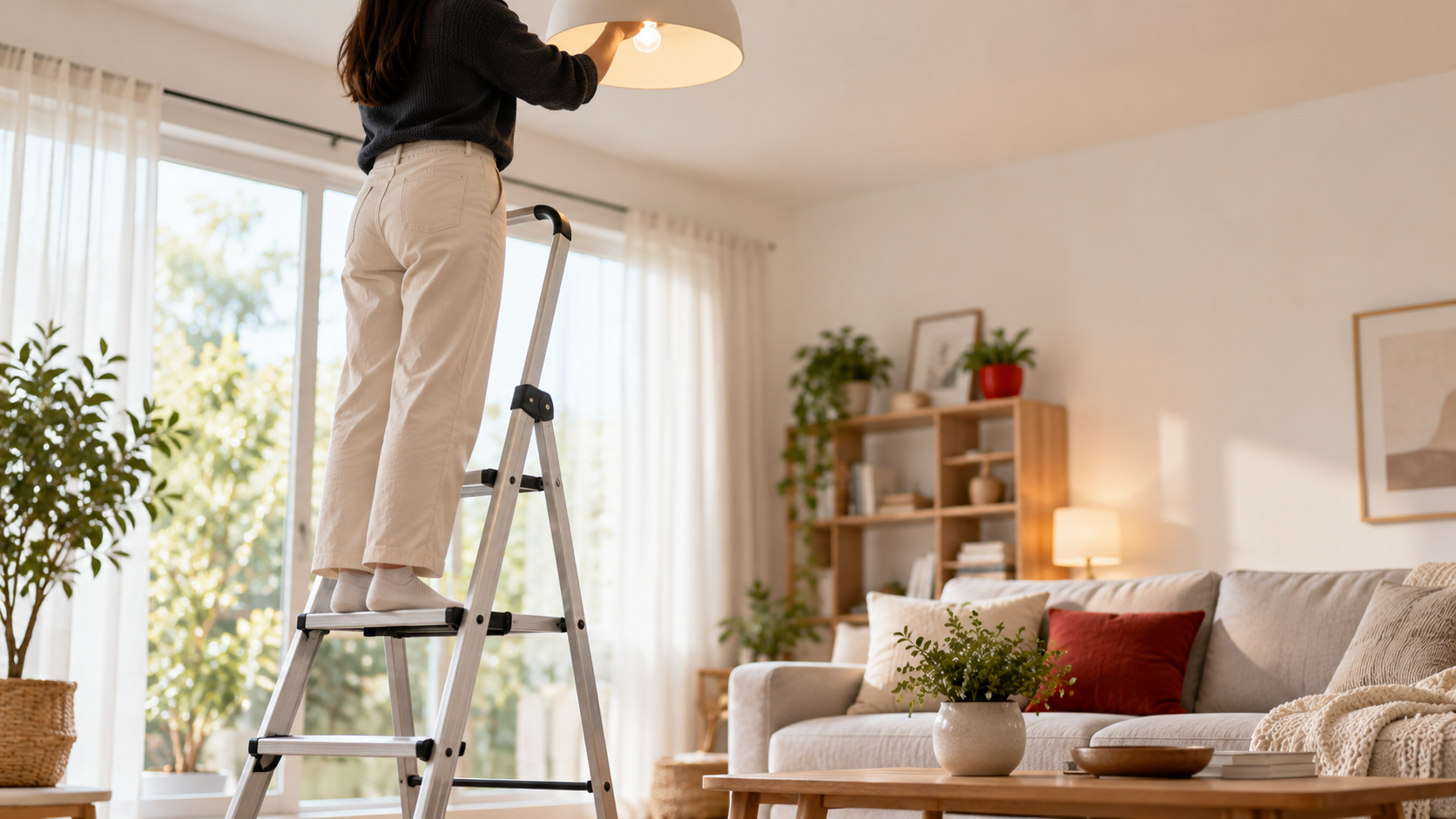
That is exactly where a handrail matters. Changing a light bulb, wiping a ceiling or fetching something from a high cupboard all put you high up, arms raised and leaning. In that posture, a hold at lower-body level makes a big difference.
The Hasegawa VSS series is a step ladder with a handrail, and the catalogue shows the European standard EN 131 mark on it. Each model also has a specific maximum working height: 3.20m, 3.45m and 3.70m.
This article does not compare step ladders in general. We use the exact figures of the three VSS models to show where the handrail sits, how high it is, and in which situations it supports you.
What is VSS?
According to the Hasegawa Vietnam catalogue, VSS is a step ladder with a handrail in the “Hasegawa Vietnam” group, made of aluminium, with a 150kg load capacity. The catalogue shows a “European Standard EN 131” mark on the product.
Features stated in the catalogue:
- Handrail: a frame extended above the top platform, giving the user something to hold.
- Top platform: 28.6×25.5cm.
- 82mm wide steps: with 26cm between steps.
- Opens and closes in a single action.
- Wide rivets through the legs: the catalogue says this makes the ladder sturdier.
- 68° and 74° angles: per the catalogue illustration.
What is EN 131?
EN 131 is a series of European standards for portable ladders. According to the standards body’s description, Part 1 defines terms and general design characteristics of ladders for professional and non-professional use. Other parts cover requirements, testing, marking and user instructions.
This article relies only on the fact that the catalogue shows the EN 131 mark on VSS. We have no documents on a specific certificate or test report, so we give no further detail on test results.
Three VSS models: catalogue figures
The figures below come from the specification table in the catalogue. Dimensions are in cm, height H in m and weight in kg. All three models have a 150kg load capacity.
| Model | H (m) | In use W×D1×H1 (cm) | Folded W×D2×H2 (cm) | Weight (kg) | Maximum working height |
|---|---|---|---|---|---|
| VSS-5ENa | 1.28 | 59×114×191 | 59×10×206 | 8.4 | 3.20m |
| VSS-6ENa | 1.54 | 63×132×217 | 63×10×234 | 9.6 | 3.45m |
| VSS-7ENa | 1.80 | 67×150×243 | 67×10×262 | 11.0 | 3.70m |
The catalogue gives the maximum working height for a user who is 1.6m tall. The folded thickness is only 10cm on all three models.
What do the 3.20–3.70m figures tell us?
If we subtract the top platform height H from the maximum working height, we get:
| Model | Maximum working height | H | Difference |
|---|---|---|---|
| VSS-5ENa | 3.20m | 1.28m | 1.92m |
| VSS-6ENa | 3.45m | 1.54m | 1.91m |
| VSS-7ENa | 3.70m | 1.80m | 1.90m |
We calculated this from the catalogue figures. The difference is almost constant, about 1.9m, which is the user’s 1.6m height plus the reach of the arms. This suggests the 3.20–3.70m figures are calculated for a person standing on the top platform with arms raised. The catalogue illustration also shows the user standing on the top platform with arms up.
In other words, at maximum height you are standing on the top platform, body upright, both arms raised. This posture makes it easy to lose balance, and it is also when a hold matters most.
Where is the handrail, and how high is it?
According to the specification table, the total in-use height H1 is larger than the top platform height H:
| Model | H1 | H | Rise above platform (H1 − H) |
|---|---|---|---|
| VSS-5ENa | 191cm | 128cm | 63cm |
| VSS-6ENa | 217cm | 154cm | 63cm |
| VSS-7ENa | 243cm | 180cm | 63cm |
This 63cm difference is the handrail frame rising above the top platform. It is a calculation from the table, assuming H1 is measured to the top of the handrail as in the illustration. The catalogue does not list the handrail height separately.
All three models have the same 63cm rise. When you stand on the top platform, the handrail sits around your lower body. The exact position depends on the person’s build.
In which situations does a handrail help?
Below is an analysis by situation, not a test result.
- Working with raised arms. Changing a bulb or wiping a ceiling points both hands upward. A handrail at lower-body level gives you a support to keep your balance when your body tilts to one side.
- Stepping onto and off the top platform. This is when you shift your weight. Having a handrail to hold helps you step more firmly, especially with something in your hand.
- Working while carrying tools. When one hand holds something, the other needs a place to grip. The handrail gives you a hold right in front of you.
- First-time users or older users. A hold that is easy to see and grasp can help them feel more confident when standing high.
A handrail does not replace correct ladder use. You still need to place the ladder on flat ground, open it fully, stay within the 150kg load and avoid overreaching.
Which to choose: VSS-5ENa, 6ENa or 7ENa?
The simplest way is to choose by the height you need to reach.
| Need | Suggestion |
|---|---|
| Work at heights up to about 3.20m | VSS-5ENa, the most compact and lightest (8.4kg) |
| Work at heights up to about 3.45m | VSS-6ENa |
| Work at heights up to about 3.70m | VSS-7ENa, the tallest but heaviest (11.0kg) |
The maximum working height is calculated for a person 1.6m tall. If you are taller or shorter, your actual reach will differ. Check the space needed to open the ladder: VSS-7ENa has an in-use depth D1 of 150cm.
When stored, all three models are only 10cm thick, but the folded length of 206 to 262cm means you need to choose a suitable storage spot.
Five things to check before buying a ladder with a handrail
- The height you need to reach: compare with 3.20m, 3.45m or 3.70m (for a person 1.6m tall).
- Space to open the ladder: in-use depth D1 from 114 to 150cm.
- Storage space when folded: folded length from 206 to 262cm.
- Standard mark: check the EN 131 mark on the product and the usage labels that come with it.
- Weight you can carry: from 8.4 to 11.0kg depending on the model.
Conclusion
The handrail is an easily overlooked detail when choosing a ladder, because it makes the ladder neither taller nor cheaper. But with the VSS series, the figures show clearly why this detail deserves attention.
On all three models, a user 1.6m tall can work at a maximum height of 3.20 to 3.70m, standing on the top platform with arms raised. The handrail rises 63cm on all three models, giving you a hold within reach in that posture.
The VSS series also carries the EN 131 mark, a 150kg load capacity and single-action opening and closing. Still, ladder safety depends on how it is used. Place the ladder on flat ground, open it fully and do not overreach.
If you are weighing the VSS models, send us the height you need to reach and the space where you will store the ladder. The Hasegawa Vietnam team will help you choose a suitable model.
Frequently asked questions
How do VSS-5ENa, 6ENa and 7ENa differ?
Mainly in height. The top platform heights are 1.28m, 1.54m and 1.80m, and the maximum working heights are 3.20m, 3.45m and 3.70m. All three carry 150kg.
How is the maximum working height calculated?
According to the catalogue, it is for a user who is 1.6m tall. The difference between the maximum working height and the top platform height is about 1.9m on all three models.
How high is the handrail?
The catalogue does not list it separately. Calculating H1 minus H from the specification table, the frame rises about 63cm on all three models.
Does VSS meet EN 131?
The catalogue shows the European standard EN 131 mark on the product. We have no further documents on a specific certificate or test report.
Does the handrail replace safe ladder practices?
No. You still need to place the ladder on flat ground, open it fully, stay within 150kg and avoid overreaching.
ーーーーーーーーーーーーーーーーーーーーー
This article is based on the official Hasegawa Vietnam catalogue. It is for general reference; please read the instructions supplied with the product and follow ladder safety principles.
Send us the height you need to reach and where you plan to store the ladder. The Hasegawa Vietnam team will help you choose a suitable model.