
What Is Scaffolding? A Beginner’s Explanation
If this term is new to you: scaffolding is a temporary support structure. It helps workers stand and work safely at height, instead of climbing onto a chair, shelving, or other equipment not designed for the purpose.
Scaffolding generally has three main parts:
- Support frame: the main load-bearing part that keeps the whole structure standing.
- Work platform: the flat surface at the top, where the worker actually stands to do the job.
- A moving or fixed base: either wheels (for mobile scaffolding) or a fixed foot (for stationary scaffolding).
Scaffolding replaces climbing directly onto unsafe surfaces, for a simple reason: it creates a stable, purpose-built surface designed to bear load and reduce the risk of slipping or falling.
Fixed vs. Mobile Scaffolding: What’s the Difference?
- Fixed scaffolding: once assembled, it stays in one place. To use it somewhere else, it has to be disassembled and rebuilt from scratch.
- Mobile scaffolding: has wheels on its base, so it can be pushed to a new location without being fully disassembled — also known as a “mobile scaffold tower.”
Mobile scaffolding suits work that moves between several positions within the same area. For example, painting along a long factory wall, or inspecting lighting and ducting that runs across a ceiling.
What Is a Telescopic Scaffold? How TSE Differs from a Standard Mobile Scaffold
Most mobile scaffolds on the market are frame scaffolds: several separate steel tube sections that the user stacks and assembles by hand, secured with diagonal braces. This type offers flexible height (add more frames to go higher), but assembling and disassembling it each time takes time and requires the right technique to stay safe.
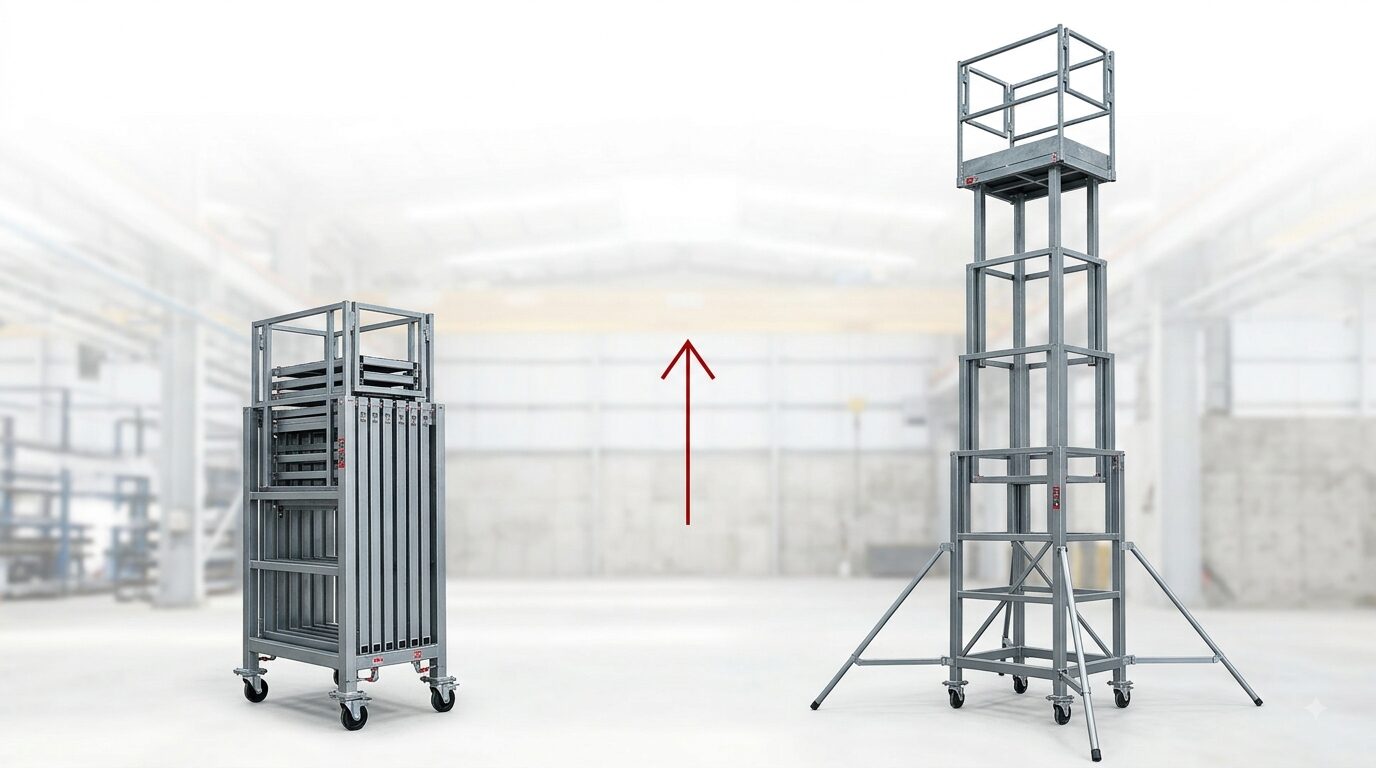
TSE belongs to a different category: a telescopic scaffold (a nested tower design). Instead of assembling individual frame sections, TSE already has several levels of frame nested inside each other, like a camera lens. The user simply pulls the levels up to increase height, or pushes them down to collapse it — no separate parts to remove, and no loose braces to fit by hand.
In other words: a frame scaffold has to be manually “stacked” level by level, while a telescopic scaffold like TSE has those levels already built into a single unit — you just pull it up or push it down.
The Basic Parts of TSE
Multi-Level Telescopic Frame
This is TSE’s main body, made of several steel frame sections nested inside one another. To work at a greater height, the user pulls the levels up; to store or transport it, they push the levels back down to collapse it.
Extending Outrigger Legs
These are supplementary support legs that extend out from the base once the tower is raised. Their function is to increase the footprint on the ground, making the tower harder to tip over. This is especially important since a taller tower is more prone to losing balance if its base is too narrow.
Sliding Joints with Built-In Plastic Bushings
The sliding joint is the part where each frame level slides against the next as it extends or retracts. TSE fits these joints with plastic bushings to reduce metal-on-metal friction. In simple terms: the plastic bushings make raising and lowering the frame smoother, less prone to sticking or loud noise, and reduce wear over time.
Anti-Pinch Protection
When raising or lowering the frame levels, a poorly designed joint can pinch a user’s fingers in the gap between two moving sections. TSE includes anti-pinch protection to reduce this risk — a small detail, but one with real, everyday safety value.
Slip-Resistant Steps
The steps leading up to the work platform have a slip-resistant surface, giving users better footing — especially useful when carrying tools, or working in dusty or damp conditions.
A 150×59cm Work Platform
This is the flat surface at the top, where the worker actually stands to do the job. At 150×59cm, it’s spacious enough for one person to move around or set down a few small tools while working.
Full Specifications for All 3 TSE Models
| Model | Usage Height H (m) | Base Size W1×D1 (cm) | Overall Height H1 (cm) | Collapsed Size W2×D2×H2 (cm) | Weight (kg) |
|---|---|---|---|---|---|
| TSE-2900S | 1.19 ~ 2.90 | 160×170 | 213 ~ 380 | 99×196×119 | 212.0 |
| TSE-3600S | 1.34 ~ 3.60 | 160×170 | 225 ~ 452 | 89×199×134 | 240.0 |
| TSE-4300S | 1.50 ~ 4.30 | 160×170 | 241 ~ 526 | 89×199×150 | 260.0 |
Note: “Usage Height” is the adjustable range of the work platform’s height. “Collapsed Size” is the footprint once the tower is folded down for storage or transport.
All three models share the same maximum load capacity of 135kg and the same 150×59cm platform size; the main difference between them is the adjustable height range.
Why the Collapsed Size Matters
With a traditional frame scaffold, once disassembled, the loose frame sections need to be stored separately — often taking up considerable warehouse space, or requiring careful packing to avoid losing small parts like braces, locking pins, or wheels.
With TSE, the entire telescopic frame collapses into a single unit (for example, the TSE-2900S collapses down to 99×196×119cm). This has two practical benefits:
- No disassembly required, so there’s no risk of losing individual small parts.
- Easier storage and transport, since the whole tower moves as one wheeled unit.
What Does Kasetsu Kogyokai Certification Mean?
This is the name of an organization in Japan, roughly translated as the “Temporary Equipment Industry Association.” It sets technical standards and issues certifications for temporary equipment used in construction and industry — including scaffolding, work platforms, and temporary stairs.
For readers unfamiliar with Japan’s certification system, think of it simply as an industry technical-standard certificate — comparable to standards bodies elsewhere in the world (such as ANSI in the US or EN in Europe), but specific to temporary equipment within Japan. TSE holding this certification means the product has been evaluated against specific industry technical criteria, not just assessed based on the manufacturer’s own claims.
Why TSE Can Be Safer in Certain Situations
According to Notice No. 1136/TB-BLĐTBXH issued by Vietnam’s Ministry of Labour, Invalids and Social Affairs, falls from height account for a high share of total workplace accidents (information current as of 2023–2024). Many employer-side causes noted relate to equipment for working at height that doesn’t meet safety requirements, or that has been assembled incorrectly.
With a manually assembled frame scaffold, part of the risk comes from assembly errors — for example, missing diagonal braces, an unlevel base, or a locking pin that wasn’t fully tightened. With an integrated telescopic design like TSE, the main load-bearing parts (frame, sliding joints, outrigger legs) are assembled and inspected by the manufacturer as one unit, reducing the risk that comes from manual on-site assembly.
Note: The information above is general reference material and does not replace an actual safety assessment for a specific worksite or advice from a qualified safety professional.
What Kind of Work Is TSE Suited For?
- Painting walls or ceilings in a tall factory building, where you need to move between several positions in the same area.
- Maintaining lighting, ducting, or electrical systems near the ceiling, especially where the ceiling is above 2m.
- Installing or maintaining signage or ventilation equipment at medium to high elevations (up to 4.3m with the TSE-4300S).
- Work that requires changing height frequently within the same shift, where reassembling a traditional frame scaffold each time would take significantly longer.
Frequently Asked Questions
1. How is a telescopic scaffold different from a frame scaffold?
A frame scaffold requires manually assembling separate frame sections. A telescopic scaffold like TSE already has nested frame levels — you just pull them up or push them down to change height.
2. What load capacity does TSE support?
A maximum of 135kg, consistent across all three models: TSE-2900S, TSE-3600S, and TSE-4300S.
3. What material is TSE made from?
Steel — unlike some of Hasegawa’s other work platforms, which are made from aluminum.
4. Is Kasetsu Kogyokai certification required to sell TSE in Vietnam?
No. It’s a certification from a Japanese industry association, not a legal requirement under Vietnamese law. It’s additional information showing the product has been evaluated against industry standards in its home market (Japan).
This article was prepared based on Hasegawa Vietnam’s official technical documentation. Legal content references publicly available documents from government authorities. Please check the original legal text or consult a qualified professional before applying this information to a specific case.