
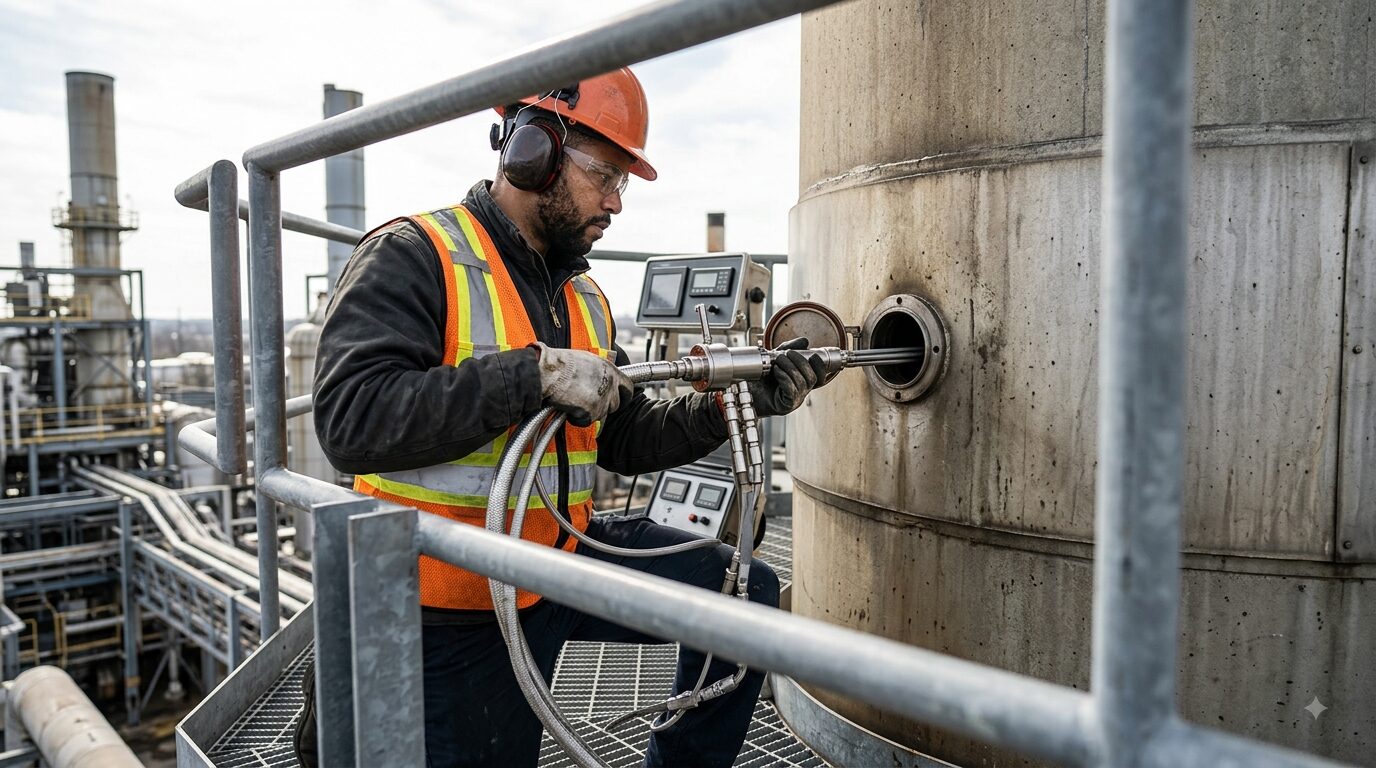
A stack emission-sampling platform is a required structure at every emission-sampling point under Clause 6, Article 17 of Circular No. 10/2021/TT-BTNMT. Failing to install a safe sampling platform can result in a fine of VND 60,000,000–80,000,000 for individuals, and VND 120,000,000–160,000,000 for organizations, under Clause 6, Article 16 of Decree No. 45/2022/ND-CP. The sections below cover the regulation in detail, sizing criteria, and a self-check list before sampling.
What is a stack emission-sampling platform?
A stack emission-sampling platform is a fixed working surface installed at the sampling port on a factory chimney (stack). Environmental monitoring technicians stand on this platform to safely insert sampling equipment into the port.
A sampling platform differs from an ordinary work platform in three ways:
- It is permanently mounted to the stack or building structure, not portable.
- It must withstand high temperature, corrosive vapor, and humidity from the emissions themselves.
- It is a permanent installation the factory must maintain long-term, not a one-time-use setup for a single sampling event.
Any factory with an industrial emission stack, regardless of sector, needs a sampling platform if it is subject to periodic emissions monitoring under its environmental permit.
Legal requirements for emission-sampling platforms
What does Circular 10/2021/TT-BTNMT require?
The requirement for a sampling platform is set out in Clause 6, Article 17 of Circular No. 10/2021/TT-BTNMT issued by Vietnam’s Ministry of Natural Resources and Environment (now the Ministry of Agriculture and Environment) on environmental monitoring techniques. Under this provision, a stack must have a sampling port of the prescribed diameter or width, fitted with a cover to adjust the opening, and a safe, convenient sampling platform must be provided. The specific sampling point location, diameter, or width is set out in Appendix 5 of the Circular.
This is the current regulation superseding earlier environmental monitoring technical rules. Factories should refer directly to Appendix 5 when designing a sampling platform for each specific stack, since the technical parameters can vary by stack diameter and emission type.
Fines for failing to install a compliant sampling platform
Decree No. 45/2022/ND-CP, on administrative penalties in the field of environmental protection, states at Clause 6, Article 16:
A fine of VND 60,000,000 to VND 80,000,000 shall be imposed for failing to provide a safe sampling platform at wastewater, dust, or emission sampling points, or emission sampling ports, as required.
This amount applies to individuals. Under Clause 2, Article 6 of the same Decree, an organization committing the same violation is fined twice the individual rate — i.e., VND 120,000,000 to VND 160,000,000. Since most production facilities operate as organizations (enterprises), this is the practical figure factories should keep in mind.
Beyond the monetary fine, the environmental authority may also require immediate remediation during a scheduled or unannounced environmental inspection.
Sizing and installation-location criteria
Platform area and width
Circular 10/2021/TT-BTNMT does not set a single fixed area figure applicable to every stack; the specific parameters are set out in Appendix 5 and can vary by stack diameter. In practice, many environmental consultants and mechanical contractors apply the following commonly-used reference figures:
| Item | Common reference range |
|---|---|
| Minimum platform area | Approximately 1.5 m² |
| Platform width (measured outward from the sampling point) | Approximately 0.8 m to 1.5 m, depending on stack diameter |
| Number of people the platform should accommodate | At least 4 people |
| Distance from platform to sampling port | Approximately 0.6 m |
The figures above are practical reference values commonly applied by emission-treatment-system contractors; they are not a verbatim quotation of the law. Factories should verify the exact figures against Appendix 5 of Circular 10/2021/TT-BTNMT, or with a licensed environmental monitoring provider, before construction.
Installation location relative to the sampling port
A sampling platform should be positioned so that it:
- Provides convenient access to the sampling port on the stack.
- Maintains a safe distance from areas with a risk of incidents, such as discharge valves or chemical storage tanks.
- Does not obstruct the airflow exiting the stack, which would affect the accuracy of sampling results.
For factories with multiple stacks, each stack should be assessed individually, since differing diameters, heights, and locations lead to different platform design requirements.
Material and structural safety requirements
An emission-sampling platform operates in a harsher environment than an ordinary work platform. Materials and structure should meet the following requirements:
- Heat- and chemical-resistant: emissions from some industries are high-temperature or carry corrosive vapor; metal components should be treated appropriately against corrosion.
- Non-slip surface: reduces the risk of slips while a technician moves with measuring equipment in hand.
- Guardrails around open edges: especially at locations with significant height.
- Safe access stairs or ladder: with a sturdy, non-slip handrail.
- Adequate load capacity: sufficient for the technician’s weight plus sampling equipment and accessories for the full duration of monitoring.
These are the same criteria Hasegawa Vietnam’s engineering team applies when advising on custom sampling platforms for individual stacks — designed to meet legal requirements while withstanding Vietnam’s humid tropical climate.
Pre-sampling self-check list
Before each periodic emissions monitoring event, a factory’s safety or environmental team can run through this quick checklist:
- Has a sampling platform been installed at every emission-sampling point in the facility?
- Is the platform’s area and width sufficient for at least 4 people to work at the same time?
- Is the platform surface slippery, or has water or grease accumulated on it?
- Are the guardrails around the platform still sturdy and not loose?
- Does the stairway or access route to the platform have a safe handrail?
- Does the platform material show signs of corrosion or rust from prolonged emission exposure?
- Is the platform located a safe distance from areas with incident risk?
- Have inspection records for the sampling platform been kept up to date?
If any item is not satisfied, the factory should remedy it before the sampling team arrives, to avoid disruption or a violation being recorded during an inspection.
Frequently Asked Questions
Is a sampling platform mandatory for every factory?
The requirement applies to facilities with an industrial emission stack that are subject to periodic emissions monitoring under current law. Factories should check the scope and frequency of monitoring specified in their environmental permit or environmental registration.
Can operations be suspended for not having a sampling platform?
Decree No. 45/2022/ND-CP specifies a monetary fine as the primary penalty for this violation, without a mandatory operational suspension. However, the competent authority may still require remediation within a set timeframe.
Are sampling platforms for emissions and for wastewater the same?
Both are covered under the same clauses of Circular 10/2021/TT-BTNMT and Decree 45/2022/ND-CP, but the installation location and technical requirements differ due to different working environments (emission platforms are typically elevated and exposed to heat and vapor; wastewater platforms are usually at ground level, exposed to liquid contact).
Conclusion
An emission-sampling platform is not only a legal requirement under Circular 10/2021/TT-BTNMT — it directly affects the safety of the technicians who perform the monitoring. Factories should review every emission-sampling point, verify against Appendix 5 of the Circular, and run through the checklist above before each monitoring cycle to avoid a fine of VND 60–160 million under Decree 45/2022/ND-CP.
If your facility needs a sampling platform designed specifically for a given stack diameter and site layout, Hasegawa Vietnam’s Workplace Safety Solutions can support the site survey and structural consultation.
Related reading: Legal Requirements and Safety Standards for Guardrails and Toe Boards on Mobile Work Platforms (article currently in Vietnamese) for more on guardrail standards across different platform types.
(This article is for reference purposes and reflects current Vietnamese law as of August 2026. The specific dimensional figures in Appendix 5 of Circular 10/2021/TT-BTNMT may vary by stack type; factories should confirm with a licensed environmental monitoring provider or the local environmental authority before construction.)