
Introduction
In Vietnam’s manufacturing, construction, and logistics sectors, falls from heights remain the leading cause of occupational accidents. While “hard” safety measures—such as wearing safety harnesses (Fall Arrest Systems) and installing handrails—are advancing, the “soft” risk of worker “Fatigue” is often overlooked. In Vietnam’s hot and humid working environment, concentration levels drop significantly just a few hours after starting work, and even veteran workers can experience a momentary lapse in judgment. In this article, we will use data to uncover the effects of fatigue on the body, explain scientific break-taking methods to prevent accidents, and detail Hasegawa’s product philosophy, which is directly linked to fatigue reduction.
The Correlation Between Fatigue and Accidents: The Truth Shown by Data
Market Data and the Reality of the Working Environment
According to reports from the Vietnam Ministry of Labour, Invalids and Social Affairs (MOLISA), the construction industry accounts for approximately 35% to 40% of recent occupational accidents, with “falls from heights” making up about 60% of the causes of death. Of particular note is the incidence rate by time of day. Accidents are concentrated between 10:00 AM and 11:00 AM, and between 3:00 PM and 4:00 PM—times when several hours have passed since the start of work and fatigue begins to accumulate.
A survey by the Ministry of Health, Labour and Welfare in Japan (2018) also indicates that when continuous working time exceeds 4 hours, the accident rate jumps to approximately 2.3 times higher compared to working for less than an hour. When the environmental load unique to Vietnam—temperatures exceeding 35°C and humidity over 80%—is added to this, the core body temperature rises, causing the heart rate to increase by 10 to 15 beats per minute, making the oxygen supply to the brain unstable. As a result, cognitive function declines, leading to “unsafe behaviors” such as overlooking a step or dropping a tool.
Risk Presentation: The “Lag” Between Brain and Body
As fatigue accumulates, the brain’s “reaction time” is delayed. Typically, a healthy worker’s reaction speed is about 0.2 to 0.3 seconds, but research shows that in a state of moderate fatigue, this extends to 0.5 seconds or more. When a person slips from a 2m high scaffold, the time it takes to reach the ground is approximately 0.64 seconds. If a reaction is delayed by just 0.2 seconds, the chance to regain one’s balance becomes virtually zero.
Scientific Break-Taking and Fatigue Management
Key Data: Fatigue and Safety Indicators in High-Altitude Work
- Increase in accident rate: Approx. 2.3 times higher after 4+ hours of continuous work (Source: MHLW, Japan)
- Decrease in reaction speed: Deteriorates from 0.3s to 0.5s due to fatigue accumulation (Source: Journal of Occupational Health)
- Percentage of fatal falls in Vietnam: Approx. 60% of all occupational accidents (Source: MOLISA 2023 Statistics)
- Effect on heart rate: +10–15 bpm increase under high-heat conditions (Source: Heatstroke Prevention Guidelines)
- Safe step width: A minimum step width of 50mm or more is recommended for fatigue reduction (Source: JIS S1121)
Reference: [MOLISA Labor Safety Report 2023 / JIS Standards Material]
Taking an appropriate break is not simply about stopping work. The ideal method is the “micro-break” approach, which involves taking a 15-minute break every two hours. Furthermore, the intake of “water + electrolytes” is essential at Vietnamese sites. It is said that losing 2% of body weight through perspiration leads to a 20% decline in judgment. Site supervisors should not only check workers for facial color or sluggish movements but should also issue mandatory break instructions based on a Wet Bulb Globe Temperature (WBGT) meter.
Minimizing Fatigue: Hasegawa’s Product Solutions
Features: Ergonomic Design
Hasegawa’s ladders and work platforms are not just “sturdy.” Ergonomics—the science of “how to prevent worker fatigue”—is at the core of their design.
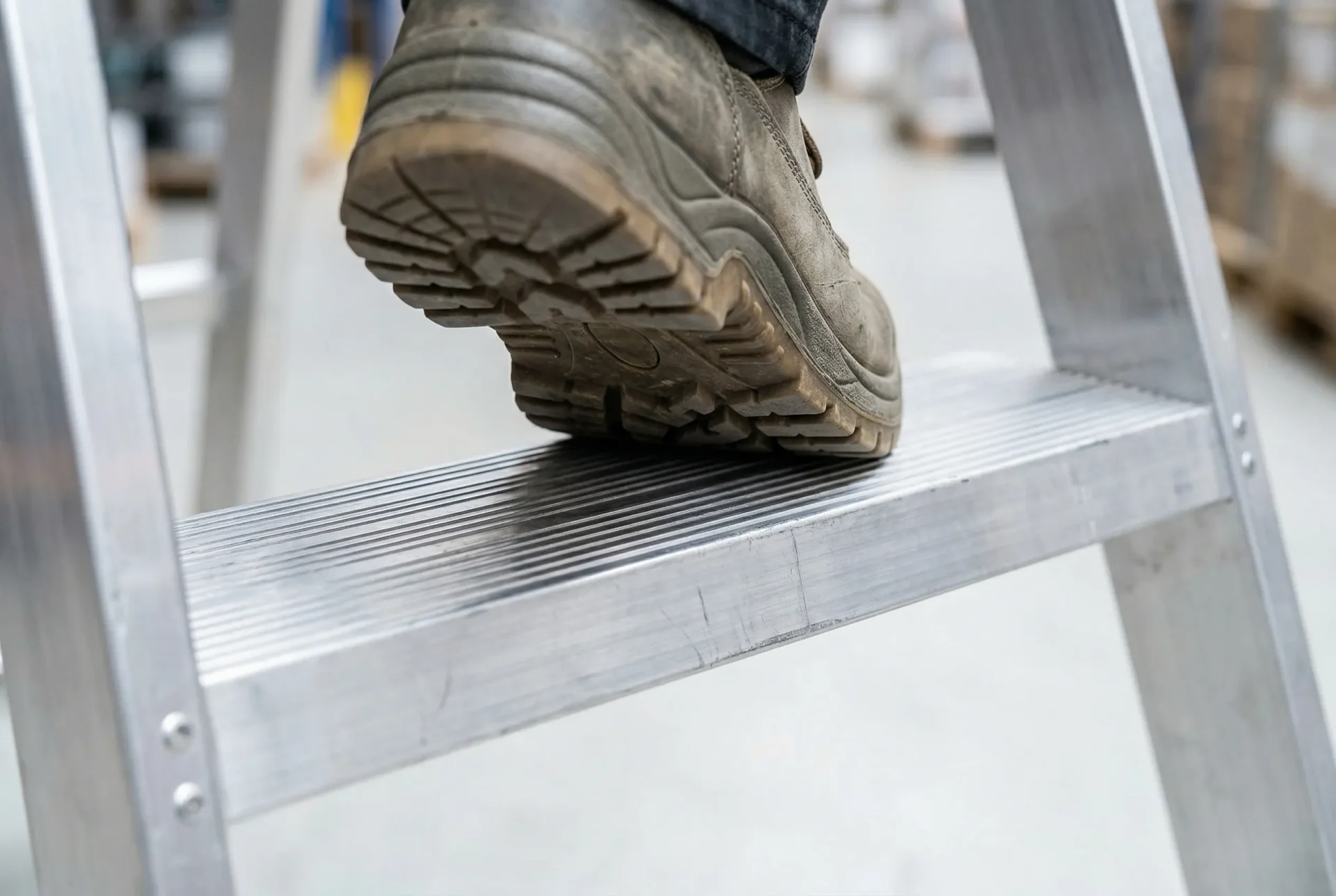
- Wide Steps: While the step width of common ladders is 30mm to 40mm, Hasegawa’s professional models utilize a wide design of 60mm or more. This distributes pressure on the soles of the feet, reducing muscle fatigue in the calves by approximately 15% to 20% even during long periods of standing work.
- Extreme Lightweighting: Through proprietary aluminum alloy technology, we have achieved a weight reduction of approximately 10% to 15% compared to equivalent products from other companies while maintaining strength. Reducing the physical load associated with moving and setup helps maintain concentration in the latter half of the workday.
- Pursuit of Stability: By increasing the torsional rigidity of the pillars, swaying during ascent and descent is minimized. This eliminates visual anxiety (mental fatigue) and provides an environment where workers can focus on the task at hand.
Case Study (Before → Action → After)
Case: Automotive parts factory on the outskirts of Hanoi (Equipment Maintenance Department)
- Before: Used inexpensive steel ladders. They weighed over 15kg, and workers were out of breath just by moving them. Foot pain occurred two hours into the work, causing concentration to break.
- Action: Introduced Hasegawa’s “Adjustable-Leg Ladders” and “Work Platforms (Zippy).”
- After: Weight was reduced to approximately 12kg, improving transport efficiency by 25%. Foot pain was eliminated due to the wide steps, and the number of tasks completed per day increased by 12%. One year after implementation, the department continues to report zero “near-miss” incidents.
The Foundation of “Peace of Mind” Provided by Hasegawa Vietnam
Quality Control and Certification
Hasegawa products comply with Japan’s JIS standards (JIS S1121, etc.) and the even stricter “A-Mark” (certified by the Japan Light Metal Association Ladder and Stepladder Division). In Vietnam, we not only clear the national standards (TCVN) but also conduct rigorous pre-shipment inspections equivalent to those in Japan. By repeating load tests from 100kg up to 160kg more than 10,000 times based on the application, we thoroughly eliminate the risk of damage due to aging.
Customization and Support System
Vietnamese work sites are diverse. We also provide “Customized Solutions” tailored to site-specific challenges, such as narrow spaces where existing products cannot reach, areas with significant height differences, or work inside clean rooms. Furthermore, we have established a collaborative support system that does not end with a sale, providing safety training and periodic inspection services after purchase.
Conclusion
Fatigue in long-term high-altitude work is quietly but surely sowing the seeds of accidents. To protect worker lives and maintain productivity in Vietnam’s harsh environment, both “appropriate break protocols” and “high-quality tools that reduce fatigue” are indispensable.
- Limit continuous work to 2 hours. Ensure a minimum 15-minute break and thorough hydration/electrolyte replenishment.
- Be aware of the decline in brain reaction speed; veterans in particular should be wary of their own “overconfidence.”
- Select highly stable work platforms (Hasegawa products) that reduce the load on the soles of the feet.
Hasegawa Vietnam merges Japanese technology with a deep understanding of Vietnamese work sites to support the creation of an environment where every customer can “return home safely today.”