
Introduction
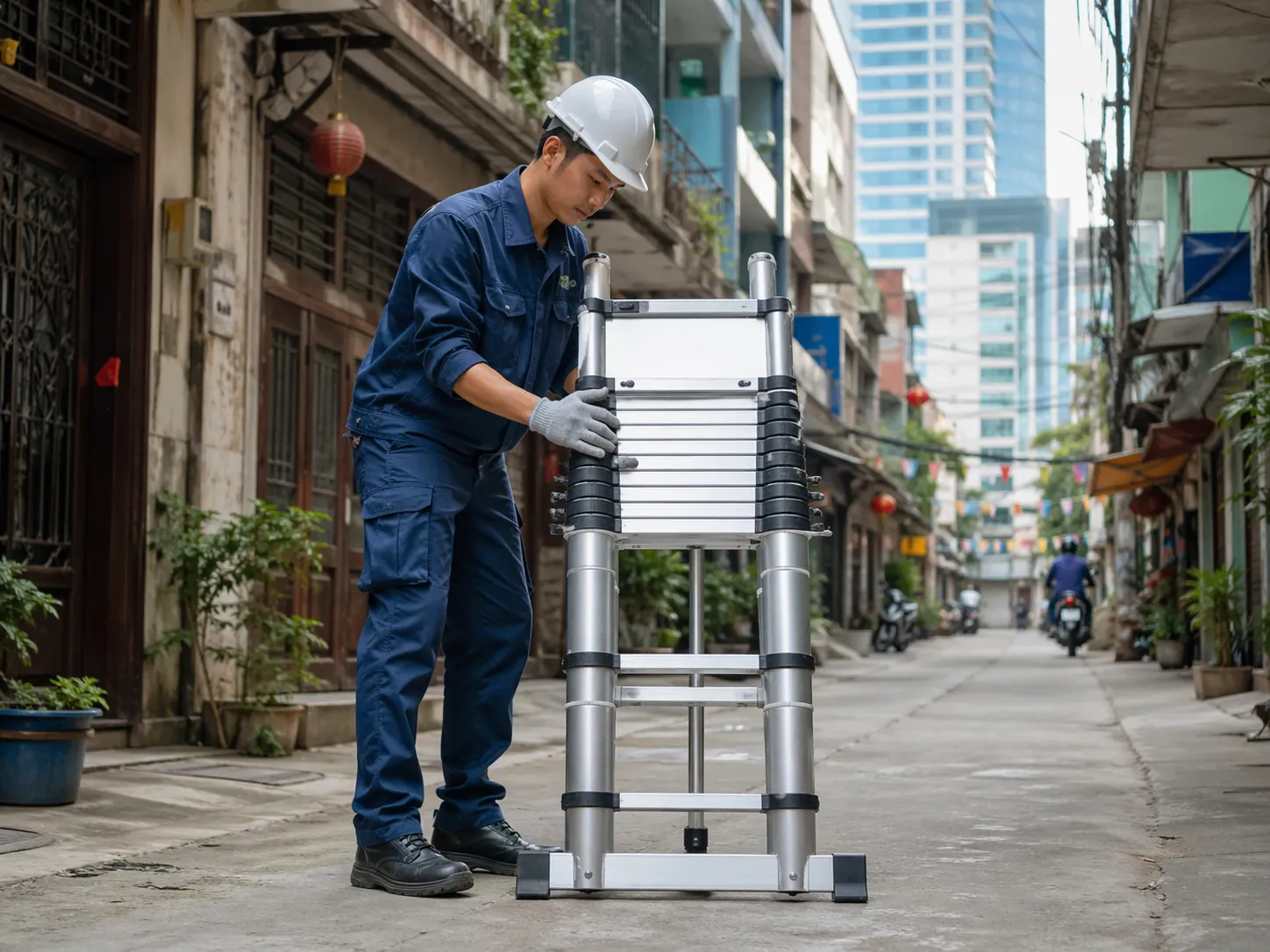
In major Vietnamese cities such as Ho Chi Minh City and Hanoi, buildings are increasingly becoming taller and more densely packed. One of the greatest challenges facing workers in manufacturing equipment maintenance and construction electrical work is “working at heights in confined spaces (Không gian hẹp).” While compact telescopic ladders (Thang nhôm rút) are highly valued in locations where conventional large stepladders cannot be brought in, fall accidents caused by the abundance of cheap products on the market continue unabated. In this article, from the perspective of Hasegawa Vietnam, we will examine the convenience and the limits of the risks associated with telescopic ladders, and provide a thorough explanation of professional selection criteria to maximize work efficiency without compromising safety, based on over 20 items of numerical data and the latest market trends.
Challenges and Background
Market Data: Current Status of Working at Heights in Vietnam
According to reports from the Vietnam Ministry of Labour – Invalids and Social Affairs (MOLISA), approximately 35% of domestic occupational accidents are related to construction and maintenance work, with “falls from heights” being the leading cause of fatal accidents. Particularly in urban areas, it is estimated that work in spaces measuring less than 2 square meters accounts for 60% of all operations, leading to a surge in demand for highly mobile elevating equipment.
The telescopic ladder market has recorded a Compound Annual Growth Rate (CAGR) of 8% over the past five years. However, there are concerns that “low-quality products” that do not meet JIS (Japanese Industrial Standards) or TCVN 8207 (Vietnam National Standards) account for approximately 40% of the market. Because these products prioritize weight reduction, the wall thickness of the aluminum material is often less than 1.2 mm (recommended is 1.5 mm or more), making “deflection” and “twisting” at heights significant factors for instability.
Risk Presentation: Structural Weaknesses Hidden Behind Convenience
Telescopic ladders are extremely useful in confined spaces, but if their structural limits are not understood, they can lead to fatal accidents. In particular, site supervisors should be most vigilant regarding the following three risks:
- Joint Wear and Rattling: Since telescopic ladders have a structure where multiple sections overlap, a gap of just 0.5 mm at a joint can amplify into a sway of over 10 cm at the top of a 5-meter ladder.
- Finger Trapping (Pinch Point) Accidents: Accidents where a worker’s fingers are crushed occur frequently when the lock is suddenly released during retraction.
- Toppling Due to Uneven Loads: In narrow spaces, it is often difficult to spread the base sufficiently, making the inclination angle improper (recommended is 75 degrees). This increases the risk of tipping over due to slight shifts in weight by 1.5 times compared to standard stepladders.
Product and Service Introduction
Key Data: Performance and Safety Statistics of Hasegawa Telescopic Ladders
- Tensile strength of aluminum alloy: 245 N/mm² or more (JIS H4100 compliant)
- Maximum load capacity: 100 kg to 150 kg (selectable by model)
- Step depth: 35 mm to 60 mm (reduces foot fatigue by 20%)
- Descent speed when unlocking: Suppressed to 0.2 m/s or less by controlled dampers
- Durability test: Maintains 98% of locking mechanism holding power even after 5,000 telescopic cycles
Features: Rigidity and Safety Realized by Hasegawa
The telescopic ladders provided by Hasegawa Vietnam are more than just “folding tools.” What we have pursued is a rigidity that allows professionals to “entrust their weight with peace of mind.”
- Soft-close via Damper Mechanism: Pneumatic dampers operate when retracting each section to physically prevent finger trapping.
- Use of High-Elasticity Aluminum: By using aluminum alloys close to aircraft grade, we have suppressed deflection at maximum load by approximately 30% compared to cheaper products of the same weight.
- High-Visibility Lock Indicators: Color signals that allow for at-a-glance confirmation that the lock is securely engaged are used to prevent human error.
Case Study (Before → Action → After)
Example: Wiring work inside a data center in Ho Chi Minh City
- Before (Challenge): The aisle width between server racks was only 80 cm, making it impossible to secure space to open the legs of a conventional A-frame stepladder. There were also concerns about equipment damage due to contact during transport.
- Action (Solution): Introduced the Hasegawa compact telescopic ladder “Skyladder” series. Leveraged its mobility with an 80 cm retracted height and 3.8 m extended height.
- After (Result): Transport and setup time were reduced by 30%. Since the workers’ footing became stable, the number of completed tasks per day improved by 15%.
The Reliability of Hasegawa
Quality Control and Certification: Bringing Japanese Standards to Vietnam
Hasegawa Vietnam products are manufactured at our own factory in Binh Duong Province under a unique and strict quality control flow (Hasegawa Quality Standard) based on the Japanese JIS S1121 (Ladder Standards).
- Material Inspection: Composition analysis of incoming aluminum material is performed for every lot (error within 0.1%).
- Destructive Testing: Three times the specified load (approx. 300 kg to 450 kg) is applied to sample products to confirm that no structural failure occurs.
- 100% Operation Check: For every ladder shipped, specialized inspectors manually verify the reliability of the locks and the smoothness of the telescopic action.
Customization and Support System
We are not just a manufacturer; we are your onsite solution partner. We provide the following support tailored to the local needs in Vietnam:
- Customization of Outriggers (Stabilizers): Detachable outriggers are available as an option for sites with unstable footing.
- Safety Training (Tool Box Talk Support): We conduct free safety training sessions (for large contracts) for onsite workers of client companies, lecturing on correct installation angles and inspection methods.
Conclusion
In confined space operations, a compact telescopic ladder may look like a magic tool. However, that convenience only functions safely when supported by the foundation of “reliable quality.” Wall thickness of 1.5 mm or more, dampers to prevent finger trapping, and strength backed by JIS and TCVN. While Hasegawa products may require a higher initial investment than cheaper alternatives, they provide overwhelming value in terms of “long-term returns” through reduced accident risk and improved work efficiency. We will continue to support the safety of the sites that power Vietnam’s development with uncompromising quality.
For assistance in selecting the ladder best suited for your work environment or to request an onsite diagnosis, please feel free to contact Hasegawa Vietnam.