
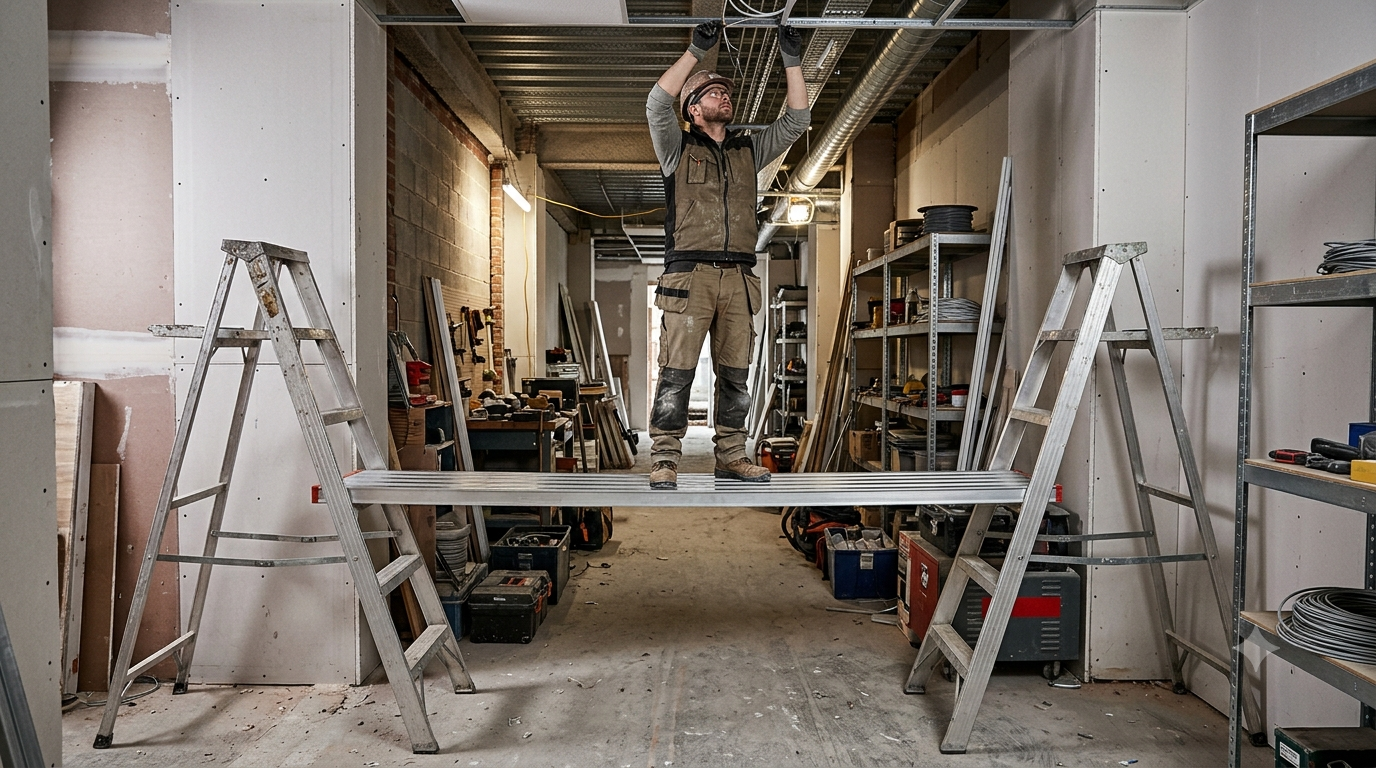
PLANK is Hasegawa’s scaffold board, made from 005-T5 aluminum alloy, designed to be paired directly with two A-frame ladders to form a temporary scaffold. It supports a load of up to 227kg, enough for two workers at once, and comes in two versions: Fixed and Adjustable (length can be extended). It’s a solution built for construction sites too tight for a bulky frame scaffold system.
If you’ve ever worked in a small room, a narrow staircase, or an area cluttered with obstacles, you already know the problem: a traditional frame scaffold — with its steel bars, diagonal braces, and bulky base — sometimes simply has no room to be set up. As a result, many crews fall back on chairs, wooden crates, or other makeshift solutions to bridge the gap they need to work across, carrying real risks of slipping and instability.
Hasegawa’s PLANK is designed for exactly this situation. Instead of bringing in an entire scaffold system, the user only needs two A-frame ladders already on hand and a single PLANK board laid between them — instantly creating a temporary work surface, sturdy enough for one or two people. The sections below explain how the product works, its specifications, and the situations it suits best.
What Is PLANK? The Principle of Pairing with an A-Frame Ladder
PLANK is a long aluminum board designed to be laid horizontally between the steps of two A-frame ladders placed parallel to each other. When set up correctly, the combination of “two ladders plus one PLANK” forms a simple temporary scaffold: the two ladders act as the legs, and PLANK acts as the surface where the worker stands and moves.
This is PLANK’s biggest departure from traditional scaffolding: there’s no dedicated scaffold frame to assemble. If a site already has A-frame ladders on hand — common equipment for most crews — PLANK can be used right away to extend them into a work surface, without needing to invest in a separate scaffold system.
Two Versions of PLANK: Fixed and Adjustable
Hasegawa offers PLANK in two versions, serving two different needs:
- Fixed Plank: has a set length for each model. Suited to situations where the distance between the two ladders is known in advance and doesn’t change.
- Adjustable Plank: can be extended or shortened within a set range. Suited to situations where the distance between the ladders needs to change from one job to the next.
In simple terms: if you always work with the same fixed distance between your ladders, Fixed Plank is lighter. If the distance changes depending on the job, Adjustable Plank offers more flexibility, at the cost of slightly more weight.
005-T5 Aluminum Alloy: Why This Alloy Was Chosen
PLANK is made from 005-T5 aluminum alloy — a heat-treated alloy that increases hardness, giving the board strong load-bearing performance while remaining much lighter than a wooden board or steel plate of the same size. For a product that’s moved between work positions frequently, that light weight means one person can set it up alone, without needing extra help.
Anti-Slip Surface: How the Grooves Work
The top surface of PLANK has anti-slip grooves running along its length. These grooves increase grip underfoot — a particularly important feature since PLANK is often used spanning a gap at height, where any slip carries more risk than it would standing on the ground.
227kg Load Capacity: Why It Supports Two Workers at Once
PLANK has a maximum load capacity of 227kg, enough for two people to stand and work on the board at the same time. This is a notable difference, since many other makeshift solutions — such as an ordinary wooden plank laid across two ladders — are usually recommended for only one person, due to concerns about sagging and unclear load-bearing performance.
For tasks that need two people working together — one holding materials while the other works, or tasks that involve passing tools back and forth — the 227kg capacity lets PLANK meet that need without requiring any additional support solution.
Fixed Plank Specifications
| Model | Weight (kg) | Width (cm) | Length (cm) | Thickness (cm) |
|---|---|---|---|---|
| Fixed Plank 6 | 7.6 | 30.5 | 183 | 6.5 |
| Fixed Plank 8 | 9.8 | 30.5 | 244 | 6.5 |
| Fixed Plank 10 | 12.3 | 30.5 | 305 | 6.5 |
Adjustable Plank Specifications
| Model | Weight (kg) | Width (cm) | Adjustable Length (cm) | Thickness (cm) |
|---|---|---|---|---|
| Adjustable Plank 6-9 | 14.5 | 33.3 | 180 ~ 272 | 6.9 |
| Adjustable Plank 8-13 | 19.1 | 33.3 | 241 ~ 394 | 6.9 |
| Adjustable Plank 9-15 | 22.5 | 33.3 | 269 ~ 447 | 6.9 |
Compared with Fixed Plank, the Adjustable line is slightly heavier at a comparable length range, due to its built-in extend/retract mechanism — a reasonable trade-off between weight and flexibility.
What Does ANSI UL-1322 / IAA Type Mean?
PLANK meets the ANSI UL-1322 standard, classified under IAA Type. For readers unfamiliar with the US standards system: ANSI (the American National Standards Institute) sets technical standards in the United States, and UL-1322 is the specific standard that applies to portable metal planks. “IAA Type” is one of the load-capacity classifications under this standard — the heaviest-duty class in the classification, typically reserved for planks with high load-bearing requirements used in industrial settings.
PLANK holding the IAA Type classification means the product has been evaluated against a specific industry load-bearing criterion, not just assessed based on the manufacturer’s own claims.
How PLANK Suits Tight Construction Spaces
A traditional frame scaffold needs space to set up its base, fit diagonal braces, and maintain a safe clearance around it. In a tight space — a narrow corridor, an area between two close-set walls, or a room crowded with machinery and shelving — a full frame scaffold system may not have enough room to be assembled correctly.
PLANK solves this by making use of equipment that’s already on hand (A-frame ladders), needing only enough space to set two ladders parallel and lay the board between them. This:
- Reduces the footprint needed compared with a complete frame scaffold system.
- Shortens setup time, since there are no multiple loose parts to assemble.
- Makes use of A-frame ladders already on site, without needing to invest in larger equipment.
PLANK vs. NNS — How Does It Differ from Hasegawa’s Other Plank Product?
Hasegawa has another long aluminum plank product called NNS (an anti-slip scaffold plank focused on drainage). Both are long aluminum boards, but they serve different purposes:
- PLANK: designed to pair directly with A-frame ladders, forming a flexible temporary scaffold with a 227kg capacity for two workers. Does not have a dedicated drainage-gap design.
- NNS: designed to sit fixed between two existing support points (a scaffold frame or supporting structure), with a 200kg capacity and 28mm drainage gaps, suited to wet environments like shipbuilding.
If you need a quick scaffold solution that makes use of A-frame ladders already on hand, PLANK is the better fit. If you need a fixed walking surface in a wet environment, NNS will serve you better.
Frequently Asked Questions
Does PLANK require any special tools to set up?
No special tools are needed. PLANK is designed to be placed directly on the steps of two parallel A-frame ladders, with no bolting or welding required.
What load capacity does PLANK support?
A maximum of 227kg, enough for two people to work on the board at the same time.
Should I choose Fixed Plank or Adjustable Plank?
If the distance between your two A-frame ladders is fixed and doesn’t change, choose Fixed Plank for a lighter product. If the distance varies from job to job, choose Adjustable Plank to adjust the length as needed.
How is PLANK different from an ordinary wooden plank laid across two ladders?
The difference is significant. PLANK is made from a dedicated aluminum alloy, has a purpose-built anti-slip surface, and carries a load-bearing certification under the ANSI UL-1322 standard (IAA Type classification). An ordinary wooden plank has none of these features, and its load-bearing performance is often unclear.
This article was prepared based on Hasegawa Vietnam’s official technical documentation. Specifications may be updated in newer catalogue versions; please confirm with the sales team before placing an order.
——————————————————————————————-
Hasegawa Vietnam’s sales team offers free consultation to help you choose the right product for your space and construction requirements.