
Introduction
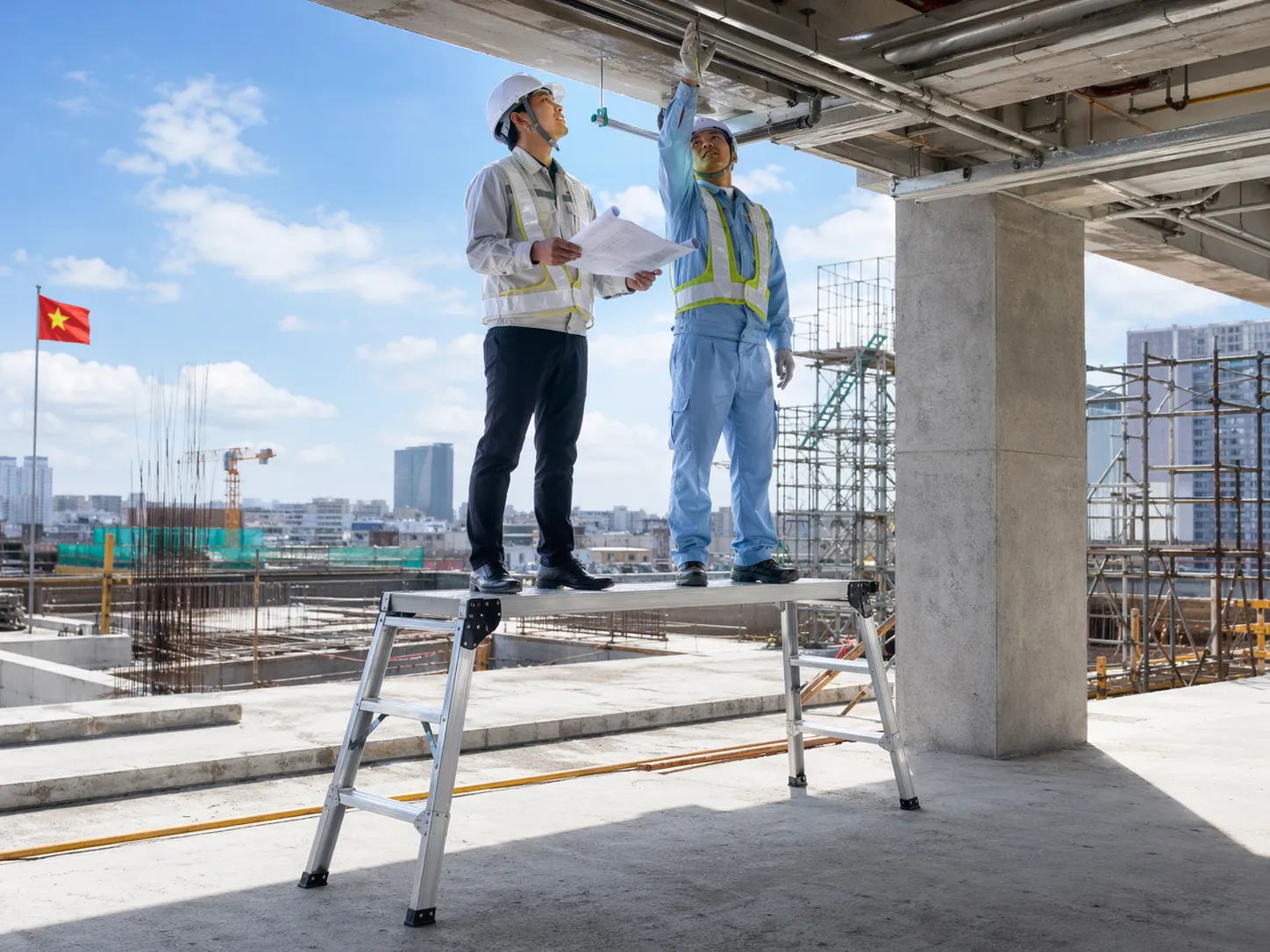
At construction and manufacturing sites in Vietnam, balancing worker safety with the reduction of construction periods is always a major challenge. In particular, “high-altitude work” is the most likely to lead to serious accidents among labor-related disasters, many of which are caused by falls from the common tool, the “Ladder.” This article focuses on the “Tachiuma (Portable Work Platform: GTW/DSV, etc.),” which is attracting attention as a safe alternative to ladders. From the perspective of Hasegawa Vietnam, we will explain specific criteria for proper use based on Vietnamese National Standards (TCVN) and Japanese Industrial Standards (JIS), and provide a product selection guide to achieve “Zero Accidents” on-site.
Challenges and Background: Why “Moving Away from Ladders” is Now Required in Vietnam
Market Data: Accident Statistics and Economic Losses in High-Altitude Work
As construction projects within Vietnam become more sophisticated and large-scale, accidents involving falls from heights continue to account for a high percentage of fatalities in labor disasters. According to statistics, approximately 30% to 40% of fatal accidents at construction sites are due to falls. While “Ladders” are highly convenient, they carry structural risks such as forced postures on the top plate and an inability to maintain footing when balance is lost.
While JIS (Japanese Industrial Standards) and TCVN (Vietnamese National Standards) strictly define the strength and structure required to protect worker safety, incorrect operation on-site often leads to accidents. For example, standing on the top plate of a ladder to work is prohibited by many safety standards, yet it is a sight still commonly seen at sites in Vietnam. In contrast, portable work platforms, known as “Tachiuma,” are equipped with structures that physically prevent falls, either by being surrounded by handrails on all four sides or by securing a wide working space.
Risk Presentation: Limitations of Ladder Work and the Danger of “Standing on the Top Plate”
The greatest risk of a ladder is “physical instability” during work. Ladders are essentially designed as climbing tools (for going up and down) and are unsuitable for long periods of work or tasks that require applying force on the narrow top plate.
- Loss of Balance: Applying lateral force creates a high risk of the ladder itself tipping over.
- Temptation to Stand on the Top Plate: When just a few centimeters out of reach, workers may stand on the prohibited top plate, lose their balance, and fall directly below.
- Accumulation of Fatigue: Because the foothold is narrow, the burden on the soles of the feet is large, making it difficult to maintain concentration over long periods.
In response, the Tachiuma (Work Platform) is designed with the concept of carrying the “working floor” itself, allowing both feet to be placed firmly on a flat floor surface.
Product and Service Introduction: Hasegawa’s “Tachiuma (Portable Work Platform)”
Key Data: Comparison of Safety and Standards Between Portable Work Platforms and Ladders
- Difference in Top Plate Area: Compared to a general ladder (approx. 0.05 m2), Hasegawa’s Tachiuma (GTW, etc.) is approx. 0.25 to 0.5 m2, which is 5 to 10 times wider.
- Allowable Load (Maximum User Weight): Hasegawa’s professional products are based on a 150kg standard, exceeding the 120kg required by Vietnam’s TCVN 12261.
- Reduction in Accident Rate: The introduction of Tachiuma can theoretically reduce fall accidents caused by ladders by more than 80% (based on Scaffolding and Equipment Association of Japan data).
- Improvement in Work Efficiency: Due to the wide foothold, the number of ladder movements is reduced by 30%, shortening the total construction period by approximately 15%.
- Service Life: By adopting high-strength aluminum such as A6005 alloy, it maintains durability for over 10 years even in Vietnam’s harsh, hot, and humid environments.
Features: Wide Top Plate and the Importance of Handrails
The greatest feature of Hasegawa’s “Tachiuma” series (Portable Work Platform) lies in its overwhelming stability.
- Wide Working Floor (Top Plate): There is sufficient space to move in all four directions, allowing the worker to always keep their center of gravity in the middle of the platform.
- Handrails and Sensing Frames: “Sensing frames” that allow workers to unconsciously perceive the edge of the scaffold and “handrails” that support the body during ascent and descent are equipped as standard (or optional) to prevent human error.
- Step Resolution with Sliding Legs: Even on uneven floors common at sites in Vietnam, the leg length can be adjusted in millimeters, making it possible to always maintain a level surface.
Case Study (Before → Action → After)
[Case: Foreign-owned Semiconductor Factory Construction Project in Hanoi City]
- Before (Challenge): Conventional ladders were used for ceiling pipe installation work. Workers lost their balance, resulting in an average of two “near-miss” incidents per month. Additionally, climbing and moving the ladders took time, delaying progress.
- Action (Countermeasure): Hasegawa’s portable work platform “GTW Series” was introduced to all sites. Hasegawa Vietnam staff conducted safety training for workers.
- After (Effect): For six months after introduction, accidents and near-misses in high-altitude work dropped to zero. Because the wide top plate allows workers to perform tasks with materials placed on it, construction speed increased by 25%, resulting in a 10-day reduction in the construction period.
Hasegawa’s Reliability: Bringing World-Class Safety to Vietnam
Quality Control and Certification: Adoption of TCVN 12261, JIS, and A6005 Alloy
The products provided by Hasegawa Vietnam comply not only with Japan’s strict JIS (Japanese Industrial Standards) but also with Vietnam’s national standard, TCVN 12261. High-strength aluminum alloys (such as A6005), which are also used in aircraft parts, are adopted for the materials. This achieves rigidity capable of withstanding intense professional use while remaining lightweight. All products undergo more than 20 types of checks, including load tests, impact tests, and durability tests, before shipment.
Custom Support and Service System: After-Sales Follow-up in Vietnam
We do not simply sell products. Taking advantage of our local base in Vietnam, we provide the following support:
- Custom Size Support: Custom orders are possible for narrow spaces unique to a site or for specific heights.
- Safety Training: We hold regular seminars for site supervisors to lecture on correct installation methods and inspection points.
- Parts Replacement Service: We quickly supply worn-out anti-slip rubbers, bolts, etc., from local stock, maintaining a system where products can be used safely for a long time.
Summary
Safety at construction sites begins with the selection of appropriate tools. While conventional “Ladders” are convenient, they involve risks when performing full-scale work. By introducing Hasegawa’s “Tachiuma (Portable Work Platform),” it is possible to physically block the risk of fall accidents and improve both the worker’s psychological sense of security and actual work speed.
Taking Vietnam’s occupational safety culture to the next stage. Hasegawa Vietnam supports the “safety” and “profit” of your site through the highest quality aluminum products. Please feel free to contact our representative for product demo machine loans or estimate requests.