
Introduction
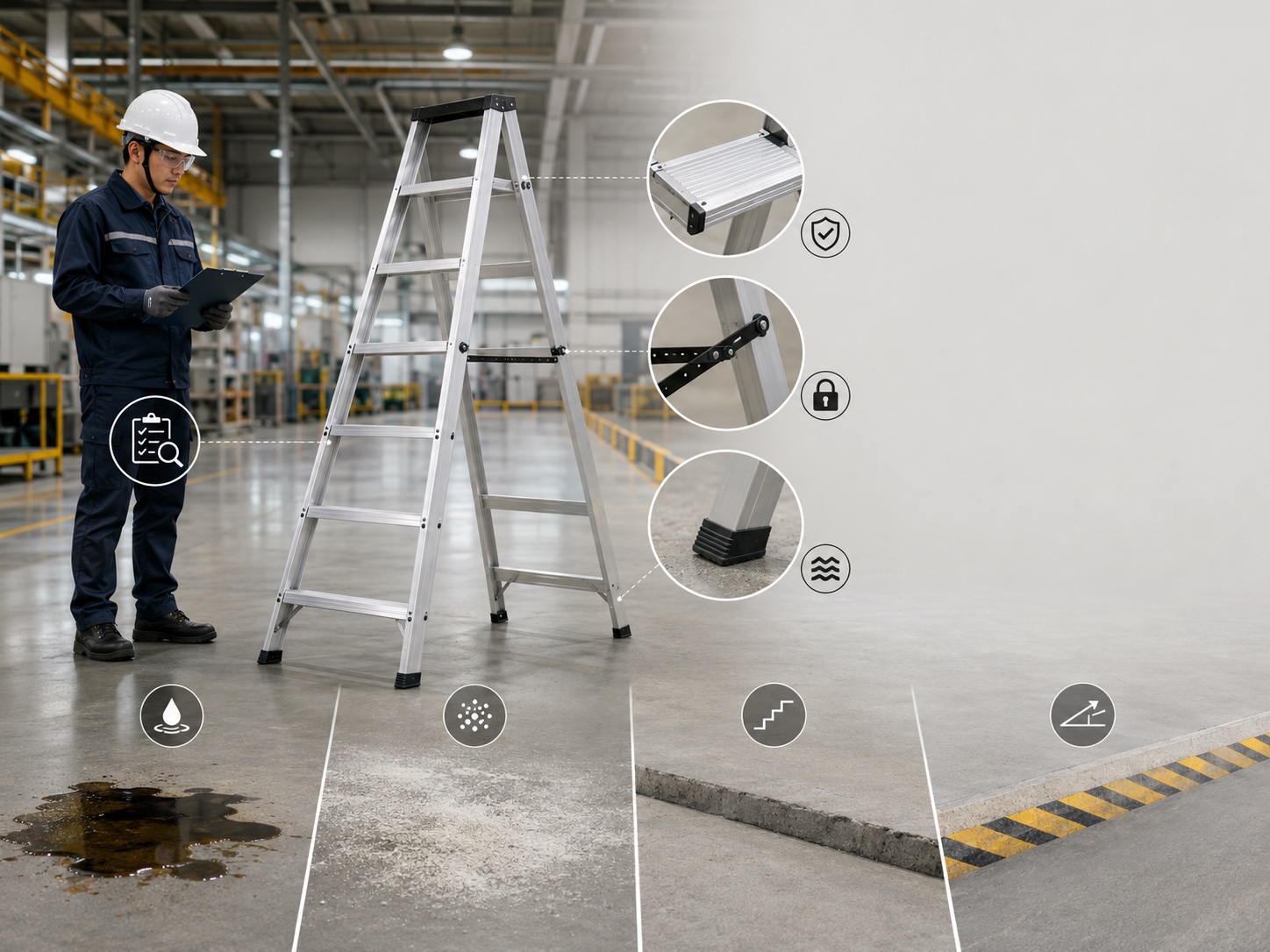
In Vietnamese factories, the working environment often differs from the well-finished floors found in Japan. Floors made slippery by cutting oil or food-derived oil, dust that rises in the dry season, steps created by expansions and piping, and aisles with ramps or drainage gradients—these “floor problems” directly threaten a stepladder’s stability. Even the same stepladder, used without regard to the floor’s condition, can lead to falls and missteps. This article organizes how to choose a stepladder and how to respond, by the four floor problems most common in Vietnamese factories.
Four Common Floor Problems in Vietnamese Factories
The four most frequently seen on site are below. Because the danger appears differently in each, the response differs too.
- Oil: floors made slippery by machine cutting oil or food oil
- Dust: dry dust that robs friction between the legs and the floor
- Steps: height differences from expansions, piping, or joints
- Slope: floors tilted by ramps or drainage gradients
Handling Oily, Slippery Floors
On oily, slippery floors, even a slight movement of a stepladder’s legs can lead to a fall. First, wipe off the oil before setting up, and choose leg ends fitted with rubber anti-slip caps. Avoid leaning ladders, whose feet slide out easily; give priority to stepladders that stand firmly on four legs, or to work platforms with a wide contact area.
Handling Dusty Floors
Dust works its way between the floor and the leg ends, greatly reducing friction. The basics are to clean the setup surface and use leg-end caps with effective anti-slip performance. In addition, because dust also gets into hinges, spreaders, and telescoping sections, keeping the moving parts working through daily cleaning and inspection contributes to safety.
Handling Floors With Steps
Place a stepladder over a step, and some of the four legs lift off, causing wobble. Matching the height with wood blocks or bricks is strictly forbidden, as they shift and collapse. If possible, move to a level spot; if it cannot be moved, consider a telescoping-leg type that lets you adjust each leg’s length individually. After setup, always confirm that all four legs are in contact with the ground and that there is no wobble.
Handling Sloped Floors
On sloped floors, a stepladder tends to tip toward the lower side. A variable-leg type (designed for steps and slopes), which keeps level by extending only one side’s legs, is effective. Keep the top plate level, and as a rule, never force work while it is tilted. On stairs or steep gradients, dedicated stairway stepladders or work platforms are also options.
| Floor problem | Main risk | Direction of response |
|---|---|---|
| Oil | Legs slip and it tips over | Wipe off oil; rubber anti-slip, wide contact area |
| Dust | Reduced friction, faulty moving parts | Cleaning, anti-slip leg ends, inspect moving parts |
| Steps | Legs lift and wobble | Move to a level surface, adjust individually with telescoping legs |
| Slope | Tips toward the lower side | Level it with variable legs, keep the top plate level |
Conclusion
Choosing a stepladder in a Vietnamese factory becomes far less error-prone when you start from “what kind of floor will it be used on.” Anti-slip and a wide contact area for oil, cleaning and moving-part inspection for dust, telescoping legs for steps, variable legs for slopes—changing the response for each problem is the shortcut to preventing falls. At Hasegawa Vietnam, we can propose the optimal unit to match these floor conditions, including leg-end specifications, telescoping and variable legs, and work platforms. Share photos of the setup surface and the floor’s condition, and we can support your selection more concretely.