
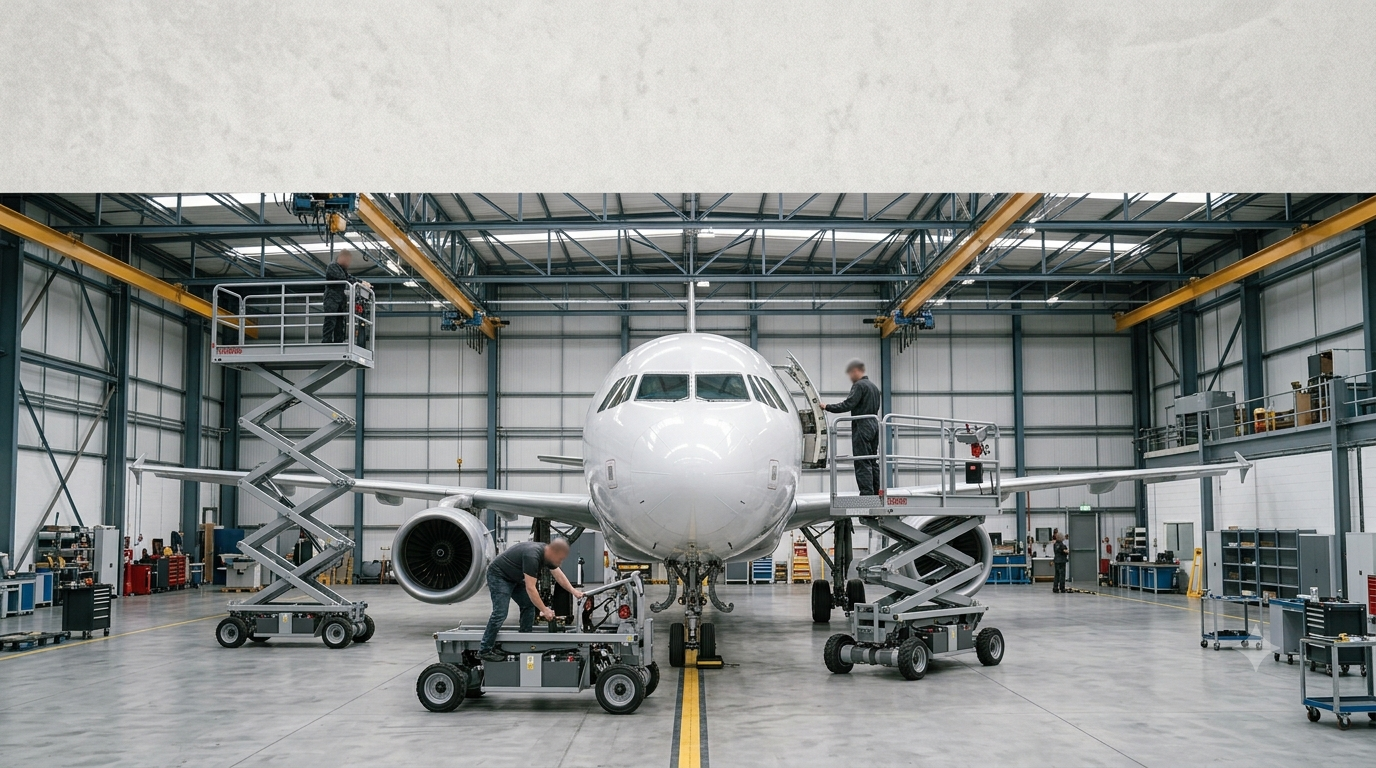
Ground support equipment used near aircraft has to meet two requirements that an ordinary industrial environment doesn’t impose: it must not generate foreign object debris that could damage an aircraft (FOD), and it must never collide with the aircraft’s surface. This article analyzes one of Hasegawa’s Order Made solutions for aviation: a maintenance and inspection platform, raised and lowered by an electric switch, with height adjustable to match different service areas on an aircraft.
If a ladder or work platform used in a factory gets scuffed or lightly bumps into a wall, the incident usually amounts to nothing more than a minor scratch. But if that same equipment accidentally strikes an aircraft’s fuselage during maintenance, the result can be a costly repair bill and a delayed flight. This is why ground support equipment in the aviation industry can’t simply be “a good ladder” — it needs to be designed around constraints that an ordinary industrial environment doesn’t impose.
This article breaks down two requirements specific to the aviation maintenance environment, how one of Hasegawa’s Order Made solutions was designed to meet them, and considerations for aircraft maintenance and inspection providers when choosing ground support equipment.
Why Does Aviation Ground Equipment Need Its Own Standards?
According to Vietnam’s Civil Aviation Authority, the operation of vehicles and equipment within an airfield must be tightly controlled to prevent two main categories of risk: the risk of collision with an aircraft, and the risk of generating FOD.
If this term is new to you: FOD (Foreign Object Debris/Damage) refers to objects that don’t belong in the flight operating environment but are capable of causing damage. FOD can harm an aircraft, ground equipment, or affect staff safety. It can be bolts, screws, metal fragments, forgotten tools, or debris generated by ground vehicles themselves during operation.
Beyond the risk of FOD, collision between ground equipment and an aircraft is also a top concern. Aircraft are extremely high-value assets; even a minor scrape between ground support equipment and an aircraft’s surface can cause significant damage and delay operations.
These two factors mean that ground equipment used for aircraft maintenance and inspection needs to be designed far more carefully than a ladder or work platform used in an ordinary factory — not just for user safety, but for the level of motion control and precision needed when working close to an aircraft’s surface.
The Challenge Behind Hasegawa’s Order Made Project for Aviation
According to Hasegawa Vietnam, one of the Order Made products developed for the aviation sector is a maintenance and inspection platform. Two features are highlighted in this design: it can be raised and lowered with an electric switch, and its height is adjustable to match different service areas on an aircraft.
These two features aren’t arbitrary — they come directly from the nature of aircraft maintenance work. The areas that need access — wings, fuselage, tail, engines — sit at many different heights. Any operation that approaches close to an aircraft’s surface needs more precise motion control than an ordinary work environment requires.
Two Key Design Elements
Electric-Switch Lift — More Precise Motion Control Than a Manual Mechanism
With a manual lift mechanism (a hand crank or mechanical pull), the speed and smoothness of the motion depends heavily on the operator’s technique. In an ordinary environment, this isn’t a major issue. But when equipment is positioned close to an aircraft’s surface, a jerky or overly fast movement can raise the risk of collision.
An electric-switch lift mechanism makes the up-and-down motion smoother and easier to control, reducing the uncertainty that comes with manual operation — an important advantage when working in a space that requires maintaining a precise distance from an aircraft’s surface.
Height Adjustable by Service Area — Matching the Range of Maintenance Positions on an Aircraft
An aircraft has multiple areas that need maintenance or inspection at different heights — from areas near the landing gear close to the ground, to the upper fuselage or tail at a much greater height. A device with only one fixed height can’t cover this range, forcing a maintenance provider to keep separate equipment on hand for each area.
Being able to adjust height by service area lets a single piece of equipment serve multiple maintenance positions on the same aircraft, reducing the number of devices needed and simplifying movement between work areas.
The Lesson Learned: Applying the 6-Step Order Made Process to Aviation
Much like the Order Made project for the railway industry analyzed in the previous article, the aviation project demonstrates the same principle: the initial Survey step needs to clarify not just physical dimensions, but the constraints specific to that industry — in this case, the need for precise motion control and the ability to adapt to different service heights on the same aircraft.
Despite their different technical specifics, both industries share the same approach: clearly identify the type of risk the environment creates — the structure gauge for railways, FOD and collision for aviation — then design the technical details to address that specific risk directly, rather than applying a generic design across every industry.
When Should Aviation Maintenance Providers Consider a Similar Solution?
Aircraft maintenance and inspection providers might consider a specialized equipment solution if they find themselves in one of these situations:
- Current equipment requires manual operation to change height, making it hard to control precise access near an aircraft’s surface.
- Multiple service areas at different heights on the same aircraft need to be accessed, but separate equipment is currently used for each height.
- The organization follows strict FOD control procedures and wants ground equipment designed to minimize the risk of generating foreign objects during use.
Frequently Asked Questions
What is FOD, and why does it matter in aviation?
FOD (Foreign Object Debris/Damage) refers to foreign objects that can damage an aircraft, ground equipment, or affect staff safety. It’s one of the risks that Vietnam’s Civil Aviation Authority and international aviation organizations pay particular attention to controlling within an airfield.
Why can’t standard ladders or work platforms be used for aircraft maintenance?
Standard products are usually not designed for precise motion control when approaching an aircraft’s surface, nor optimized to limit the risk of generating FOD within an airfield environment.
Is an electric-switch lift mechanism a mandatory requirement in aviation?
It’s a design choice that provides better motion control, which Hasegawa applied to this specific product. Any specific mandatory requirement, if applicable, would depend on the regulations of the particular airport or operator involved.
Does an Order Made project for aviation follow the same 6-step process as other industries?
Yes. The process still follows the same 6 steps: Survey, Design, Quotation, Order, Production, and Delivery. The difference lies in what’s covered during the Survey step, which needs to clarify the aviation industry’s specific FOD and collision-control constraints.
This article was prepared based on Hasegawa Vietnam’s official introductory materials, combined with publicly available information on airfield safety from Vietnam’s Civil Aviation Authority. The content is general reference material; each project needs to be surveyed and designed individually according to the actual requirements of the relevant airport or operator.
———————————————————————————————
Hasegawa Vietnam’s technical team has experience designing ground support equipment with FOD and aircraft collision risks in mind. Get in touch for a free consultation on your specific project.
Email: sales1@hasegawa.com.vn