
Introduction
As the manufacturing, construction, and logistics industries in Vietnam undergo rapid modernization, workplace “occupational safety and health” has become a paramount issue affecting corporate sustainability. In particular, fall accidents during high-altitude work directly lead to severe management risks. This article focuses on the “aluminum alloy grades” that fundamentally support the safety of professional work platforms and ladders. Why is there such an overwhelming difference in durability and stability—not just price—between general household ladders and professional industrial equipment? The secret lies in the material-engineering-based selection of metal grades and structural design. We will thoroughly explain Hasegawa’s (Hasegawa Vietnam) dedication to manufacturing, which meets strict standards such as JIS (Japanese Industrial Standards) and TCVN (Vietnam National Standards) to maintain reliability for years and decades in harsh on-site environments, along with specific numerical data.
Challenges and Background
Market Data
With industrial development in Vietnam, the demand for high-altitude work equipment is rising year by year. However, on the other hand, many challenges remain in the safety management systems at work sites, especially regarding the quality selection of the equipment used. According to the 2023 occupational accident statistics report released by the Ministry of Labour, Invalids and Social Affairs (MOLISA) of Vietnam, the number of occupational accidents occurring nationwide reached 7,394, with the number of fatalities reaching 662. Among these, “falls from heights (Ngã từ trên cao)” at construction and manufacturing sites accounted for approximately 35.5% of all fatal accident causes, remaining the most frequent and critical disaster.
Furthermore, a detailed analysis of the background of these accidents reveals many cases caused by the use of inappropriate work scaffolding or the breakage of work platforms and ladders due to aging and insufficient strength. The market is flooded with low-priced imported products and low-quality ladders made by recycling aluminum scrap of unknown origin. Although their appearance closely resembles professional ones, their actual mechanical strength falls short of satisfying industrial requirements.
Looking at aluminum demand forecasts, the total aluminum consumption across the Association of Southeast Asian Nations (ASEAN) exceeds 4.5 million tons per year, and more than 600,000 tons of aluminum products are consumed annually in Vietnam alone, primarily in architecture, infrastructure, and manufacturing. In such a massive market, the proper distribution and selection of high-strength aluminum that meets safety standards (particularly the heat-treatable alloys known as the 6000 series) is an indispensable factor for protecting the lives of workers on site.
Risk Identification
A mistake that many purchasing managers and site supervisors tend to fall into is the misconception that “all aluminum is the same light and durable metal.” “Household ladders” designed for changing light bulbs or general cleaning at home fundamentally differ in their required design load (maximum weight capacity) and durability cycles from “industrial/professional ladders” where workers with different body weights and cargo climb up and down dozens of times every day.
The design load of a typical household ladder is usually around 80 kg to 100 kg, and its service life expectancy assumes a scale of several thousand repetitions in climbing tests. In contrast, professional ladders regulated by the JIS S1121 standard in Japan or the EN131 standard in Europe must guarantee a design load of 100 kg to 130 kg or more, and pass repetitive load tests reaching tens of thousands of cycles. Reusing low-grade ladders intended for household use (with a wall thickness of less than 1.2 mm or low-strength aluminum materials without proper heat treatment) in industrial sites, especially in harsh environments such as petrochemical plants and construction sites, creates the following invisible and fatal risks:
First is sudden structural failure due to metal fatigue—a phenomenon where invisible, microscopic cracks progress inside the metal under severe repetitive loads. Unlike iron, aluminum does not have a “fatigue limit,” so its strength decreases over time through repeated exposure, even under small loads. Second is the “corrosion risk” caused by Vietnam’s characteristically hot and humid climate, salt damage in coastal areas, and chemical substances within factories. Aluminum without appropriate surface treatments (such as anodizing) gradually corrodes from the surface due to moisture and salt, significantly reducing its strength. In particular, when corrosion progresses around joints and rivets, it can cause a catastrophe where the worker’s footing suddenly collapses without warning.
Product and Service Introduction
Features
The reason why Hasegawa’s (Hasegawa Kogyo / Hasegawa Vietnam) professional ladders and work platforms enjoy immense trust from Vietnamese professionals lies in the “grades” and “heat treatment” of the aluminum alloys used.
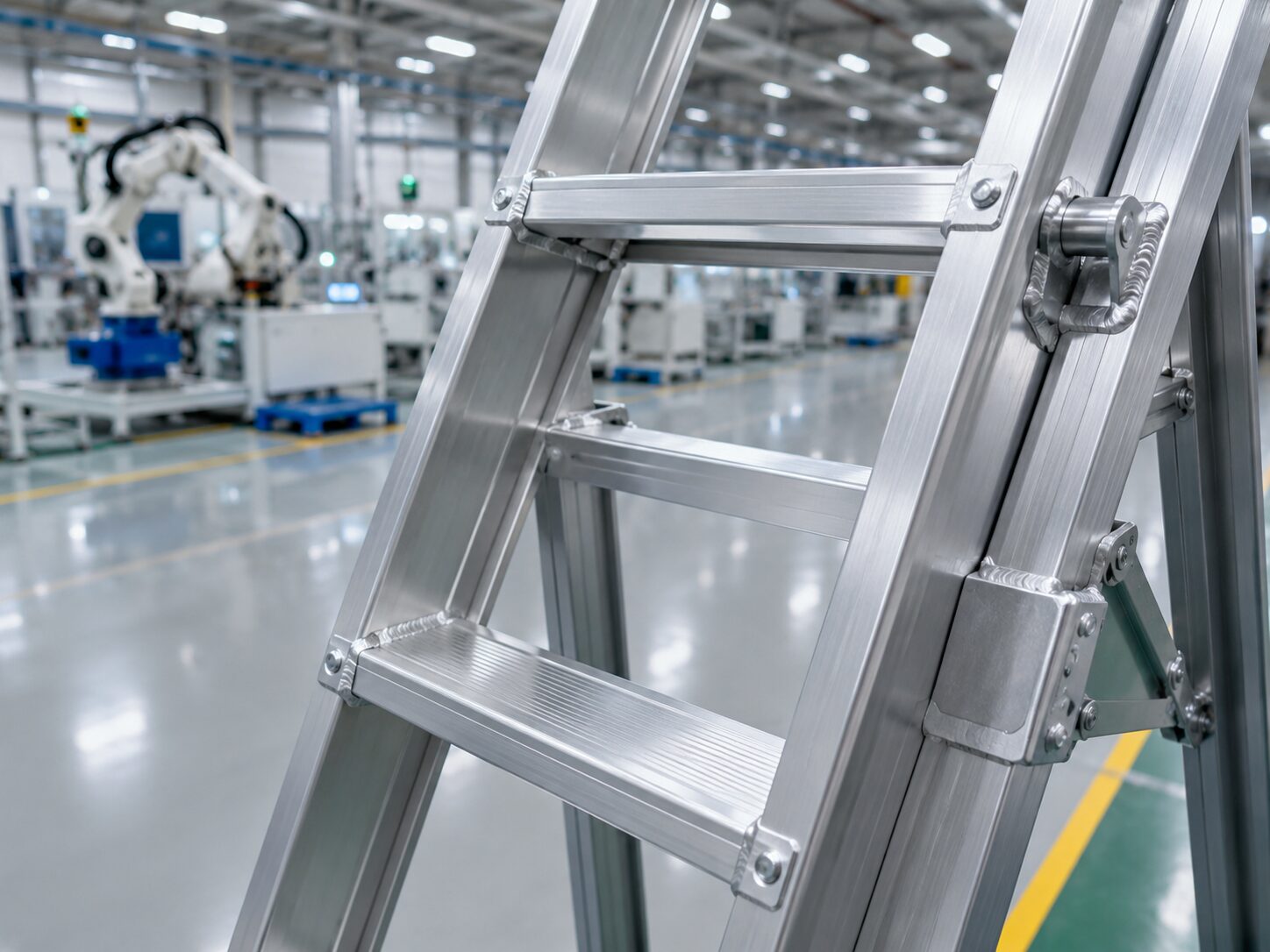
For the main structural parts of Hasegawa products (such as stiles and rungs), aluminum alloys of the “A6063-T5” and “A6061-T6” grades are primarily adopted. The four-digit number of the aluminum alloy represents its composition (the elements added).
-
A6063 Alloy: This is an “Al-Mg-Si series” heat-treatable alloy with magnesium (Mg) and silicon (Si) added to aluminum. It possesses excellent extrudability, allowing the stiles of ladders with complex cross-sectional shapes to be formed with high precision. It is also characterized by extremely high corrosion resistance (resistance to rust) and surface-treatment properties.
-
A6061 Alloy: Compared to A6063, trace amounts of copper (Cu) and chromium (Cr) are further added, boasting higher mechanical strength (tensile strength and yield strength). At Hasegawa, this A6061 is carefully selected and used especially for large work platforms subjected to high loads or custom-specification products that prioritize strength above all else.
The most critical part here is the temper designation (a symbol indicating the state of heat treatment) such as “T5” or “T6” attached after the numbers. Aluminum does not exhibit its inherent strength simply by being molded.
-
T5 Tempering: This process involves forced air cooling after extrusion or shaping at an elevated temperature, followed by artificial aging (a treatment to increase strength by heating at a specific temperature for a certain period to precipitate fine compounds within the metal structure).
-
T6 Tempering: This is a heat treatment that yields the highest strength by performing solution heat treatment (a process where elements are completely dissolved at a high temperature and then rapidly cooled) followed by artificial aging.
While the tensile strength of pure aluminum (1000 series) is about 70 to 90 MPa (megapascals), the A6063-T5 used by Hasegawa has a deformation-resistant strength (yield strength) of 110 MPa or more, and A6061-T6 boasts a yield strength of 245 MPa or more, which is an overwhelming strength several times that of pure aluminum. By processing this top-quality material into stiles with Hasegawa’s proprietary “hollow structure” (a unique cross-sectional design featuring internal reinforcement walls called ribs while remaining hollow inside), “flexing” when a operator stands on it is minimized to the absolute limit. This achieves the “balance of lightness and strength” that safely supports loads of 100 kg or more while weighing only a few kilograms.
Source: Japan Aluminum Association Standard Properties Data
Case Studies (Before → Action → After)
Here are actual on-site case studies that demonstrate the value of Hasegawa products in Vietnam.
-
Before (Challenges Prior to Implementation): At a major Japanese/foreign-affiliated chemical manufacturing plant located in Binh Duong Province in southern Vietnam (with a site area of approximately 50,000 square meters and a steady workforce of 300 workers), about 50 general, inexpensive aluminum ladders widely available on the market (costing around 500,000 to 800,000 VND per unit) were being operated for pipeline maintenance inside the plant, daily valve inspections, and electrical system maintenance. However, due to trace amounts of acidic gas unique to chemical plants and a harsh atmospheric environment with an average humidity exceeding 80% typical of Vietnam, white powder (corrosion products of aluminum hydroxide) began to blow on the aluminum surface just half a year after implementation. Furthermore, when a Vietnamese worker weighing 85 kg climbed near the topmost step carrying a set of tools (approx. 10 kg), a phenomenon occurred where the stiles flexed significantly by more than 15 mm. Complaints and reports of strong safety concerns, such as “it shakes under my feet every time I climb and it’s terrifying” or “I can’t focus on my work because I don’t know when it will break,” were submitted one after another to the Health and Safety Department.
-
Action (Measures Taken by Hasegawa): The plant’s safety managers and purchasing staff recognized this situation as a precursor to a major fall disaster and requested an on-site investigation from a dedicated engineer at Hasegawa Vietnam. The Hasegawa team analyzed the environmental strength of the site and discovered that the wall thickness of the existing ladders was less than 1.0 mm and that the tempering of the alloy was insufficient (an inexpensive grade without heat treatment). As a solution, Hasegawa proposed a comprehensive replacement of 45 units total for the main inspection pathways and high-altitude work areas with professional industrial ladders (“long-size dedicated stepladders”) that fully comply with JIS standards and feature “A6063-T5 high-strength aluminum alloy,” alongside professional-specification work platforms treated with corrosion-resistant “high-grade anodized coating (film thickness of 10 microns or more).”
-
After (Effects After Implementation): As a result of introducing Hasegawa’s professional equipment, the on-site working environment improved dramatically. Even under the same load, the newly introduced ladders restricted “flexing” to less than 2 mm, allowing workers to firmly step with both feet, which improved the speed of valve replacement work at heights to 1.5 times the conventional rate. Furthermore, thanks to the effect of Hasegawa’s proprietary anodized surface treatment, no rust, white corrosion, or rattling from metal fatigue has occurred at all, even now, more than three years after introduction in the harsh environment of the chemical plant. This completely eliminated the cycle of “discarding broken ladders and buying replacements” that previously occurred more than 20 times a year. Although the initial investment was about 2.5 times that of general products, looking at the total cost of ownership (TCO) over three years, it ultimately achieved a cost reduction of approximately 40%. Above all, the peace of mind that comes from having a “guaranteed safe footing” boosted the motivation of workers on site, bringing about a massive, invisible asset in the form of enhanced safety awareness across the entire factory.
Hasegawa’s Reliability
Quality Control and Certifications
Hasegawa’s aluminum products are manufactured by transplanting Japan’s strict manufacturing DNA directly into its production base in Vietnam (Hasegawa Vietnam). Their reliability is objectively proven by various international quality certifications and compliance with standards.
Hasegawa’s ladders and stepladders are certified under Japan’s highest authority, “JIS S1121 (Aluminum alloy ladders and stepladders),” and the “SG Mark (Safe Goods)” established by the Consumer Product Safety Association. To maintain JIS standard certification, it is required not only that the product design is excellent, but also that the quality control system of the entire manufacturing plant is consistently at a high level. The Hasegawa Vietnam factory has 100% achieved “ISO9001 (Quality Management System),” an international standard, and conducts strict inspections across more than 20 total processes, from the acceptance stage of aluminum ingots (metal blocks) as raw materials to the shipment of finished products.
To give an example of specific in-house testing, a “load resistance test” is performed on the rungs (steps) of finished ladders by applying a vertical load of “2,000 Newtons (approx. 204 kgf),” which corresponds to twice the specified design load. After leaving it for 20 minutes, it is verified that the residual deformation (bending that does not return to its original shape) is 1 mm or less. Furthermore, a “destruction and durability test” is regularly conducted to verify that no cracks or looseness occur at all in welded parts or rivet joints by repeatedly dropping the ladder from a height of 25 cm onto a hard concrete floor surface more than 1,000 times. Even under Vietnam’s national standards (TCVN), safety criteria for high-altitude work equipment are becoming stricter year by year, and Hasegawa is capable of issuing certificates that guarantee complete traceability (manufacturing history tracking capability) against these domestic Vietnamese laws and standards.
Custom Modifications and Support System
In manufacturing and construction sites, there are always “special spaces” that cannot be accommodated by ready-made ladders or work platforms alone. For example, setting up a scaffold in the intricate gaps of large machinery, working safely on sloped ground with steps, or wanting a mobile inspection stage tailored precisely to a specific height are all detailed on-site needs.
The greatest strength that sets Hasegawa Vietnam apart from other competing suppliers is this “local custom modification capability (custom order capability)” and “rapid after-sales support system.” Hasegawa possesses its own design engineering team within Vietnam, which visits customers’ factories or sites directly to perform accurate dimensional measurements and strength calculations using 3D CAD. Based on site conditions (such as the load capacity of the floor, the number of workers using it, and the surrounding chemical environment), they select the optimal aluminum alloy grade, such as A6061-T6 or A6063-T5, to design and manufacture one-of-a-kind custom-made safety scaffolding with a short lead time.
Moreover, it does not end with delivering the product. For professional tools, the rubber parts at the feet (feet pads) may wear down over long periods of use, and locking hardware may develop play. Hasegawa products keep more than 1,500 points of all component parts (replacement rivets, safety locks, non-slip rubber, etc.) constantly in stock at its local warehouse in Vietnam, and a support system is established where specialized staff rush to the site within 24 hours at the earliest in response to any unexpected malfunction or consumables replacement request. This makes it possible to always maintain a 100% safe state without stopping on-site operations.
Conclusion
Correctly understanding the “grade” and “heat treatment” of aluminum for ladders and work platforms used in professional sites is more than just knowledge of materials—it is a “management decision to protect employees’ lives” itself. The high-strength aluminum alloys like A6063-T5 and A6061-T6 that Hasegawa remains dedicated to, its precisely applied heat treatment, and its rigorous quality control backed by JIS standards may fall behind low-priced products if you only look at the immediate cost (initial cost) at the time of purchase. However, from the perspective of long durability, low maintenance costs, and above all, completely preventing “management losses due to fall accidents (production halts, damage compensation, loss of corporate credibility)” before they happen, it becomes the most wise investment with the highest return on investment (ROI). True peace of mind with Japanese quality for Vietnamese sites. Hasegawa will continue to support the safety of your workplaces at the forefront with the highest peak of materials and technology. Please feel free to contact Hasegawa Vietnam’s local specialized staff to request our latest product catalog or for consultations on on-site safety diagnostics and custom scaffolding.