
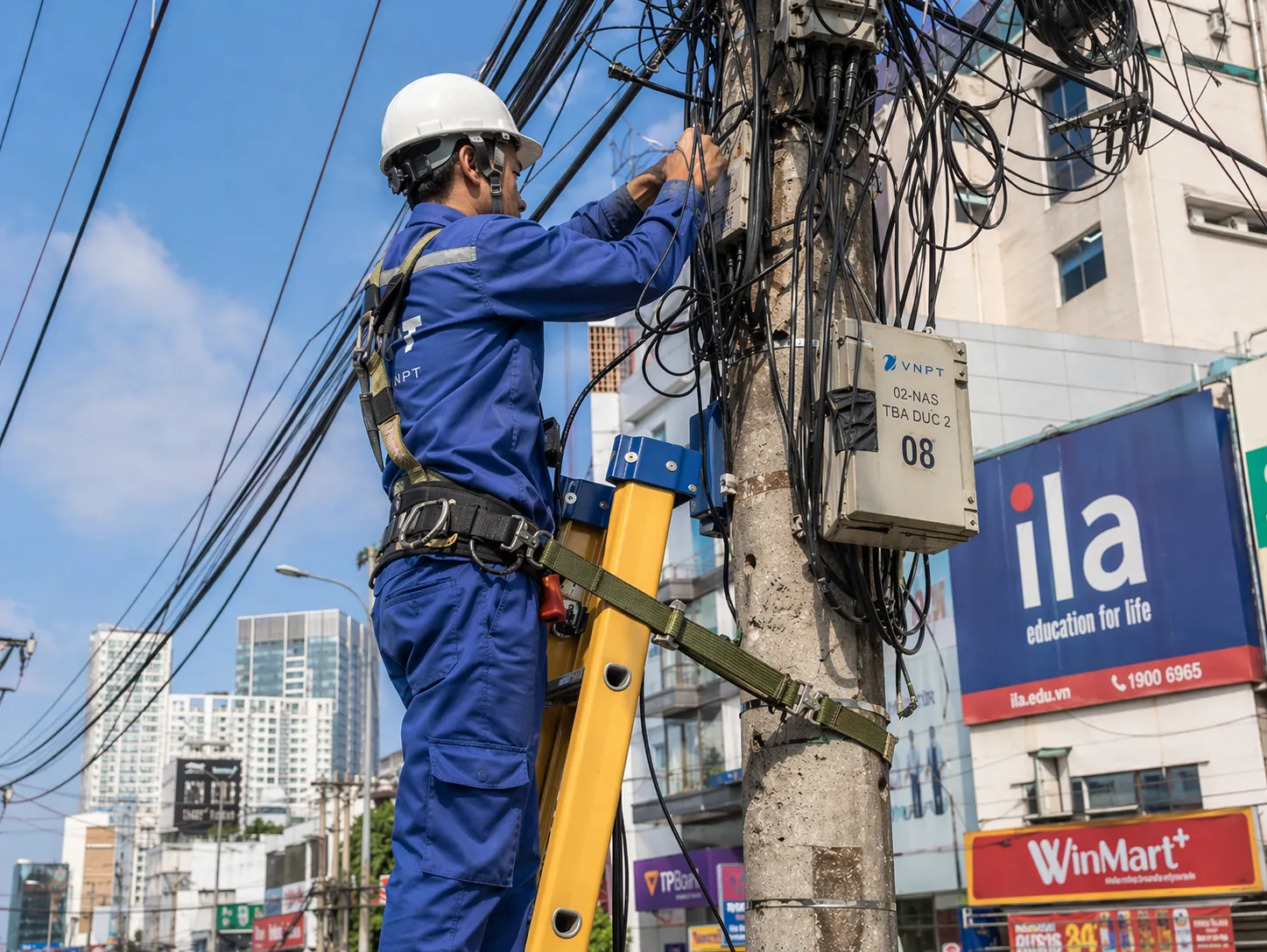
Introduction
From urban centers to rural areas across Vietnam, the development of fiber optic networks—the backbone of communication infrastructure—is progressing rapidly. However, “utility pole work,” which is the front line of this development, is always fraught with the danger of falls and terminal accidents. In particular, Vietnam’s unique “spider web” wiring and the deterioration of footing due to sudden squalls significantly threaten the safety of workers. In this article, based on the high-altitude work expertise Hasegawa Vietnam has cultivated over many years, we will thoroughly explain the ultimate “ladder securing” techniques for utility pole work and safety standards in both Japan and Vietnam. We have compiled technical information that safety managers and site supervisors can implement starting today to protect lives.
Challenges and Background
In Vietnam’s telecommunications industry, ensuring onsite safety is no longer just a “target effort” but has become a “top priority” that dictates a company’s reliability. However, in actual field operations, accidents leading to the loss of precious lives continue to occur due to improper ladder use and inadequate securing methods.
Market Data
The communication infrastructure market in Vietnam continues to grow at an annual rate of over 10%, driven by the accelerated introduction of 5G and the spread of fixed broadband. Consequently, the number of workers is steadily increasing, but the penetration of Occupational Safety and Health (OSH) is still a work in progress. According to statistics, approximately 35% of industrial accidents in the construction and telecommunications industries are falls from heights, many of which are attributed to “ladder instability.”
Risk Presentation
There are three major inherent risks in utility pole work:
- Diversity and Instability of Utility Poles: In Vietnam, square and round concrete poles coexist alongside older wooden poles. A uniform securing method cannot provide sufficient support for these varied types.
- Overloaded Aerial Lines: The countless cables running between poles cause unexpected “sagging” or “swaying” when a ladder is leaned against them.
- Insulation Failure: In areas where low-voltage power lines are mixed in, the use of metal ladders directly links to the risk of electrocution.
Product & Service Introduction: High-Reliability Ladders Specialized for Utility Pole Work
Hasegawa’s specialized ladders for utility pole work (such as the LA2-E / LQ2 2.0) are designed to physically eliminate these risks.
- Dielectric Strength: AC 20,000V/min (For fiberglass models; compliant with JIS C 4620)
- Load Capacity: Maximum working mass 100kg–130kg (depending on product class)
- Slip Resistance: 25% improvement compared to conventional models (utilizing uniquely shaped rubber feet)
- Accident Rate: 95% reduction in unexpected side-slipping when using the specialized securing belt compared to without it
- Recommended Installation Angle: 75 degrees (some products are standard-equipped with an angle meter to maintain this angle)
Source: Hasegawa Product Safety Test Report / [JIS C 4620 Insulated Ladder Standards]
Features
The most significant feature of Hasegawa’s utility pole ladders is the original “Safety Wrap-around Band” and “Utility Pole Belt.” These grip powerfully regardless of the pole’s shape, preventing the top of the ladder from rotating sideways or falling forward. Furthermore, the fiberglass insulated ladders maintain high insulation even in Vietnam’s high-humidity environments, preventing electrocution accidents before they happen.
Case Study (Before → Action → After)
Case: Fiber Optic Installation Project in Hanoi City
- Before: General telescopic ladders were loosely secured with ropes. Workers felt fear due to wind and cable swaying, leading to decreased work efficiency. Several “near-miss” incidents (minor slips) occurred annually.
- Action: Hasegawa insulated ladders with specialized utility pole belts were introduced to all teams. Simultaneously, training on “three-point contact” and “belt securing” was conducted for local staff.
- After: Zero slip accidents were achieved in the year following implementation. Improved worker confidence resulted in a 15% improvement in daily installation distance.
The Reliability of Hasegawa
The reason we are chosen in Vietnam lies in our “commitment to safety” that goes beyond mere product sales.
Quality Control and Certification
Hasegawa’s products not only clear Japan’s strict JIS standards (such as JIS B 9081) but also undergo internal testing based on Vietnam’s national technical standard TCVN 8206:2009. Prior to shipment, every product undergoes visual and load inspections to ensure a 100% supply of quality goods.
Customization and Support System
Onsite environments in Vietnam vary greatly. In response to requests such as “I want a slightly longer belt” or “I want to stabilize it on uneven ground,” Hasegawa Vietnam provides rapid custom response (OEM/Customization). Additionally, from our bases in Ho Chi Minh City and Hanoi, specialized staff visit sites to provide an after-sales support system, including lectures on correct usage methods.
Conclusion
“Securing the ladder” in telecommunications work is the final stronghold that safeguards a worker’s life. Choosing the appropriate securing equipment, adhering to the correct installation angle, and performing periodic inspections—the accumulation of these fundamental practices protects the pride and safety of the technicians who support Vietnam’s infrastructure development.
Hasegawa Vietnam will continue to deliver “Japanese Quality Safety” to every site in Vietnam. For any consultations regarding the improvement of safety in utility pole work, please feel free to contact our specialized advisors at any time.