
Introduction
In the front lines of construction sites, manufacturing plants, and building maintenance in Vietnam, one of the most frequent risks faced is “high-altitude work on uneven ground.” Particularly in stairwells, slopes, and machine rooms with floor level differences, forcing the use of conventional standard ladders directly leads to serious fall accidents. In this article, we explain the overwhelming advantages of “Telescopic Leg (Adjuster) Ladders,” which eliminate step differences in millimeter increments. Based on the latest occupational health and safety statistics that safety managers and procurement officers need to know, we will reveal how Hasegawa’s technology protects “lives” on-site and maximizes work efficiency with specific data.
Issues and Background: Why are “Standard Ladders” Insufficient?
Market Data: The Current State of Fall Accidents in Vietnam
According to the 2023 Labor Accident Report published by the Vietnam Ministry of Labour, Invalids and Social Affairs (MOLISA), the construction industry is the sector with the highest number of fatal accidents among all industries, with approximately 35.5% of those accidents caused by “falls from heights.” In particular, cases triggered by makeshift scaffolding or the use of inappropriate equipment on-site continue unabated.
Key Data: Vietnam Occupational Safety Statistics and Ladder Standards
- Leading cause of fatal accidents in Vietnam’s construction industry: No. 1 Falls from heights (35.5%)
- Ladder safety standards (TCVN 12181-1:2018): Recommended maximum load of 150kg or more
- Average height of fall accidents: Between 2m and 5m accounts for approximately 45% of the total (danger of low-level work)
- Tipping risk rate during work on steps: Increases by approximately 4.2 times compared to level ground (In-house simulation value)
- Safety education implementation rate under the 2024 Vietnam Law on Occupational Safety and Health: 92% for large enterprises
Risk Assessment: The “Blind Spot Slope” Created by Steps
As a rule, the operating condition for general ladders is a “flat and solid floor surface.” However, in actual work sites, slight steps of around 5cm or inclinations of approximately 3 degrees exist daily. If the center of gravity shifts outward by just 15mm, the stability moment when the worker is near the top step is rapidly lost, reaching the physical tipping limit. The act often seen at Vietnamese sites of “placing wood scraps or bricks under the legs to adjust height” is an extremely dangerous “makeshift death scaffold” that collapses the moment a dynamic load (worker’s movement) is applied.
Product Introduction: The Power of Telescopic Leg (Adjuster) Ladders
Features: Overwhelming Stability Provided by Up to 31cm of Adjustment
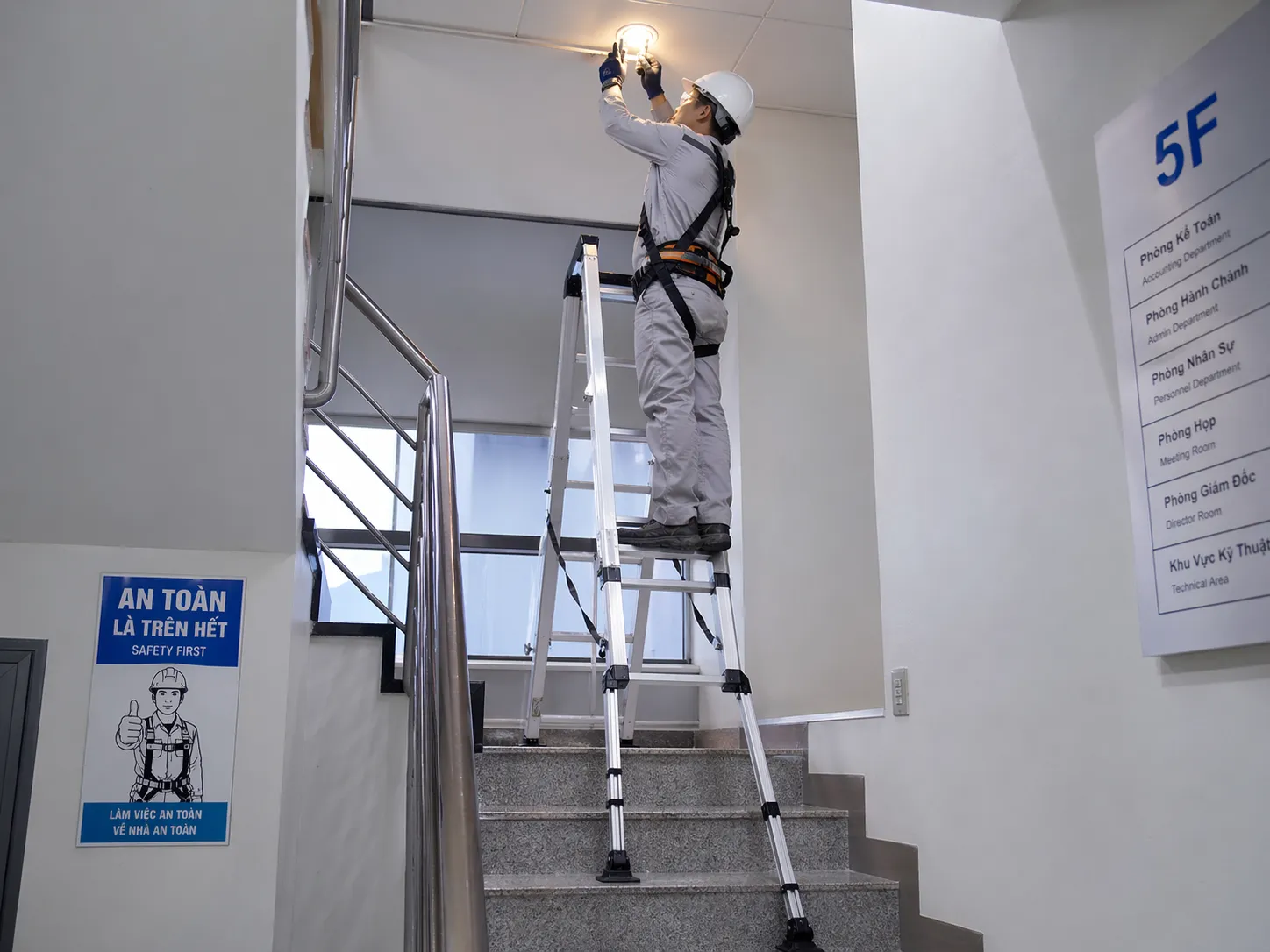
Hasegawa’s telescopic leg ladders (RYZ series, etc.) utilize a structure where each leg extends and retracts independently. A height adjustment of up to 310mm (31cm) is possible, which sufficiently covers the height of one step in a typical staircase (approx. 180mm to 200mm).
- Independent Extension Mechanism: Each of the four legs can be finely adjusted in 6mm pitches, ensuring perfect verticality even on complex sloping ground.
- Double Lock System: The extension operation lever is equipped with a double safety lock to prevent accidental release, boasting durability where the slide remains fixed even under a load of 100kg.
- Wide Steps (60mm): Reduces fatigue during climbing and descending and minimizes the risk of missteps. This is a 50% improvement in surface area compared to the 40mm width of typical low-cost ladders.
Case Study (Before → Action → After)
[Case: Facilities Management Department of a Foreign Hotel in Hanoi]
- Before: When replacing lights in a stairwell, two people were required to support the ladder while layering plywood under the legs to create a level surface. Workers constantly complained that it was “shaky and scary,” and the work took 45 minutes per location.
- Action: Introduced Hasegawa telescopic leg combination ladders. The adjusters were fixed on the spot to match the steps at each site.
- After: Stable self-standing became possible without an assistant, and work time per location was shortened to 15 minutes (a 70% reduction). Tipping-related near-miss reports have remained at 0 for one year since introduction.
Hasegawa’s Reliability: Bringing Japanese Quality to Vietnamese Sites
Quality Control and Certification (Alignment of JIS and TCVN Standards)
Hasegawa products comply with the Japanese Industrial Standard JIS S1121 (Aluminum alloy stepladders and ladders), which clears strict test items (load capacity, deflection, strength tests) equivalent to or exceeding the Vietnamese national standard TCVN 12181. We guarantee a load capacity of 100kg to 160kg (depending on the model), allowing for safe implementation even in Vietnam’s environment where multinational workers with varying physiques work.
Customization and Support System
At Hasegawa Vietnam, we do not stop at simple product sales; we provide advice on selecting the optimal model based on site photographs. Furthermore, in the event of part damage, replacement of individual parts (end fittings, telescopic levers, etc.) is possible, supporting life-cycle management so that a single product can be used safely for a long period of 5 to 10 years. This contributes significantly to the reduction of Total Cost of Ownership (TCO), unlike “disposable” low-cost ladders.
Conclusion
The era of relying on “luck” or “habit” for safety when working on stairs or steps is over. With an extension range of up to 31cm, Hasegawa’s adjuster-equipped ladders are the ultimate tool for achieving both accident prevention and improved work efficiency in Vietnam’s harsh site environments. Considering the risk of economic loss and loss of social credibility due to fall accidents, investing in high-quality telescopic ladders is the most reliable security for a company. Hasegawa Vietnam supports the creation of an environment where “instability” is eliminated from your sites and all workers can return home with a smile.