
Introduction
Ladders are one of the most familiar tools in Vietnam’s manufacturing and construction sites. However, due to this familiarity, the most fundamental safety rule—”do not stand on the top plate (the flat area at the very top of the ladder)”—is often overlooked. Even when a site supervisor warns, “That’s dangerous!”, workers might respond with, “I’m used to it, so I’m fine” or “It’s only for a short time.”
However, standing on the top plate is not merely a breach of etiquette. From a physics perspective, it is an extremely hazardous action that “personally flips the switch for a fall.” In this article, we will provide safety managers and procurement officers with a thorough explanation of why standing on the top plate is prohibited, using scientific evidence such as center of gravity shifts and the base of support, along with numerical data. Guidance based on solid evidence will raise the safety culture of Vietnamese worksites to the next level.
Issues and Background
Market Data
The state of occupational safety in Vietnam is becoming more stringent alongside rapid industrialization. According to statistics from the Vietnam Ministry of Labour, Invalids and Social Affairs (MOLISA), approximately 30% to 35% of fatal occupational accidents are caused by “falls from heights.”
Of particular note is that accidents occur frequently not only at large-scale construction sites but also during routine equipment maintenance and warehouse operations. Referring to data from Japan’s Ministry of Health, Labour and Welfare (Industrial Accident Trend Survey), approximately 45% of falls from ladders and stepladders occur during low-height work of 2 meters or less. In Vietnam as well, a 2024 survey reported over 1,200 cases per year of falls in small-scale manufacturing plants caused by the use of inappropriate climbing equipment, many of which were due to working on top plates or leaning out too far.
Risk Presentation
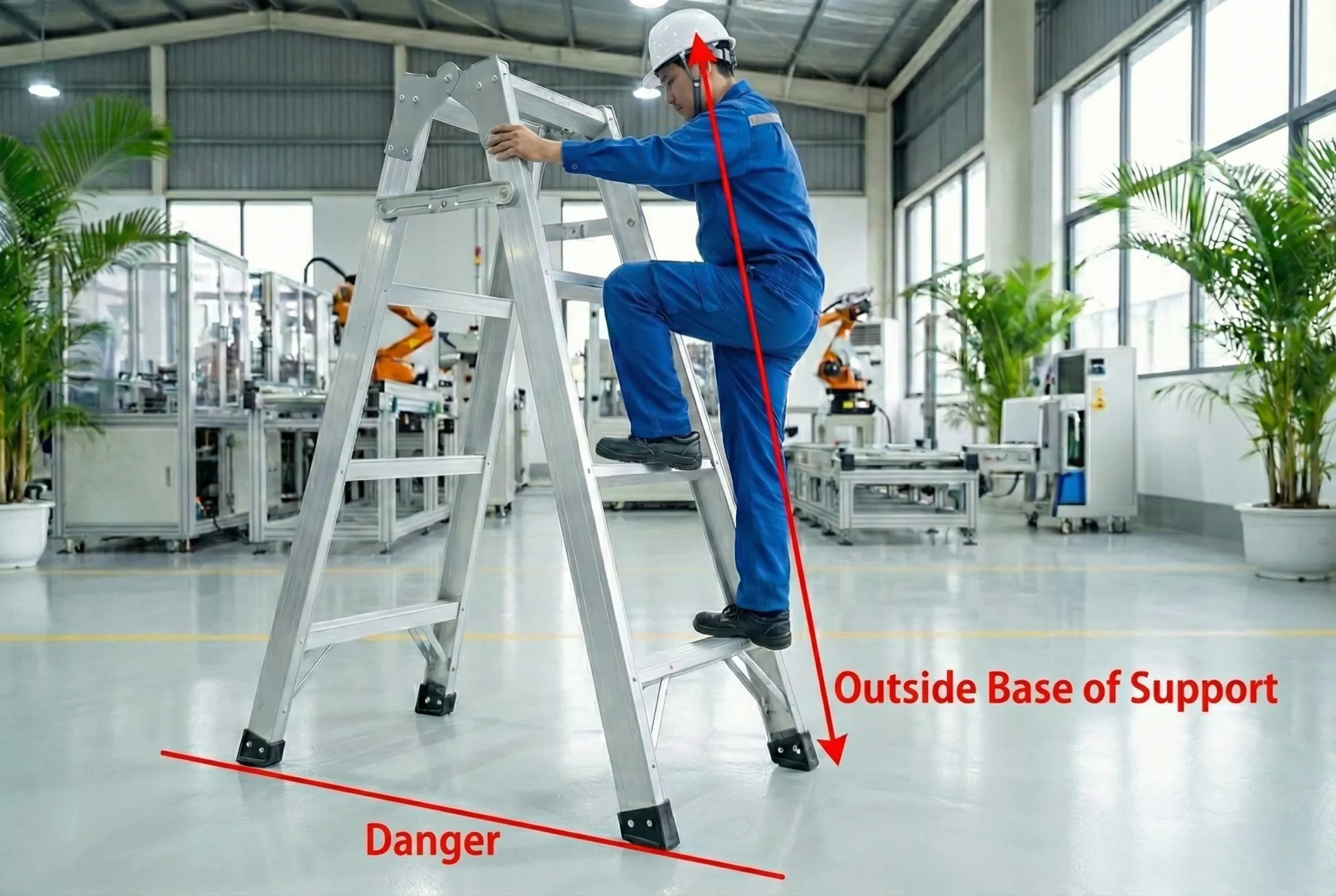
Why is the “top plate” so dangerous? It is because the structure of a ladder is “not designed with the assumption that someone will stand on the top plate.” A ladder creates a stable “A-frame (triangular)” structure when the left and right ladder sections are opened and secured with spreader bars.
However, standing on the top plate causes the following three physical risks to occur simultaneously:
- Extreme rise in the center of gravity: The human center of gravity (around the navel) is positioned far above the apex of the ladder, and even a slight wobble generates a large rotational moment.
- Inability to maintain a stable stance: On the top plate, there is absolutely no “support” around you to use your knees to maintain balance.
- Deviation from the base of support: In physics, the stability of an object is determined by whether the vertical line of the center of gravity stays within the “base of support” (the area between the four points in contact with the ground). When working on the top plate, the center of gravity easily shifts outside this range.
Ladder Safety and Physics: The Story of Gravity
Features
Let’s unravel ladder stability using formulas and theory from a physics perspective.
Whether an object falls is determined by the balance between the restoring moment and the overturning moment. When looking at the ladder from the side, if the contact width with the ground is $L$ and the height of the center of gravity is $h$, the tipping angle $\theta$ is suggested by the following relationship:
$$\tan \theta = \frac{L}{2h}$$
As shown by this formula, the higher the center of gravity $h$, the smaller the angle $\theta$ required to cause a tip-over. In other words, “the higher you climb, the more a slight tilt leads to failure.” Standing on the top plate is an act that maximizes $h$ and minimizes stability.
Key Data: Physical Risk Indicators in Ladder Work
- Incidence of fall accidents (low-height work): Approx. 45% (Estimated combined total for Japan and Vietnam)
- Recommended maximum load during ladder use: 100kg to 130kg (Compliant with JIS S 1121 / TCVN 12108)
- Increase in tip-over risk when working on the top plate: Approx. 3.5 times compared to using normal steps
- Average center of gravity position of a worker: Approx. 1.5m to 1.8m from the ground (when standing on the top plate)
- Average days away from work due to accidents: Approx. 28.5 days (when involving fractures, etc.)
Case Study (Before → Action → After)
[Case: Electronic Components Factory A, near Ho Chi Minh City]
- Before (Issue): Workers frequently stood on the top plate of ladders during lighting replacement and wiring maintenance inside the factory. Despite warnings from the Environmental Health and Safety (EHS) manager, no improvements were made due to reasons like “we’d need another ladder” or “it’s too much trouble,” resulting in three “near-miss” (almost tipping over) incidents per year.
- Action (Countermeasure): Based on Hasegawa’s recommendations, the factory introduced “Ladders with Handrails” and “Work Platforms” that physically prevent standing on the top plate while ensuring stability at heights. Simultaneously, safety training was conducted to visualize “why it is prohibited” based on the physics of the center of gravity.
- After (Effect): For one year following the introduction, ladder-related near-miss incidents were reduced to zero. Workers provided feedback such as, “My legs used to shake before, but having the handrail allows me to work with both hands at ease, and work speed has improved by 1.2 times.”
Hasegawa’s Reliability
Quality Control and Certification
Hasegawa Kogyo products are manufactured according to internal standards that meet or exceed Japan’s JIS standards (JIS S 1121), which are considered the strictest in the world, as well as Vietnam’s national standard TCVN 12108.
Tests for “strength” and “deflection” are particularly thorough, ensuring durability that prevents damage even when subjected to several times the specified load. Even in the hot and humid environment of Vietnam, surface treatments that suppress the corrosion of aluminum alloys are applied, maintaining initial safety performance over a long period.
Customization and Support System
Hasegawa Vietnam does more than just sell products. Our strength also lies in “Customized Solutions” tailored to the conditions of your site.
- On-site Diagnosis: A safety representative will visit your factory to propose the optimal height and type of ladder or platform for your specific tasks.
- Safety Training: We provide workshops that teach basic rules, such as “do not stand on the top plate,” through physical demonstrations.
- Local Inventory: With logistics hubs within Vietnam, we promptly deliver safe products whenever they are needed.
Conclusion
Standing on the top plate of a ladder is an act of creating an “extremely unstable state” from a physics perspective. Because the center of gravity becomes high and easily shifts out of the base of support, it is impossible to correct your balance once it is lost.
To protect precious employees working at Vietnamese sites, more than just warnings are needed; hardware-based measures, such as “choosing ladders of a height that eliminates the need to stand on the top plate” and “introducing products with structures that prevent standing on the top plate,” along with education based on the scientific evidence explained in this article, are essential.
Hasegawa Vietnam strongly backs your company’s goal of achieving “zero industrial accidents” with high-quality products and specialized knowledge. A safe working environment is the first step toward improving productivity.
Contact Us: If you would like help choosing a safe ladder or wish to have an on-site safety diagnosis, please feel free to contact Hasegawa Vietnam.