
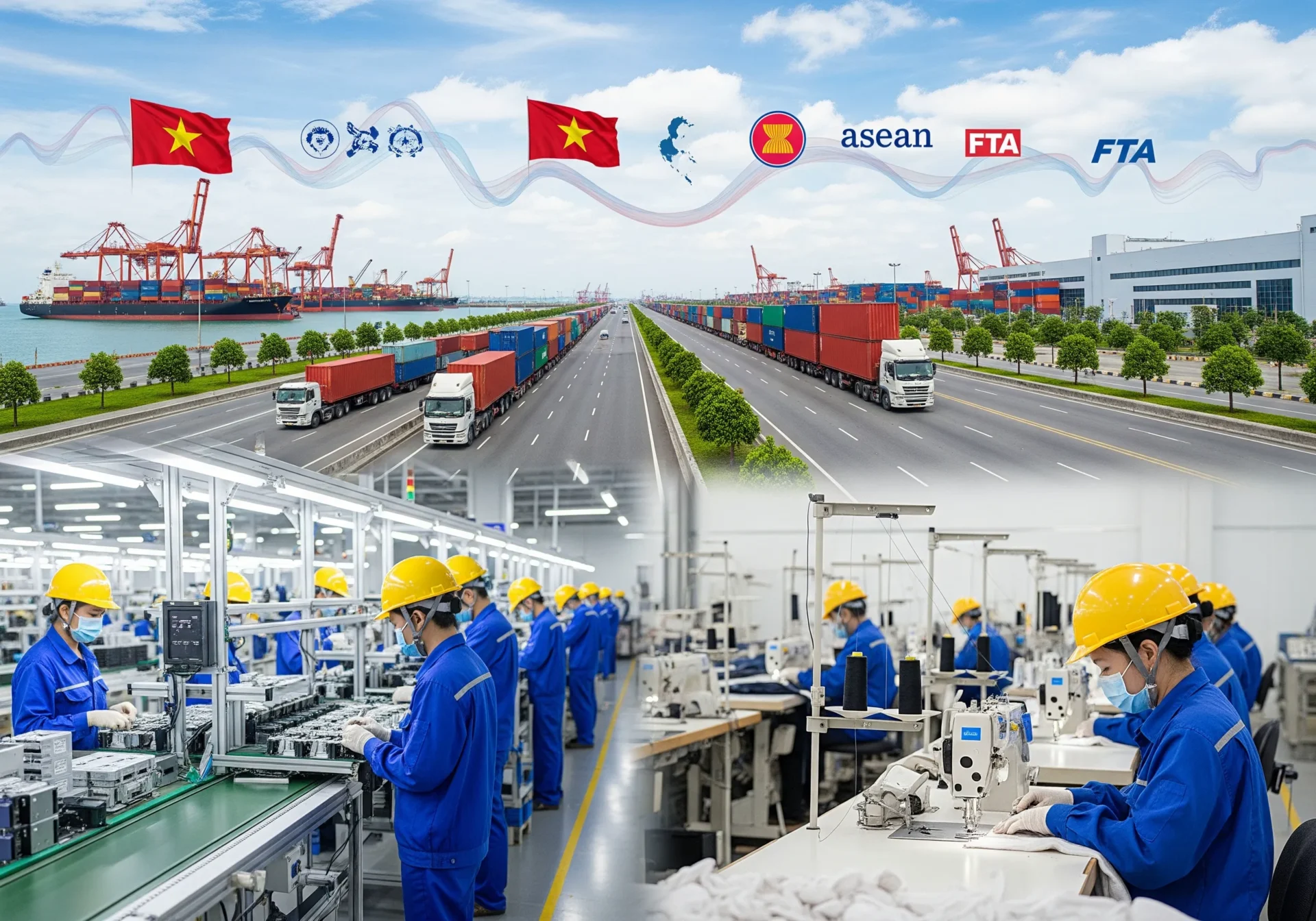
Introduction | Why a Manufacturing Base in Vietnam Now?
Against the backdrop of a post-pandemic recovery and rising geopolitical risks, the global economy is undergoing a rapid reorganization of supply chains. The “China Plus One” strategy, aimed at diversifying risks away from dependency on China, has become a critical option for manufacturers worldwide. Within this context, Vietnam is gaining attention as a new manufacturing hub that combines geographical advantages, political stability, and cost competitiveness. Furthermore, its expanding network of Free Trade Agreements (FTAs) and developing logistics infrastructure are strengthening its access to global markets.
This article is intended for executives, heads of overseas operations, and manufacturing managers. It explains the merits, practical processes, and key considerations for establishing a manufacturing base in Vietnam, using primary data. The goal is not to offer mere theory or promotion, but to provide field-based knowledge to improve the accuracy of investment decisions.
Background of Vietnam’s Manufacturing Growth and Investment Environment
Economic Foundation Supporting High Growth
In 2024, Vietnam’s economy recorded a GDP growth rate of 5.7%, with the manufacturing value-added growth rate remaining strong at 6% (World Bank, GSO). The expansion of export industries, particularly electronics, textiles, and furniture, has been a key driver of this growth, with exports to the US and EU increasing by double digits from the previous year. Additionally, advancing urbanization and an expanding middle class are boosting domestic demand, leading to a surge in demand for durable consumer goods and services. With nearly half of its 100 million people under the age of 35, Vietnam’s young population is a strength for both its labor supply and consumer market.
Government Investment Incentives and Deregulation of Foreign Investment
The Vietnamese government has positioned attracting foreign investment as a national strategy, implementing measures such as corporate tax reductions (exemption for up to 4 years + 50% reduction for 9 years), preferential treatment in special economic zones and industrial parks, and reductions in land use fees. In January 2024, the Economic Needs Test (ENT), which had hindered the expansion of retail and service businesses, was abolished. The range of industries allowing 100% foreign ownership has also been expanded to include manufacturing, IT, logistics, and education. This allows multinational corporations to develop their businesses with greater freedom, and this trend of deregulation is expected to continue.
The Appeal of Vietnam as a Manufacturing Base
High Cost Competitiveness
As of 2024, the average wage in Vietnam’s manufacturing sector is approximately 320 USD, which is about one-third of that in China’s coastal areas and lower than in Thailand or Malaysia. This low-cost structure directly contributes to higher profit margins for manufacturing businesses. Furthermore, electricity tariffs and port usage fees are also competitive compared to neighboring countries, providing an advantage in terms of infrastructure costs. Industrial parks feature stabilized power supplies and dedicated logistics services, and high transport efficiency supports companies’ production planning.
Abundant and Young Workforce
With nearly half of the population under 35, the labor supply is stable. Many young people have graduated from technical vocational schools and universities, providing a rich pool of talent with the skills needed in the manufacturing and IT sectors. The government and international organizations are strengthening vocational training and skills certification systems, and skills training programs specifically for Japanese companies are also on the rise. This makes it possible to secure a highly adaptable workforce in a short period.
Geographical Advantage and Access to Export Markets
Vietnam is geographically close to Southern China and major ASEAN countries, allowing for short transit times by land, sea, and air. By leveraging numerous FTAs such as the EU-Vietnam Free Trade Agreement (EVFTA), the Comprehensive and Progressive Agreement for Trans-Pacific Partnership (CPTPP), and the Regional Comprehensive Economic Partnership (RCEP), businesses can benefit from tariff reductions and expedited customs clearance. Major ports like Hai Phong, Cai Mep-Thi Vai, and Da Nang are being expanded, and the development of airports and high-speed railways is also underway. This establishes a system for efficiently supplying products to the global market.
Practical Steps and Considerations for Establishing a Base
Criteria for Selecting Industrial Parks and Locations
The success of a manufacturing base is heavily dependent on its location. Hanoi, the center of the northern economic zone, has the advantage of proximity to the Chinese border and a concentration of electronics and automotive parts industries. Ho Chi Minh City, the largest commercial city in the south, has well-developed ports and logistics networks, attracting a wide range of industries such as textiles and food processing. Da Nang, an emerging hub in the central region, offers cost advantages and the appeal of proximity to both a port and an airport. When selecting a location, it is necessary to comprehensively evaluate infrastructure connectivity, distance to major suppliers and customers, and the local talent supply.
Establishment Procedures and Legal Compliance
Company establishment requires obtaining an Investment Registration Certificate (IRC) and an Enterprise Registration Certificate (ERC), a process that typically takes 1 to 3 months. After registration, procedures such as tax registration, social insurance registration, and opening a bank account follow. In addition, it is essential to understand and comply with multiple legal regulations, including Environmental Impact Assessments (EIA), labor contract compliance, minimum wage and overtime regulations, and the application of corporate income tax and value-added tax. Utilizing local law firms and consultants can help prevent delays and errors in these procedures.
Equipment Installation and Talent Acquisition
Production equipment costs and delivery times can be optimized by combining local procurement with imports. A quality management system should be established from the design stage, aiming for international certifications like ISO 9001 to ensure reliability. For talent acquisition, local hiring should be the foundation, with a focus on balancing corporate culture and skills through introductory training and on-the-job training (OJT). It is particularly important to place personnel fluent in Japanese or English in management positions to ensure smooth communication between the local site and headquarters.
Risks and Countermeasures
Risk of Delivery Delays and Logistics Congestion
In Vietnam, delivery delays can occur due to congestion at ports and customs, as well as seasonal increases in shipping volumes. To prevent this, it is important to secure multiple suppliers for key components and to establish multiple transportation routes (land, sea, and air) in advance. The flexibility to switch transportation modes in an emergency is key to meeting deadlines.
Ensuring Quality and Stabilizing Production
Inconsistent quality and unstable production lines can lead to a loss of customer trust. It is crucial to pursue international certifications like ISO 9001 and ISO 14001 and conduct regular on-site audits to ensure adherence to standard operating procedures. It is also effective to digitize process management and inspection processes to monitor quality data in real-time.
Preparing for Policy Changes and Currency Fluctuations
Vietnam’s tax and labor laws may be revised every few years, and the currency fluctuates against the US dollar and Japanese yen. Long-term contracts should include price adjustment clauses, and currency risks should be managed with forward contracts or natural hedges. Furthermore, it is essential to build a network with local chambers of commerce and industry associations to create a system for quickly grasping policy changes and market trends.
Conclusion | For a Successful Vietnam Base Strategy
Vietnam is a manufacturing base candidate with four key strengths: a high-growth economy, cost competitiveness, an abundant workforce, and an export advantage through FTAs. However, risks such as logistics congestion and policy changes also exist, making advance preparation and flexible countermeasures essential. The decision to expand should not be based solely on short-term cost comparisons but from the perspective of medium- to long-term market expansion and supply chain enhancement.
As a next step, businesses should first conduct local market research to consider multiple optimal location candidates. Additionally, a site visit to confirm the infrastructure, labor environment, and potential partners, along with building a reliable support network for legal, accounting, and recruitment matters, will be the shortest path to success.