
Introduction | For Everyone Unsure About Ladders vs. Stepladders
Ladders and stepladders are often confused because they look similar, making it difficult to decide “which one to choose.” However, misusing them significantly increases the risk of falls, and numerous industrial accident cases have been reported in both Japan and Vietnam. This article is for construction site managers, safety officers, and purchasing managers, as well as home users who perform work at height. We will clarify the definitions and structural differences between ladders and stepladders and explain how to choose the right one for each purpose. We will also cover safety standards such as JIS, ISO, and Vietnamese regulations, introducing practical safety tips.
Challenges and Context Regarding the Difference Between Ladders and Stepladders
Ladder and Stepladder Usage Status Based on Market Data
In Japan and Vietnam, thousands of accidents occur annually while working at height using ladders and stepladders. According to a survey by Japan’s National Institute of Technology and Evaluation (NITE), there are over 3,000 accidents related to stepladders and ladders each year, with more than 60% being falls. Similarly, statistics from the Vietnamese Department of Labor report that falls from height account for approximately 55% of all industrial accidents. In terms of demand, the market is expanding widely, from small household step stools to telescopic ladders used on construction sites, with a particularly notable increase in demand in logistics warehouses and manufacturing plants.
Risks Caused by the Difference Between Ladders and Stepladders
Ladders and stepladders have different structures, and misusing them can lead to serious accidents. For example, a ladder cannot stand on its own and must be leaned against a wall, but if the angle is incorrect, there is a risk of it falling backward. A stepladder can stand on its own, but standing on the top platform is unstable and highly dangerous, leading to falls. Furthermore, using either on uneven ground can cause them to slip and lead to a loss of balance. Without understanding these differences, you face not only reduced work efficiency but also significant safety risks.
The Basic Differences and Selection Tips for Ladders and Stepladders
Features and Comparison Points of Ladders and Stepladders
When selecting a ladder or stepladder, the key is to choose the type and size based on “where, who, and what you are doing.”
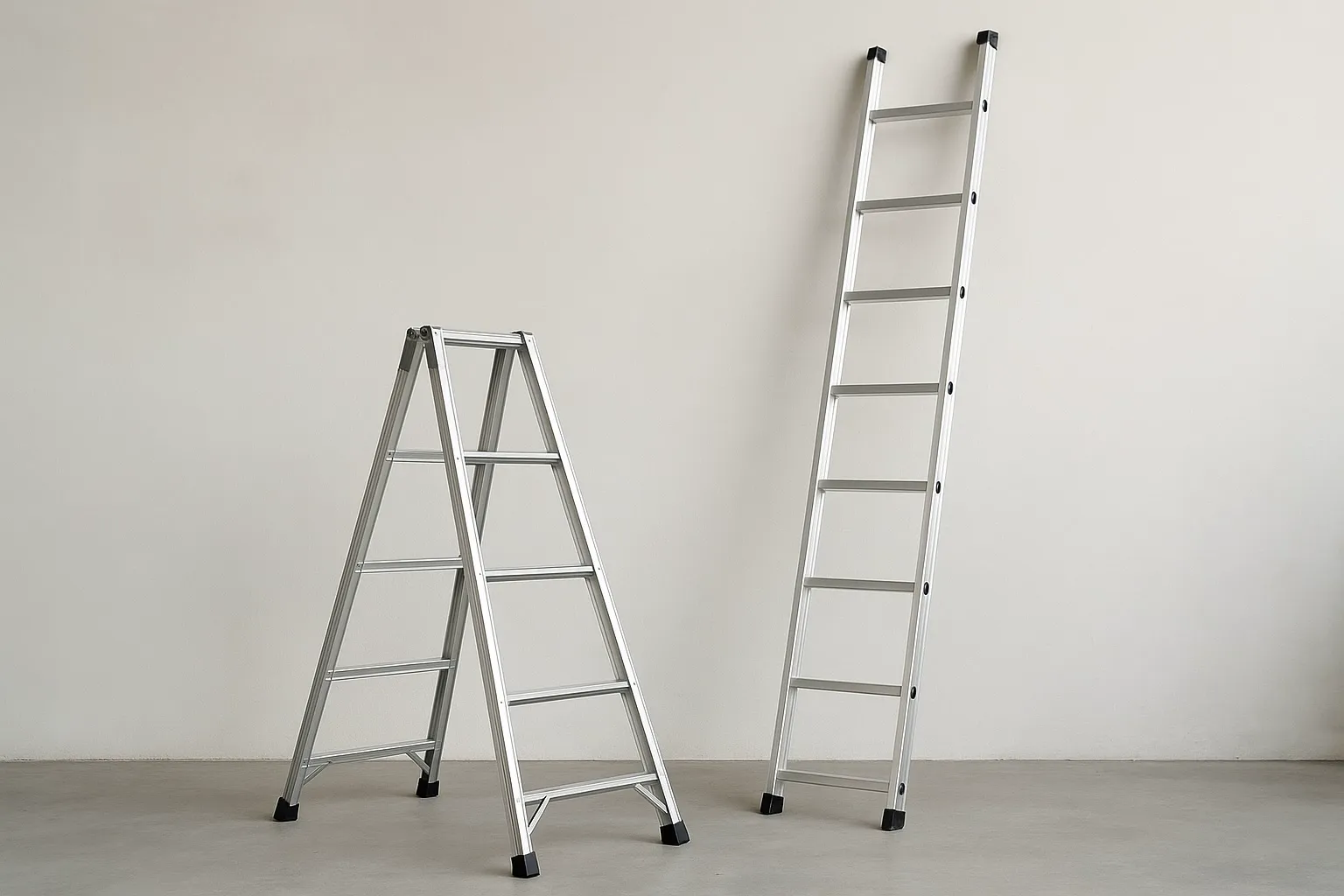
A ladder is a tool with two side rails and rungs at regular intervals, used by leaning it against a wall. It cannot stand on its own, but it can access heights that a stepladder cannot. A stepladder, on the other hand, has a self-supporting structure with four legs and can be used for elevated work even without a wall. However, standing on the top platform is considered dangerous. In terms of materials, there are options to suit the purpose, such as FRP (fiber-reinforced plastic) ladders for electrical work, and lightweight aluminum stepladders for easy portability. In workplaces where efficiency is a priority, the use of stable work platforms is also increasing.
Here is an example of a comparison by use case:
- Home use: Telescopic ladders and lightweight stepladders for easy storage
- Logistics warehouse: Stable work platforms and large stepladders
- Construction site: FRP ladders and stepladders for high-altitude work
Effects and Improvements Seen in Case Studies
- Construction site: Risk of accidents due to ladder misuse → Improved by introducing stepladders, reducing accident cases in conjunction with harness use.
- Logistics warehouse: Reduced work efficiency from using step stools → Improved efficiency and safety by introducing work platforms with a wide top platform.
- Home use: Long ladders difficult to store → Solved with a compact, foldable telescopic FRP ladder.
The Reliability of Hasegawa Products
Safety Through Quality Control and International Certifications
Hasegawa develops products that comply with JIS, ISO, and even Vietnamese national standards (TCVN), meeting internationally recognized safety criteria. Products that have acquired the SG Mark and A Mark, in particular, are highly trusted for their strength, stability, and durability. Furthermore, we have in-house testing facilities to conduct tens of thousands of opening/closing and load tests, ensuring quality that can be used with confidence on any job site.
Custom Orders and Local Support System
In addition to standard products, we also handle the design of custom stepladders and ladders tailored to the site environment and work content. For example, we can provide slim stepladders for narrow spaces and insulated FRP ladders for electrical work, catering to various demands. Furthermore, we have a local support system through our Vietnamese subsidiary, ensuring prompt response for post-sale services like regular inspections and parts replacement. This provides support for safe and efficient long-term use.
Data Box
| Metric | Japan | Vietnam | Source |
|---|---|---|---|
| Annual accidents from elevated work | Approx. 3,000 cases | Approx. 2,200 cases | NITE Product Safety Center / VN MOLISA Labor Statistics |
| Percentage of fall accidents | Over 60% | 55% | NITE Product Safety Center Report / VN OSH Report |
| Stepladder height classification | 0.8 to 4m | Equivalent | JIS S1121 / TCVN 5864:1995 |
| Start height for harness obligation | 2m or more | 2m or more | Industrial Safety and Health Act (Japan MHLW) / Decree 138/2020/NĐ-CP |
| International Standards | ISO 14122-4 | ISO 14122-4 | ISO Official Website |
Summary
The difference between a ladder and a stepladder lies in their “self-supporting ability” and “reachable height.” By choosing the appropriate tool for each task, you can reduce the risk of accidents and increase work efficiency. As the market data and accident statistics presented in this article show, misuse can lead to serious falls. Therefore, when considering a purchase, be sure to check the safety standards (JIS/ISO/TCVN) and Vietnamese labor safety regulations.