
Introduction
With the rapid development of the manufacturing, construction, and logistics industries in Vietnam, on-site “safety management” has become a top priority for companies. In particular, fall accidents during work at height still account for a high percentage of occupational accidents, many of which are caused by the incorrect use of “ladders” and “stepladders”.
Safety managers and purchasing personnel on-site may be scratching their heads, wondering, “Why aren’t accidents decreasing even though we conduct safety training?” The cause often lies in complex, text-only manuals and a “list of prohibitions” that are not intuitively understood by on-site workers.
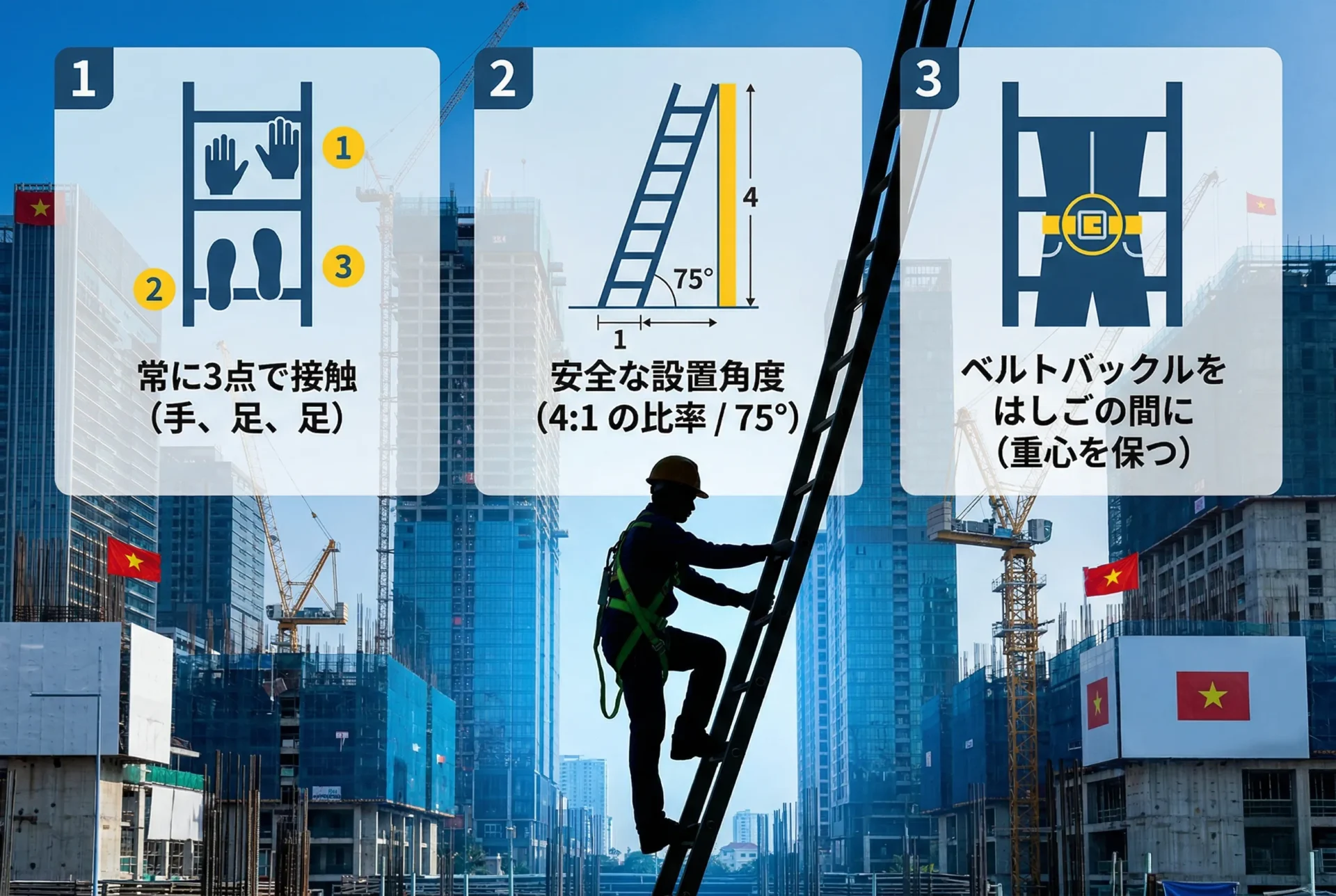
In this article, we explain the “5 Rules to Reduce Misuse” advocated by Hasegawa Vietnam. By introducing highly visual and memorable specific safety standards to the workplace—such as the “3-Point Contact,” “4-to-1 Rule,” and “Belt Buckle Rule” recommended by OSHA (Occupational Safety and Health Administration) and Japan’s Ministry of Health, Labour and Welfare—we provide practical know-how to drastically reduce human error and protect workers’ lives as well as corporate trust.
Challenges and Background
Market Data
In occupational accidents, falls from ladders and stepladders often occur due to the careless assumption that “it’s low, so it’s safe,” resulting in an endless number of cases leading to serious aftereffects or fatal accidents. Comparing the latest occupational accident statistics from Vietnam and Japan reveals that this is a universal problem that crosses borders.
The data box below shows real figures for fall accidents based on primary information released by public institutions in both countries.
Key Data: Statistics on Occupational Accidents and Falls in Japan and Vietnam
- Indicator 1: The number of occupational accidents nationwide in Vietnam in 2024 was approximately 8,286 (Source: MOLISA)
- Indicator 2: Of the above, falls from height accounted for approximately 26% (Source: MOLISA)
- Indicator 3: The number of casualties due to falls in Japan in 2024 was approximately 20,699 (Source: Ministry of Health, Labour and Welfare)
- Indicator 4: Of the fall accidents in Japan, those caused by ladders and stepladders accounted for approximately 18% (Source: Ministry of Health, Labour and Welfare)
- Indicator 5: Even falls from “low heights” of less than 2.0 meters account for about 35% of fatal accidents (Source: National Institute of Occupational Safety and Health, Japan)
Risk Presentation
Under occupational safety and health regulations, a height of 2.0 meters or more is generally defined as “work at height,” and wearing a safety belt (fall arrest equipment) is mandatory. However, many stepladders and ladders frequently used on-site are around 1.0 to 1.5 meters high. This “in-between height” is the biggest factor that diminishes workers’ vigilance.
If a human falls onto a concrete floor from a height of 1.5 meters, the speed at which the head strikes the floor reaches about 22 km/h. This is an impact more than sufficient to cause skull fractures or brain contusions if a protective helmet is not worn.
Furthermore, looking at the root causes of accidents, human error (mistakes due to human carelessness or illusions) caused by “habituation” overwhelmingly outnumbers equipment defects. Routine risky behaviors (the normalization of disregarding safety)—such as “I can reach it if I stretch a little” or “It’s faster to climb while carrying the load”—can suddenly lead to paying a fatal price one day. That is precisely why “clear criteria that anyone on site can judge visually” are necessary.
Product & Service Introduction
Features
Hasegawa Vietnam promotes the spread of the following “5 Rules” as software (safety education) to maximize hardware performance, going beyond simply providing high-quality access equipment. These act as fail-safes (mechanisms that operate safely even in the event of an operational error) allowing workers to objectively view their own posture and prevent danger before it happens.
Rule 1: 3-Point Contact (Always maintain three points of contact with hands and feet)
This is the most fundamental international safety standard when ascending or descending a ladder. The rule dictates that out of a human’s four limbs (two hands and two feet), three points—either “both feet and one hand” or “both hands and one foot”—must be securely in contact with the ladder’s rungs (steps) or rails at all times. This ensures that even if one point slips, the remaining three points can support the body’s center of gravity and prevent a fall.
Rule 2: 4-to-1 Rule (The golden ratio of a 75-degree setup angle)
This is the rule regarding the setup angle when using a leaning ladder. The ladder should be set up at a ratio where the height to the point of contact on the wall is “4”, and the distance from the base of the wall to the feet of the ladder is “1”. For example, when resting a ladder at a height of 4.0 meters, the feet should be placed 1.0 meter away from the wall. This ratio mechanically stabilizes the ladder at an angle of approximately 75 degrees. If the angle is shallower, the feet are prone to slipping (slip out), and if it is too steep, the risk of falling backward (tipping over) increases.
Rule 3: Belt Buckle Rule (Keep your center of gravity between the rails)
This rule prevents tipping over caused by “leaning out” during work. You must be conscious to always keep your workwear belt buckle (or navel) within the two rails of the ladder or stepladder. Since the human center of gravity is around the navel, if you reach out so far that the buckle goes outside the rails (more than about 30 cm left or right), the overall center of gravity falls outside the base of support, causing the stepladder to tip over sideways. If you cannot reach, the iron rule is to not cut corners, but to step down and move the stepladder.
Rule 4: Never Stand on the Top Step
The flat board at the very top of a stepladder (top step) is a space for placing tools, not for people to stand on. Standing on the top step removes any structure to support your knees or shins, and a slight loss of balance will result in a fall. To work safely, you must always stand on a rung that is the second step from the top (about 60 cm from the top) or lower, and stabilize your body by resting your shins against the step above.
Rule 5: Principle of Free Hands (No hoisting loads while climbing)
This rule prohibits moving while holding tools or materials in one hand when ascending or descending a ladder. Breaking this rule makes the aforementioned “3-Point Contact” physically impossible. Necessary tools should be stored in a dedicated tool belt, or pulled up later using a rope (hoisting). It is also important to understand that a ladder’s maximum load capacity (typically 100 kg for general products, 130 kg for professional use) means “the worker’s weight + the total weight of the equipment and tools being worn.”
Case Study
At a large foreign-affiliated logistics warehouse (with approximately 500 employees) in Binh Duong Province in southern Vietnam, minor fall accidents from stepladders during routine picking operations were occurring 3 to 5 times a year.
Before:
The conventional safety manual was written in lengthy Vietnamese and was not sufficiently read by the on-site workers. To “finish the work quickly,” risky behaviors were rampant, such as standing on the top step and retrieving goods in unnatural postures.
Action:
Simultaneously with product delivery, Hasegawa Vietnam posted “5 Rules” posters heavily utilizing illustrations and pictograms at various locations throughout the site. Furthermore, we conducted a total of 5 hours of “Visual Safety Training” for site supervisors, establishing a clear common language: “If the belt buckle goes out, you’re out.”
After:
For the year from the implementation of the training to the present, fall accidents related to stepladders have dropped to absolute zero (a 100% reduction). In addition, working in unnatural postures decreased, and the procedure for properly moving stepladders was strictly enforced. As an unexpected byproduct, worker fatigue was reduced, resulting in an approximately 15% increase in picking efficiency.
Hasegawa’s Reliability
Quality Control and Certification
No matter how thoroughly excellent safety rules are enforced, accidents cannot be prevented if the strength of the equipment itself is insufficient. Hasegawa (Hasegawa Kogyo) is a top manufacturer of stepladders and ladders with over 60 years of history in Japan.
The professional-use products we deploy in the Vietnamese market clear Japan’s strict JIS (Japanese Industrial Standards: JIS S 1121, etc.) and SG Mark (Consumer Product Safety Association) standards, or undergo equivalent quality inspections. For example, for products guaranteeing a maximum load capacity of 130 kg, we conduct static load tests applying several times that weight, as well as grueling fatigue tests (cyclic testing) applying continuous loads to the rungs over 30,000 times at our own factories, proving durability that can withstand hard use on-site.
Customization and Support System
To meet the diverse on-site environments in Vietnam, Hasegawa Vietnam not only sells off-the-shelf products but also accepts custom orders (made-to-order) tailored to site requirements. For example, for factories with complex, intertwined piping, we can design and manufacture custom work platforms and scaffolding whose height can be adjusted in millimeter increments (5 mm pitch).
Additionally, our post-delivery support system is fully equipped. Bilingual staff fluent in Vietnamese and Japanese are stationed permanently, directly providing multilingual manuals on proper product usage and conducting demonstrations and safety training support for local workers. Overcoming language barriers, we have earned high praise from many Japanese and local companies as a partner in firmly rooting Japanese “safety quality” in Vietnamese workplaces.
Conclusion
Fall accidents during work at height are by no means “unavoidable bad luck.” The dangers lurking on-site can be reliably prevented by strictly enforcing 5 visual rules: “3-Point Contact,” “4-to-1 Rule,” “Belt Buckle Rule,” “No Standing on Top Step,” and “Free Hands.”
However, a safe workplace environment is not completed by rules alone. True occupational safety and health is established only when the two wheels of “rules that workers can intuitively follow” and “reliable equipment that absolutely will not break or slip” are aligned.
Hasegawa Vietnam strongly backs up your company’s efforts toward zero occupational accidents through our access equipment, which boasts overwhelming quality, and our safety education support from the perspective of the site. If you feel even the slightest concern about your current scaffolding environment or safety measures, please feel free to contact Hasegawa Vietnam. Our expert staff will listen to your on-site challenges and propose the optimal products and safety solutions.