
Introduction
Have you ever faced a situation after the morning assembly at a construction or manufacturing site in Vietnam where you think, “Huh? The ladder that was supposed to be here yesterday is gone”? This “mysterious disappearance,” which many site supervisors experience at least once, is not simply a loss of goods. It is a serious incident that simultaneously steals corporate profits and site safety.
According to one survey, theft damage of equipment and tools in the construction industry is on the rise globally, with total damages estimated to reach hundreds of millions of dollars annually. Particularly in rapidly growing markets like Vietnam, the demand for materials is increasing along with the construction rush, and the risk of theft for resale purposes is constantly present.
Hasegawa ladders are trusted as “partners on the job site” due to their high safety and durability, but at the same time, because of their high asset value, they can become targets for theft if not managed properly. In this article, we will explain practical “techniques to protect your tools of the trade,” combining physical measures and operational rules, rather than just abstract theory. Let’s prevent wasteful cost outflows with measures you can start today.
Challenges and Background: Why are ladders targeted at sites?
The Reality of Theft at Construction Sites and Market Background
Theft at construction sites and factories is never a problem that can be dismissed as just “bad luck.” According to reports from Western construction-related associations (such as CIOB), more than 50% of theft damage in the construction industry is attributed to security flaws or lack of management at the site. In Vietnam as well, at sites around Ho Chi Minh City and Hanoi where urban development is progressing, it is often difficult to track who took what because an unspecified number of workers and contractors come and go.
A particular reason why stepladders and ladders are targeted is the “soaring price of aluminum raw materials.” Looking at past data from the London Metal Exchange (LME), aluminum prices often hover at high levels while fluctuating, making it a material with very high resale value as scrap. Ironically, Hasegawa products using high-quality aluminum alloys have high material value, making them prime targets at sites with low crime prevention awareness.
Also, the “low recovery rate” after a theft occurs is serious. It is generally said that the probability of stolen tools or equipment returning to the owner is less than 10%. This is because many pieces of equipment do not have individual identification numbers (serial numbers, etc.) clearly specified, making it difficult to prove ownership.
Risk Presentation: The “Invisible Costs” Caused by Theft
If one ladder is stolen, the damage amount is not just the “purchase price of the ladder.” What you should truly fear are the following two “invisible costs.”
- Downtime (Work Stoppage) Cost If there is no ladder of the necessary height for the work, the work stops until alternative equipment is arranged. For example, if a one-hour work delay stops the hands of five workers, the labor costs and overtime pay to recover the schedule delay will easily exceed the price of one ladder. Some estimates suggest that indirect losses due to lost equipment can swell to 3 to 5 times the direct replacement cost.
- Safety Risk due to Lowered Safety This is the most serious risk. Suppose a genuine Hasegawa ladder is stolen, and as a stopgap measure, a cheap or unidentified used ladder is purchased from a street stall or recycle shop. What happens if that ladder is distorted or wobbly? In labor accident statistics, falls and tumbling accidents always occupy the top ranks. Using alternative products of uncertain quality is nothing less than an act that puts workers’ lives at risk.
Doable from Tomorrow! Ladder & Tool “Management and Crime Prevention Techniques”
So, specifically, how can you protect your precious assets? Here, we will introduce techniques that can be immediately introduced at sites in Vietnam from three perspectives: “Physical Measures,” “Operational Rules,” and “Education/Culture.”
Physical Measures: Don’t Let Them Take It, Don’t Let Them Resell It
The basis is to physically create a state where it is “difficult to steal” and “difficult to resell.”
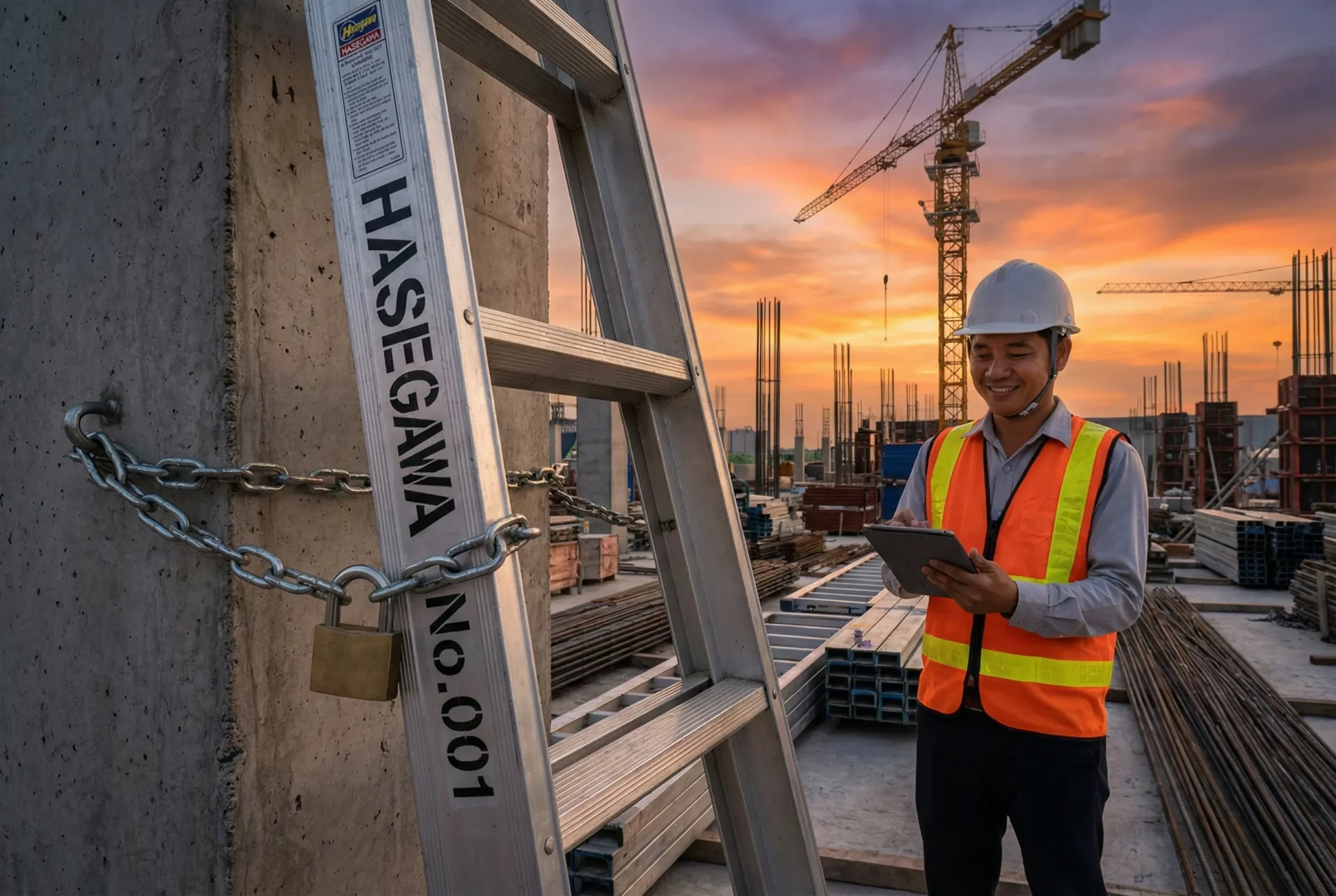
- Thorough “Fixed Location Management” and Chain Locks “Returning it to its original place after use” is basic, but take it a step further and “fix” it. Always provide an anchor point at the storage area and lock multiple ladders together with a chain or wire. A hardened chain with a diameter of 8mm to 10mm or more takes time to cut with general bolt clippers, serving as a powerful deterrent to thieves.
- Visual Deterrence: Painting Company Colors and Management Numbers Paint your company logo or name largely on the stiles (frames) or treads of Hasegawa ladders. Even more important is the “Management Number (ID).” Write unique numbers like “H-001” or “H-002” largely with industrial paint markers or sprays that are hard to erase. Criminals aiming for resale hate “being traced.” Ladders with characteristic markings that are instantly recognizable as “Property of XX Construction” risk being refused purchase by scrap dealers or the second-hand market, making them more likely to be excluded from theft targets. In fact, there are voices from the field saying that the theft rate of equipment with conspicuous painting is about 30% to 40% lower** compared to unpainted ones.
Operational Rules: Preventing Human Error and Moments of Temptation
Physical measures alone are not enough. As long as things are moved by people, measures in management rules (software side) are essential.
- Introduction of “Lending Management Registers” and Thorough Analog Operation Although digitization is progressing, paper “Lending Management Registers” are still effective at sites.
- Date and time of lending
- Name of the person taking it out (Signature)
- Management Number (e.g., H-001)
- Scheduled return time. Record these and enforce the flow of “Write in front of the manager when borrowing” and “Cross out in front of the manager when returning.” This psychological pressure of “being watched” prevents internal crime and loose management like “borrowing it for a bit and leaving it there.”
- “Physical Verification” at Morning and Evening Assemblies At the end of every day, always count whether the inventory in the management register matches the actual number of ladders in the storage area. From the perspective of asset management in ISO 9001 (Quality Management System), this daily check is important. If a loss is discovered, within 24 hours, the probability of finding it left somewhere on the site increases, but if several days pass, the discovery rate drops significantly.
The Deep Relationship Between Organization (5S) and Crime Prevention
“5S (Sort, Set in order, Shine, Standardize, Sustain),” which Japan’s manufacturing and construction industries boast to the world, is actually the strongest crime prevention measure. In a site where organization is thorough and all tools and ladders are lined up in an orderly manner, the abnormality of “one missing” is immediately apparent. Conversely, in a site where things are scattered, no one notices if one ladder is gone. As the “Broken Windows Theory” suggests, in places where the environment is disordered, discipline is also disordered, and minor crimes are more likely to occur. Storing Hasegawa products beautifully aligned leads to raising the morale of the site and fostering an atmosphere that does not tolerate dishonesty.
Hasegawa’s Reliability: “Quality” Worth Protecting
Why is it necessary to go that far to protect Hasegawa ladders? It is because Hasegawa products are not just “tools for climbing,” but “high value-added assets” that support site safety over the long term.
Quality Control & Certification: World-Class Safety Based on JIS/JQA
Hasegawa ladders are designed and manufactured in compliance with strict Japanese Industrial Standards (JIS) and Consumer Product Safety Association (SG Mark) standards. For example, the bonding strength of important parts such as “treads” and “stiles,” as well as the overall load-bearing capacity (generally 100kg to 150kg), are guaranteed through repeated severe load tests.
In the Vietnamese market as well, this “Japan Quality” is highly evaluated. Cheap copy products or inferior goods may have brittle welded parts or uneven aluminum thickness, and it is not uncommon for wobbling to occur within just a few months of use. On the other hand, properly managed Hasegawa ladders demonstrate stable performance for several years. In other words, protecting and continuing to use Hasegawa products, even at the cost of theft prevention measures, produces an overwhelmingly higher Return on Investment (ROI) from a long-term perspective than frequently buying replacements.
Custom Order Handling & Support System: Backup in Case of Emergency
At Hasegawa Vietnam, we not only provide standard products but also have a system for handling custom orders tailored to the special needs of the site and support regarding maintenance. In the unlikely event of theft or damage, we have established a system to quickly supply replacement products through our authorized distributor network within Vietnam. This makes it possible to minimize site downtime. Also, we not only sell products but also conduct educational activities on “correct usage” and “inspection methods.” By performing daily inspections (pre-start inspections), you will be able to quickly notice signs of theft or equipment abnormalities.
Summary
Theft of ladders and tools at sites is a serious risk that squeezes profits and threatens safety. However, even without installing expensive surveillance camera systems, damage can be dramatically reduced by thoroughly implementing the following three basics.
- Physical Lock and Identification: Fix with chains and clearly state the management number and company name to prevent resale.
- Visualization of Management: Thoroughly implement lending registers and 5S to create an environment where “abnormalities” are immediately understood.
- Reform of Consciousness: Cultivate a culture that treats ladders as “important assets” rather than “consumables.”
Hasegawa ladders are partners supporting the “Safety” and “Efficiency” of your site. Protecting that partner is directly linked to protecting the lives of the workers working there. Hasegawa Vietnam will continue to contribute to the development of Vietnam’s construction and manufacturing industries, not only by providing high-quality products but also by sharing this kind of site management know-how. Why not review your site’s asset management system once more?