
Introduction
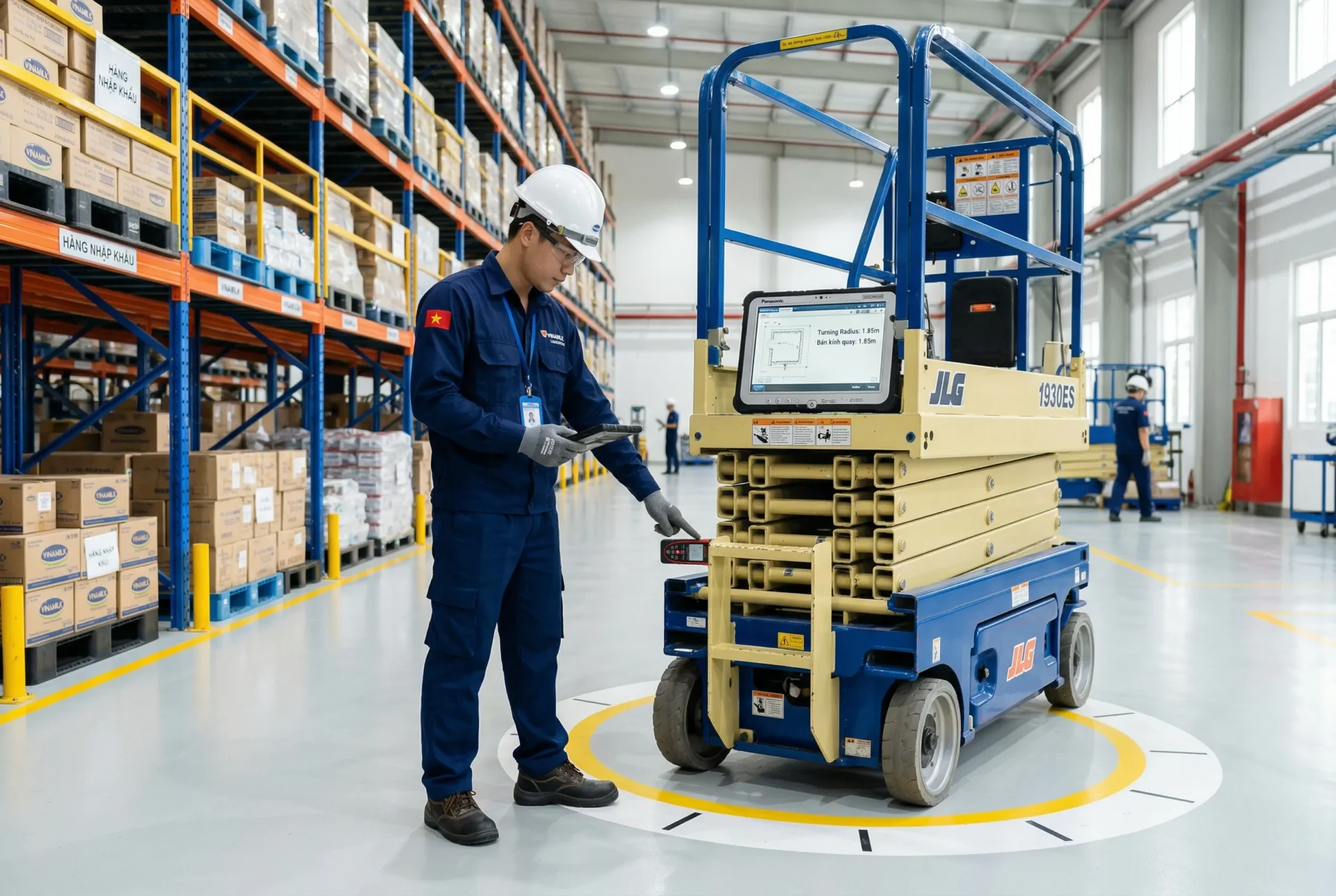
With Vietnam’s rapid industrial development, the “high-density” optimization of factories and warehouses is accelerating. However, the industry continues to see a never-ending series of troubles rooted in dimensional planning errors, such as “installing the latest work platform only to find it cannot turn corners in the aisles” or “being unable to enter specific areas due to height restrictions of fire shutters.”
In this article, based on the on-site expertise Hasegawa Vietnam has cultivated over many years, we explain a “reverse-calculation” selection method that identifies the optimal model based on three physical constraints: aisle width, turning radius, and stowed height. This is a practical guide for safety managers and purchasing departments to avoid wasteful investment and maximize Occupational Safety and Health (OSH) on-site.
Challenges and Background
Market Data
Logistics and manufacturing costs in Vietnam account for approximately 16.8% to 17% of GDP (Source: VLA/World Bank), significantly exceeding the global average of 10.6%. To reduce these high costs, many companies are promoting “high-density storage” by increasing rack heights and narrowing aisle widths to the absolute limit.
However, spatial optimization drastically increases the difficulty of operating work equipment. According to statistics from the Ministry of Labour, Invalids and Social Affairs (MOLISA), the cost of damages from occupational accidents reaches approximately 4 trillion VND (about 175 million USD) annually. Key factors cited include “inappropriate work procedures” and “lack of safety guards.” Operating equipment forcibly in narrow spaces triggers contact accidents and falls, leading to significant economic losses.
Risk Presentation
There are two primary fatal risks hidden in equipment selection that disregards on-site dimensions.
- Equipment Damage due to Inability to Turn: If the Minimum Turning Radius is miscalculated, equipment will come into contact with racks or products when turning corners. Caution is especially required in existing factories in Vietnam, where aisles are often complicated by retrofitted equipment.
- Creation of Dead Zones due to Height Restrictions: If the “Stowed Height” of the equipment exceeds the height of fire shutters or beams installed under Vietnam’s Fire Safety Regulations (QCVN 06:2022) by even 1cm, the area beyond becomes a “maintenance-impossible” blank space.
Product and Service Introduction
Key Data: Vietnam’s On-site Environment and Safety Indicators
- Logistics costs as a percentage of GDP: 16.8% – 17.0% (Global average: 10.6%)
- Percentage of falls from height: 60.4% of fatal accidents at construction and manufacturing sites
- Annual economic loss from occupational accidents: Approx. 4 trillion VND (Approx. 175 million USD)
- Recommended safety clearance (Aisle width calculation): Right-angle stack + Load length + 300mm (12 inches)
- Vietnam Safety Standard for Work Platforms: TCVN 12455:2018
Features
Hasegawa Vietnam’s equipment adapts “Japanese precision design” to the “narrow work sites” of Vietnam.
- Compactness & Turning Performance: With a design that minimizes the turning radius, smooth maneuvering is possible even in narrow aisles of 900mm to 1200mm where standard forklifts cannot pass.
- Low-Floor & Low-Overall-Height Design: We have expanded our lineup of models with a stowed height of 2,000mm or less. This allows entry through common factory entrances and elevators in Vietnam.
Case Study (Before → Action → After)
[Case: Precision Electronic Component Factory near Ho Chi Minh City]
- Before: The aisle width was narrow at 1,500mm, and conventional scaffolding took a long time to set up, requiring the production line to be stopped for extended periods. Additionally, maneuvering to avoid ceiling piping was difficult.
- Action: Introduced Hasegawa’s “High-Rigidity, Maneuverable Work Platform.” We pre-measured the aisle corners and piping heights on-site to select a model that fit down to the millimeter.
- After: Setup time was reduced by 50%, and the risk of line stoppages was drastically decreased. Workers’ psychological safety improved, and maintenance efficiency increased by 30%.
Hasegawa’s Reliability
Quality Control and Certification
Hasegawa products are based on Japanese JIS standards and strictly comply with the Vietnamese National Standard TCVN 12455:2018 (Safety requirements for mobile elevating work platforms). We guarantee long-term precision and rust resistance even under Vietnam’s hot and humid conditions through repeated non-destructive testing of welds and stability tests at several times the rated load.
Customization and Support System
For unique sites where “off-the-shelf products simply cannot turn the corners,” Hasegawa Vietnam offers Custom-made design support from our Da Nang factory. Our professional engineers will visit your site to measure aisle width, turning radius, and stowed height, proposing a unit customized to the optimal dimensions.
Summary
The starting point for equipment selection should be “on-site dimensions,” not catalog specifications. By narrowing down models through reverse-calculation from three figures—aisle width, turning radius, and stowed height—you can achieve factory operations that balance safety and efficiency even in Vietnam’s harsh competitive environment.
Hasegawa Vietnam goes beyond simple equipment sales; we walk alongside you as your “Safety Partner,” from on-site dimension measurement to optimal model proposals and support for safe operations in accordance with TCVN standards. If you are concerned about “narrowness” at your site, please take advantage of our dimensional optimization diagnosis.