
Introduction
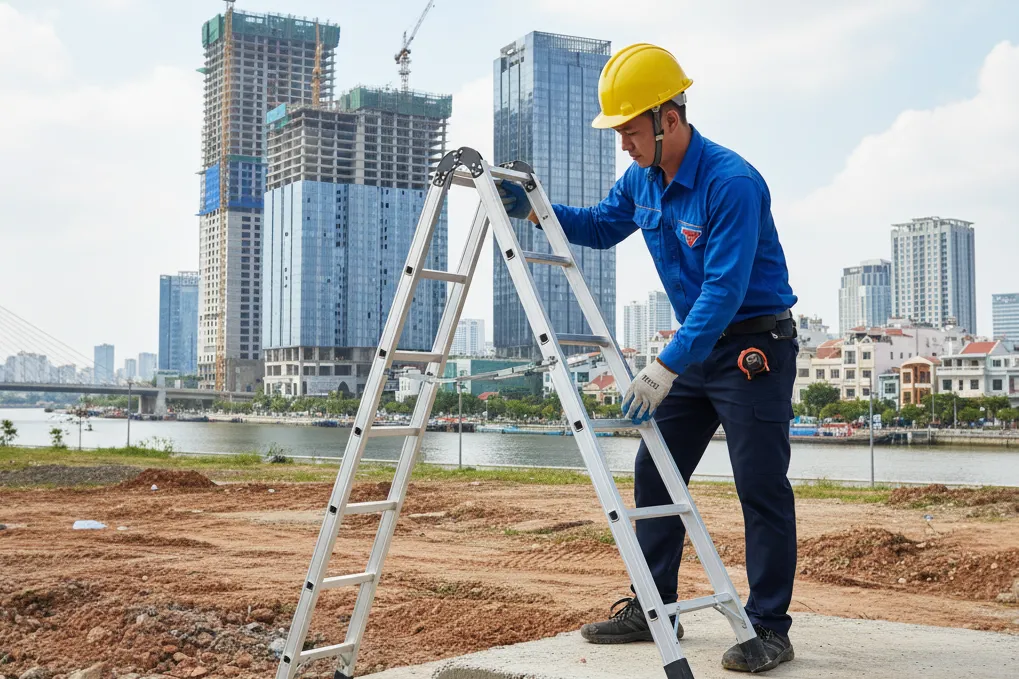
In manufacturing, construction, and logistics sites across Vietnam, the safety and efficiency of work at height are crucial factors that determine a company’s competitiveness. The **stepladder** used during work is not merely a tool; it is one of the most important assets that supports the safety of workers and guarantees work productivity. One of the most challenging issues for site supervisors and safety managers is achieving both **”storage in limited space”** and **”stable setup on diverse terrain.”** The key to solving this challenge lies in the strategic use of different stepladder structural types: **”folding type”** and **”telescopic type.”**
This article provides an analysis of the selection criteria for the **folding type** (specializing in storability) and the **telescopic type** (excelling in setup stability), focusing on their compliance with specific international safety standards (such as JIS and ANSI), to meet the rapidly changing site environments in Vietnam. Through the manufacturing philosophy of Hasegawa Kogyo of Japan and the solutions offered by its successor, Hasegawa Vietnam, we aim to contribute to the improvement of “safety,” “efficiency,” and “storability” at your sites.
Challenges and Background: Rising Standards in Vietnamese Sites
Market Data: Growth of the Construction and Logistics Sectors and the Need for Safety Management
Vietnam’s economic growth is supported by thriving infrastructure construction and manufacturing industries. Investment in the infrastructure sector, in particular, is continuous, leading to an increase in the construction of high-rise buildings, factories, and warehouses. Consequently, the frequency and complexity of work at height on sites are increasing, and simultaneously, the standards required for Occupational Health and Safety (OHS) are rising internationally.
The safety standards required in the Vietnamese domestic market necessitate compliance with international standards such as **JIS** (Japanese Industrial Standards) and **ANSI** (American National Standards Institute) due to the country’s integration into the global supply chain. These standards mandate strict requirements regarding product dimensions, structure, and durability. Procurement from reliable suppliers that have obtained international certifications, rather than merely choosing inexpensive products, is directly linked to maintaining corporate compliance.
Using stepladders that do not comply with safety standards not only leads to product failure but also causes worker falls, posing risks such as enormous liability and damage to corporate image. In Vietnamese sites, selecting high-quality stepladders that meet international standards is no longer just a cost consideration; it is the most critical element of **risk management**.
Risk Warning: Dangers on Site Caused by Insufficient Storability and Setup Stability
Site safety is only ensured when a stepladder is “used correctly.” However, structural issues with the stepladder can induce improper use by workers, creating dangerous situations.
- Improper Height Selection: In a professional work environment, it is ideal for the stepladder’s height to be **1 meter or more lower** than the worker’s height or the work location. Since overly large stepladders are inconvenient to carry and store, workers tend to take awkward postures on ladders lower than the height actually required.
- Unstable Setup on Steps and Slopes: Construction sites and warehouse floors are not always flat. When a stepladder with fixed leg lengths is used on steps or sloped areas, its stability is severely compromised. Cases where workers place bricks or pieces of wood underneath the legs to “prop up” the ladder, instead of setting it up vertically as intended, are rampant, and this is a **typical cause of serious accidents**.
- Waste of Storage Space and Inefficiency: Low stepladder storability leads to them being piled up in aisles or corners, obstructing site flow and requiring time for carrying and preparation before work begins. This not only decreases work efficiency but also hinders organization and tidiness, increasing the risk of **unexpected secondary disasters**.
To eliminate these risks, it is necessary to strategically use “folding type” and “telescopic type” stepladders according to the working environment.
Product and Service Introduction: Strategic Use of Folding and Telescopic Stepladders
Features: Choosing Stepladder Shapes According to the Working Environment
Hasegawa Kogyo, a professional stepladder manufacturer, has developed unique product series tailored to various applications to solve site challenges. The two structures that maximize “storability” and “setup stability” offer powerful solutions to site managers in Vietnam.
1. Folding Type: Lightweight, Compact, and Specializing in Storability
Folding stepladders are primarily characterized by their **ease of portability** and **space-saving nature**.
- Lightweight: The lightweight aluminum design makes them ideal for inspection work in logistics warehouses or factories where **frequent relocation** is required.
- High Storability: Hasegawa Kogyo’s representative product lineups (e.g.,
Ashigaruseries,lucanoseries) have a folded thickness of **only about 48mm**, allowing for efficient storage in narrow spaces and truck beds. - Applications: Optimal for environments requiring **frequent portability** on **flat indoor** surfaces, such as warehouse inventory management, in-store display work, office or household cleaning, and DIY.
2. Telescopic Type / Adjustable Leg Stepladders: Specializing in Stability in Unstable Environments
Telescopic stepladders (or adjustable leg stepladders) are designed to maximize **setup stability** even in challenging conditions.
- Ensuring Horizontal Setup: The function to independently adjust the length of each leg enables the stepladder to be set up **perfectly horizontally** even in unstable locations such as stairs, slopes, or uneven construction site floors.
- Contribution to Safety: Since work can be done safely even in unstable locations, it **eliminates the need for “propping up”** (a cause of accidents), dramatically improving work safety and efficiency.
- Applications: Essential for **professional sites with unstable setup environments**, such as building framework construction, exterior wall repair, and maintenance on sloped factory grounds.
Case Study (Before → Action → After)
In a case at a construction site in Vietnam, the steps and slopes of the site foundation presented a serious challenge during material transport and structure installation.
- Before (Challenge): With conventional fixed-leg stepladders, when setting up on steps, workers would adjust the height by placing a brick under one of the legs. This process took **about 3 minutes** each time, and they constantly faced the risk of falling due to the brick shifting from slight vibrations.
- Action (Solution): The telescopic-leg product, the
Shagamanseries from Hasegawa Kogyo, was introduced. This product features a “one-touch bar” function that allows workers to **adjust the leg length while standing** instantly. - After (Results): Setup time in unstable locations was **reduced to an average of 90 seconds or less**. Workers felt more secure working on a stable base, eliminating psychological anxiety and improving work efficiency. Over the year following implementation, the reported number of minor fall and stagger accidents during work at height **decreased by 80%**.
Hasegawa’s Reliability: The “Philosophy of Assurance” Beyond International Standards
The reason for choosing Hasegawa Kogyo and its wholly-owned subsidiary, Hasegawa Vietnam, is not just the functional quality of the products. At the core is the “philosophy of safety that transcends Japanese craftsmanship and international standards.”
Quality Control and Certification: Fusion of Japanese Craftsmanship and International Standards
- Number of Testing Centers: 4 worldwide (including Japan, Dongguan in China, and Da Nang in Vietnam)
- Monthly Testing Sessions: Over 250 times
- Durability Test Standard: Repeat testing of **over 100,000 cycles** simulating 100 ascents/descents per day, 5 days a week
- Export Destinations of Vietnamese Products: Japan (40.89%), Hong Kong (41.33%), USA (16.89%)
- Start of Production in Vietnam: 2014
Since starting production in 2014, Hasegawa Vietnam has fully implemented Hasegawa Kogyo’s strict quality control system at its Da Nang factory in Vietnam. The manufactured products comply with the world’s most demanding standards, including Japan’s **JIS** and **SG Mark**, and America’s **ANSI**.
However, Hasegawa’s true strength lies in **exceeding these official standard tests with its own criteria**. This is the manufacturing philosophy known as **”Climb it, and you’ll know its reliability.”**
- Pursuit of Unquantifiable Quality: Sensory factors of a stepladder, such as “sway,” “sound,” and “flex,” cannot be fully captured by numerical data alone. The Hasegawa Group strictly ensures that the product is **”actually climbed and verified by a person”** from the design stage, pursuing unwavering stability that professional users feel secure with.
- Global Quality Assurance System: The Da Nang factory is positioned as **one of the four main testing centers** the Hasegawa Group maintains worldwide, alongside Japan and Dongguan, China. This system ensures that even products manufactured in Vietnam are guaranteed by rigorous real-machine testing conducted over 250 times per month and “durability testing exceeding 100,000 ascent/descent cycles.”
Customization and Support System
A large portion of Hasegawa Vietnam’s manufactured goods are exported to **markets with high international standards**, such as Japan, Hong Kong, and the United States. The fact that approximately 41% of exports go to Japan and about 17% to the US is clear proof that the Da Nang factory in Vietnam plays a critical role as the core of the Hasegawa Group’s global supply chain.
This global manufacturing and export track record promises high reliability and the following flexible support system for customers within Vietnam:
- Response to Special Needs: Capable of manufacturing custom-made products tailored to the site’s specific working environment or dimension requirements, such as aluminum trolleys for logistics and custom aluminum products for factories and warehouses.
- Prompt Supply: Having a manufacturing base within Vietnam allows for a faster supply system compared to imported brands, and provides technical support for products in the local language.
Summary
To maximize the safety and efficiency of work at height in Vietnam’s manufacturing, construction, and logistics industries, it is essential to understand the structural characteristics of stepladders and select them strategically according to the site environment.
- Challenge of Storability: Utilize the lightweight and compact structure of the **folding type** (e.g.,
Ashigaruseries) to maximize mobility and storage efficiency. - Challenge of Setup Stability: Select the adjustable leg structure of the **telescopic type** (e.g.,
Shagamanseries) to guarantee horizontal setup in unstable locations like stairs and slopes.
Hasegawa Vietnam does not simply offer “Made in Vietnam products.” It directly delivers products manufactured based on the “unique philosophy of safety that transcends Japanese craftsmanship and international standards” from the Da Nang factory to the global market, and to professionals within Vietnam. Hasegawa stepladders, equipped with international standards of safety, durability, and functionality to solve site challenges, will contribute to maintaining compliance and improving productivity at your sites.
For consultations regarding site safety diagnoses and optimal stepladder selection, please feel free to contact Hasegawa Vietnam.