
Introduction
Along with the rapid infrastructure development across Vietnam and the rush to establish factories by foreign direct investment (FDI) manufacturing companies, “Health, Safety, and Environment (HSE)” standards at worksites are becoming stricter every year. Especially for site safety managers and purchasing agents, preventing accidents during high-elevation work is one of the most critical priorities. In Vietnam’s hot and humid climate, as well as the harsh environments unique to construction and manufacturing sites, fall and tumble accidents caused by “slipping” during work on ladders and stepladders are unceasing.
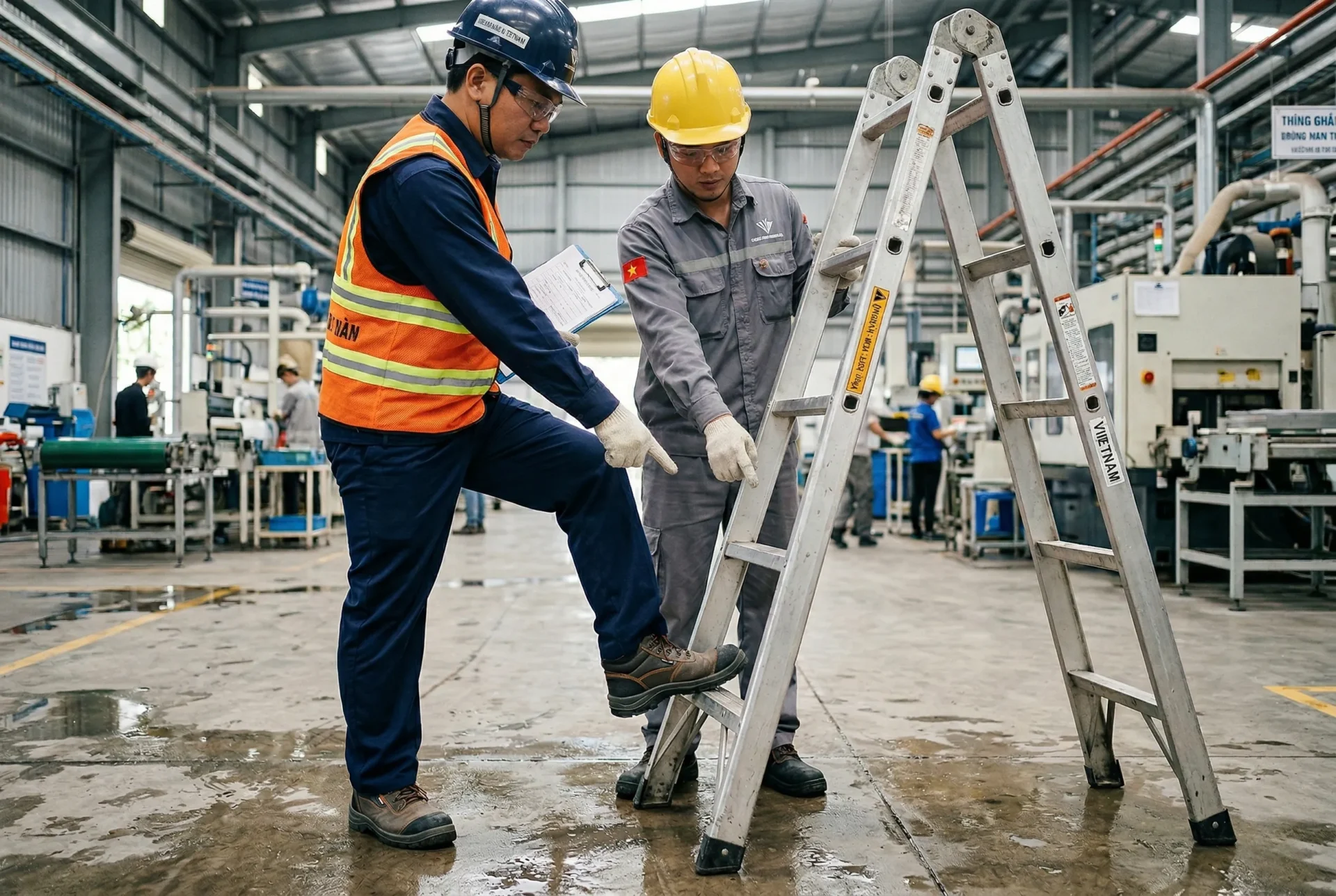
Based on the professional expertise of Hasegawa Vietnam, this article focuses on the three major adverse conditions encountered on-site: “dust,” “oil,” and “water.” To maximize safety under these conditions, it is essential to have a “trinity” of countermeasures that optimally combines the three elements: the “rung” (step) where workers place their feet, the “leg cap” (foot) that contacts the floor, and the “shoe sole” (outsole) worn by the worker. Through this article, we will explain the physical risks at the site and provide a logical framework for selecting the optimal equipment that you can put into practice immediately.
Challenges and Background
Market Data
Looking directly at the current state of occupational accidents in Vietnam highlights just how severe the impact of fall and drop accidents from high places truly is. With rapid industrialization, accidents due to poor scaffolding at construction sites and during maintenance work inside factories are occurring frequently, and the scrutiny of corporate safety management systems during audits is intensifying.
Key Data: Statistics and Standards Regarding Occupational Accidents and Slip Resistance in Vietnam
- Indicator 1: Approximately 30% of fatal occupational accidents in Vietnam in 2023 were caused by “falls/drops” (Source: Ministry of Labour, Invalids and Social Affairs of Vietnam, MOLISA)
- Indicator 2: The standard slip velocity in the slip resistance test of JIS T 8101 (Safety Footwear) is 0.22±0.02 m/s (Source: JIS T 8101 Standard)
- Indicator 3: The standard vertical force in the same test is 500±25 N for men’s sizes (26.0cm) and 400 N for women’s sizes (23.5cm) (Source: JIS T 8101 Standard)
- Indicator 4: When a water film is present on a smooth stainless steel plate, the dynamic friction coefficient drops by up to approximately 40% compared to dry conditions (Source: National Institute of Occupational Safety and Health, Japan)
- Indicator 5: The safety standard value for the dynamic friction coefficient in an oil environment (90% glycerin aqueous solution) (Slip Resistance Category F1) is 0.20 or higher, and the high-performance standard (F2) is 0.30 or higher (Source: JIS T 8101 Standard)
Risk Presentation
“Slipping” on-site is not caused by worker negligence, but by the physical loss of frictional force. Frictional force is physically expressed by the equation $F = \mu N$ (where $F$ is frictional force, $\mu$ is the dynamic friction coefficient, and $N$ is the normal force). Even if the normal force ($N$), such as body weight, remains constant, if the dynamic friction coefficient ($\mu$: a numerical value indicating the resistance force when continuing to slide after starting to move) drops drastically due to the surface condition of the floor or rung, the frictional force ($F$) is lost, leading directly to a fall.
The three environmental conditions that require particular vigilance on-site are as follows:
- Wet Environments: At outdoor sites during the rainy season or in washing rooms of food factories, the “hydroplaning phenomenon” (where an object floats due to a water film) is prone to occur between the shoe sole and the contact surface. As a result, the dynamic friction coefficient, which is 0.50 or higher when dry, plummets to less than 0.30.
- Oil-Coated Environments: Lubricating oil and cutting fluids scatter in machining plants and automotive repair shops. When a highly viscous oil film intervenes, such as the 90% glycerin solution used in JIS standard tests, the dynamic friction coefficient drops sharply to 0.15 or less, rendering standard rubber materials completely unable to grip.
- Dusty Environments: Fine dust generated at cement plants, woodworking shops, and polishing sites enters the contact surface, causing the “roller bearing effect” (where dust acts like tiny ball bearings, robbing friction). This reduces the contact area to about 40% of its original size, triggering unpredictable slipping.
Products and Services: Optimization Mechanisms by Slip Condition
To completely eliminate these risks, it is necessary to optimize the combination by calculating the physical interactions among the “rung,” “leg cap,” and “shoe sole,” as advocated by Hasegawa. Here, we explain the optimal solutions for each condition.
Features: “Trinity” Solutions by Condition
Condition 1: Combination for Wet Environments (Rainy Weather, Washing Sites)
The most important factor in wet environments is “drainage.”
- Rungs: Hasegawa’s high-quality aluminum alloy stepladders feature wide rungs of 60mm instead of the standard 40mm width. The surface is processed with unique ribs (grooves) measuring 2mm to 5mm in depth, instantly channeling water adhering to the shoe sole outwards.
- Leg Caps: Adopts “elastomer resin” (a synthetic resin with highly elastic, rubber-like properties) that offers high adhesion to the floor surface. By providing an appropriate softness with a Shore A hardness (an index indicating rubber hardness) of around 60, it conforms to the microscopic unevenness of wet tiles or concrete, exerting an effect similar to a vacuum suction cup.
- Shoe Soles: By combining an outsole that clears the slip resistance category “F1 (dynamic friction coefficient 0.20 or higher)” of ISO 13287 and JIS T 8101 and features a block pattern with excellent water drainage, the hydroplaning phenomenon is completely prevented.
Condition 2: Combination for Oil-Coated Environments (Machining, Maintenance Factories)
An “edge effect” (the ability of sharp edges to cut through the oil film and grip the floor surface directly) and “oil resistance” are indispensable to cut through oil films.
- Rungs: Rungs with a slit (gap) structure where oil dirt is unlikely to accumulate, or sharper corrugated steps, are optimal. The rung pitch (distance between steps) for ascending and descending is ergonomically designed to 298mm or 300mm, the distance where human force is most easily applied, reducing the risk of missing a step.
- Leg Caps: Common natural rubber and PVC (polyvinyl chloride) swell (a phenomenon where they absorb oil, expand, and become brittle) when they come into contact with oil. Therefore, leg caps made of “NBR (nitrile rubber),” which has extremely superior oil resistance, are essential.
- Shoe Soles: A combination with oil-resistant safety shoes that meet “F2 (dynamic friction coefficient 0.30 or higher),” the highest level of JIS standards, is an absolute requirement. The lugs (protrusions) on the sole must be sharp, and a structure that pushes out the oil film to grip the metal surface directly is required.
Condition 3: Combination for Dusty Environments (Cement, Woodworking, Polishing Sites)
A structure that “releases” dust and a “self-cleaning property” to prevent clogging are key.
- Rungs: A 60mm wide rung that is flat but has broad grooves is effective, making it difficult for dust to accumulate. Grooves that are too fine will clog with dust, causing the opposite effect.
- Leg Caps: Large caps made of slightly harder vulcanized rubber (rubber strengthened by adding sulfur) with a Shore A hardness of about 70 are used. If it is too soft, it rolls up the dust and becomes slippery, so a design that deliberately increases the hardness to push out the dust with its edges is suitable.
- Shoe Soles: Select a shoe sole with wide gaps between the treads and a self-cleaning structure that automatically discharges dust clogged in the grooves through flexion during walking.
Case Studies (Before → Action → After)
Case 1: Major Food Processing Plant in Dong Nai Province (Wet & Oil-Stained Environment)
- Before: Due to daily washing operations and the scattering of cooking oil, the factory floor was always slippery. Because they used conventional, cheap local stepladders, near-misses where workers lost their balance near the top plate (highest step) occurred an average of 12 times a month.
- Action: Hasegawa’s HSE expert team conducted a site audit. They introduced dedicated stepladders supporting a maximum safe working load of 130kg complying with the JIS S 1121 standard, and formulated a “trinity” safety protocol mandating the use of elastomer leg caps and F2 standard slip-resistant shoes.
- After: Coupled with a structure that keeps the ladder setup angle below 85 degrees for maximum stability, near-misses due to slipping decreased to 0 incidents in the 6 months after introduction. The psychological peace of mind of the workers improved, increasing the efficiency of high-elevation maintenance work by approximately 15%.
Case 2: Cement Manufacturing Plant in Hai Phong City (Dusty Environment)
- Before: Fine cement powder covered the entire factory, and when standard ladders (used at a 75-degree angle) were propped up, accidents where the legs slipped due to dust on the contact surface occurred 3 times a year.
- Action: Instead of stepladders, they introduced Hasegawa work platforms featuring special steps that prevent dust accumulation. At the same time, customization was done to equip them with large, vulcanized rubber leg caps with a hardness of 70.
- After: Slipping due to the roller bearing effect was completely resolved, achieving zero accidents over the past 1 year. They also cleared MNC (multinational corporation) standards in safety audits, significantly improving the safety evaluation score of the entire plant.
Hasegawa’s Reliability
Quality Control and Certification
The product line provided by Hasegawa Vietnam is backed not just by convenience, but by standards such as “JIS S 1121 (Aluminum Alloy Stepladders and Ladders),” one of the strictest safety standards in the world. While general products use a load capacity of 100kg as a baseline, Hasegawa’s pro-use models boast a maximum safe working load of 130kg (a design capable of withstanding approximately 1300 N of vertical force). Furthermore, we have established a quality control system that complies with ISO and Vietnamese national standards (such as TCVN 2291 occupational health and safety requirements), conducting thorough quality assurance from the extrusion molding of materials to assembly and friction testing of the leg caps.
Customization and Support System
Factory flooring materials in Vietnam vary widely from site to site, including epoxy resin coatings, bare concrete, and tiled surfaces. Hasegawa Vietnam has built a rapid support system based in Ho Chi Minh City and Hanoi, staffed by Japanese experts and local HSE engineers. By actually investigating the floor materials and contamination conditions (dust, oil, water) at the site, we provide highly detailed, localized support rooted in Vietnam, such as changing the material of leg caps to suit the conditions or designing custom sizes tailored to the work environment.
Conclusion
To prevent fall accidents during high-elevation work, equipment selection based on physical evidence, rather than mere mental discipline like “being careful,” is indispensable. By achieving a trinity of optimization—”60mm wide rungs,” “leg caps suited to the environment,” and “shoe soles clearing slip resistance standards”—against the adverse on-site conditions of dust, oil, and water, the risk of accidents is drastically reduced.
Hasegawa Vietnam delivers world-class safety and quality to all companies operating in Vietnam. To visualize the hidden “slip” risks at your worksite and find the optimal solution, please first utilize a “Free Site Safety Audit” by our HSE expert team. Site safety begins with proper footing.