
Introduction | Three Systems to Transform Ladder and Stepladder Safety Management
Ladders and stepladders are tools used in daily work, but their convenience can lead to carelessness, making them a major cause of serious accidents from falls. According to statistics from the Ministry of Health, Labour and Welfare, of the approximately 1,000 stepladder accidents per year, about 84% are fall accidents, many of which are caused by a lack of basic operational rules. This article, focusing on the three safety management systems of “Education,” “Display,” and “Recording,” will introduce improvement measures that can be implemented on-site with concrete examples and numerical data. This content will serve as a practical guide for safety managers and supervisors in the construction, manufacturing, and logistics industries who want to raise on-site safety awareness.
Challenges and Background | The Invisible Risks Lurking On-site
The Reality of Increasing Fall Accidents
According to statistics and industrial accident reports from the Ministry of Health, Labour and Welfare, there are approximately 1,000 stepladder accidents annually, with about 84% of them resulting from falls. Furthermore, about 27 people lose their lives each year, and the non-wearing rate for helmets, which protect the head, reaches as high as 84%. These incidents are particularly frequent in the construction, building maintenance, and logistics industries, making the improvement of work environments and procedures an urgent issue.
Accidents Caused by Inadequate Internal Rules
Many accident causes are not just due to physical equipment defects but also to shortcomings in organizational safety management. When safety education becomes a mere annual event with outdated content, when notices become old and lose their visibility and persuasiveness, and when accident and inspection records are missing, delaying the planning and execution of corrective measures, the risk of similar accidents recurring increases.
How to Build Safety Operational Rules | Best Practices for Education, Display, and Recording
Education: Practical Safety Training for Ladders and Stepladders
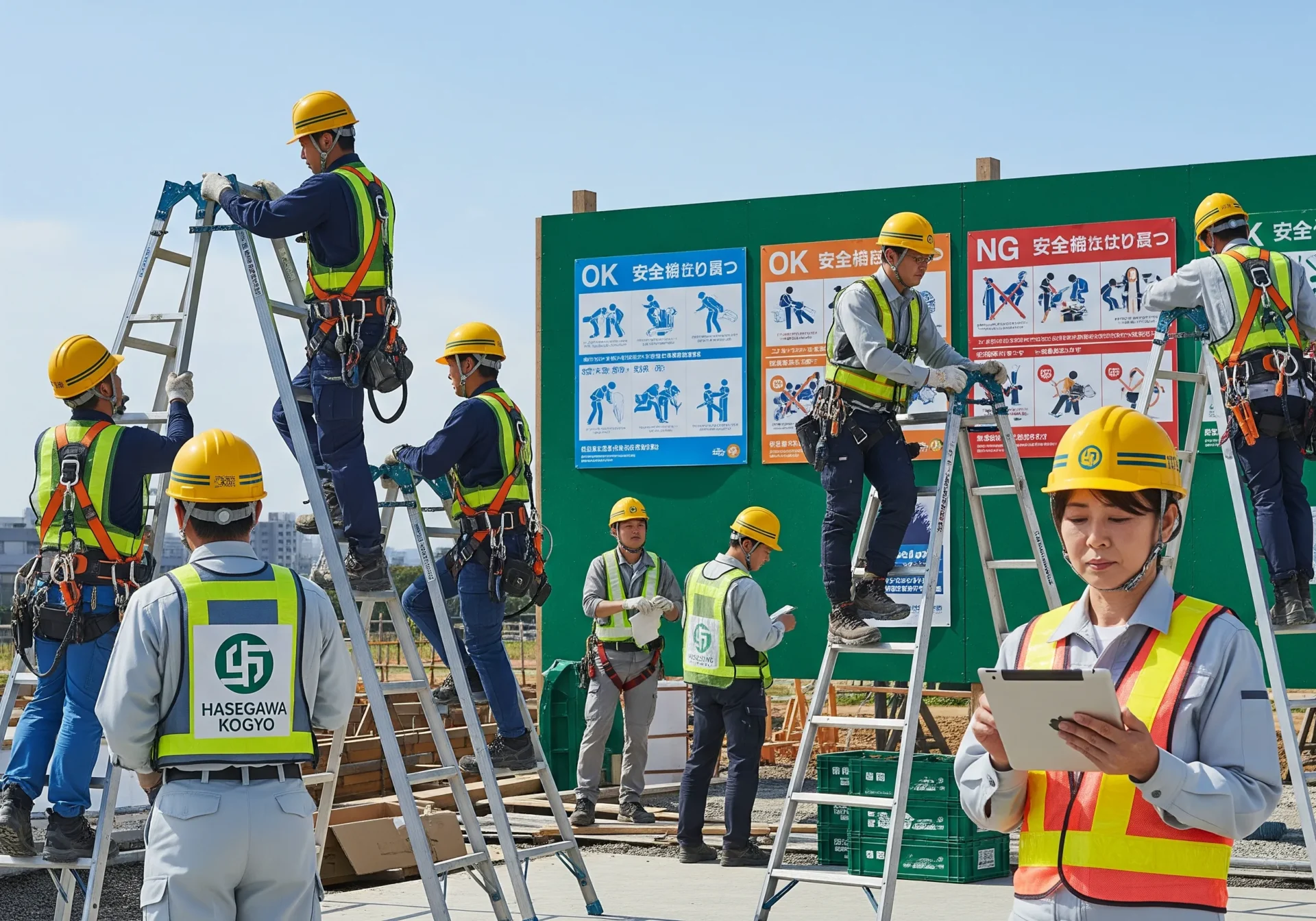
It is crucial for education to be experienced on-site, not just at a desk. By using actual equipment to demonstrate dangerous actions and allowing workers to experience what leads to accidents, their awareness for behavioral improvement increases. By conducting refresher training at least twice a year for everyone, regardless of whether they are newcomers or veterans, and sharing the latest safety standards and accident case studies, the knowledge level of all personnel can be standardized.
Display: OK/NG Rules for Ladder and Stepladder Use
Safety notices should not be mere warnings but “living information” that is relevant to the on-site situation. Displaying OK/NG examples with photos and illustrations makes them easier to understand visually. Additionally, by updating the number of accidents and near-miss cases monthly, a sense of urgency and a mindset for improvement can be instilled throughout the site.
Recording: Protecting Safety with Evidence
By centrally managing education, inspections, and accident reports with digital tools, it becomes easier to plan and manage the progress of recurrence prevention measures. Recording training attendance rates, notice update rates, inspection implementation rates, and the number of near-miss submissions as monthly KPIs and reviewing them in safety meetings prevents rules from becoming a formality and leads to continuous safety improvement.
Success Story | Achieving Zero Accidents by Introducing Operational Rules
This case study is about a safety reform implemented by Company A, a mid-sized construction-related company.
Before: Education was only provided to new employees, old posters were left neglected on display, and records were scattered on a paper basis—a triple threat. Near-misses were frequent on-site.
Action: The company mandated watching educational videos on-site and set up safety notice boards for each department. Furthermore, they introduced a cloud-based recording app that could centrally manage inspection and education histories. This created an environment where everyone could access the latest information.
After: For two years after implementation, they achieved zero fall accidents. Safety-related conversations and pointers became a daily routine, and a sense of safety awareness took root throughout the company.
Hasegawa’s Safety Support Service | Support from Both Product and Operational Aspects
Hasegawa Kogyo provides support for both physical safety and operational aspects. In addition to offering products with the latest safety designs, such as highly slip-resistant steps and reinforced locking mechanisms, the company also develops educational PDF and video materials that can be used immediately on-site, as well as on-site training services with dispatched instructors. By combining these, Hasegawa Kogyo supports the cultivation of an overall safety culture on-site, going beyond just providing products.
Conclusion | Zero Accidents Are Created by a “System”
Education, display, and recording are the most effective and low-cost investments for continuously enhancing the safety culture on-site. By naturally integrating them into daily operations rather than as one-off measures, a state of zero accidents can be maintained over the long term. Let’s start today to create a workplace where everyone can work with peace of mind by utilizing the safety support services and products offered by Hasegawa Kogyo.
How to Use Stepladders Safely (Official)
How to Use Ladders Safely (Official)