
Introduction
Along with Vietnam’s economic growth, the industrial parks near Ho Chi Minh City and Hanoi are facing serious challenges such as rising land prices and a shortage of warehouse space. Especially in the manufacturing, construction, and logistics sectors, ladders and stepladders are essential tools, yet their “storage methods” are often neglected. Ladders left in aisles not only cause trip-and-fall accidents but also lead to damage by forklifts and economic losses in floor space. From the perspective of Hasegawa Vietnam, this article provides a thorough explanation of professional techniques based on “Vertical Storage” and “5S (Sort, Set in order, Shine, Standardize, Sustain)” to maximize limited space and protect worker safety.
Challenges and Background
Market Data: Warehouse Costs in Vietnam and the Importance of 5S
The average rent for logistics warehouses in Vietnam ranges from approximately $4 to $7 per square meter near major cities. For example, leaving 30 ladders haphazardly on the floor occupies about 15 to 20 square meters of space, which translates to over $1,000 in “hidden costs” annually.
Furthermore, according to a report by the Department of Occupational Safety and Health in Vietnam, approximately 15% of accidents at construction and manufacturing sites are caused by “poor organization and tidiness.” Establishing effective storage rules—rather than letting 5S activities become a mere formality—is no longer just a matter of etiquette, but a part of business strategy.
Risk Disclosure: Improper Storage Leads to Product Degradation and Industrial Accidents
Storage by “laying flat” or “leaning against a wall,” which is common at many sites, involves the following three major risks:
- Risk of Permanent Deformation: Stacking heavy objects on top of aluminum ladders during storage causes microscopic distortion in the rungs (stiles). This disrupts the balance during use and leads directly to falls during high-altitude work.
- Progression of Corrosion: In Vietnam’s uniquely hot and humid environment, aluminum products placed directly on the floor are susceptible to moisture and chemicals, accelerating surface oxidation and corrosion.
- Falling Accidents: Ladders merely leaning against a wall can fall over due to slight vibrations or contact. If a professional ladder weighing over 15kg falls, it can result in a major disaster involving human life.
Practical! Smart Storage Ideas for Ladders and Stepladders
Features: Wall-Hanging Techniques to Maximize Vertical Space (Walls and Ceilings)
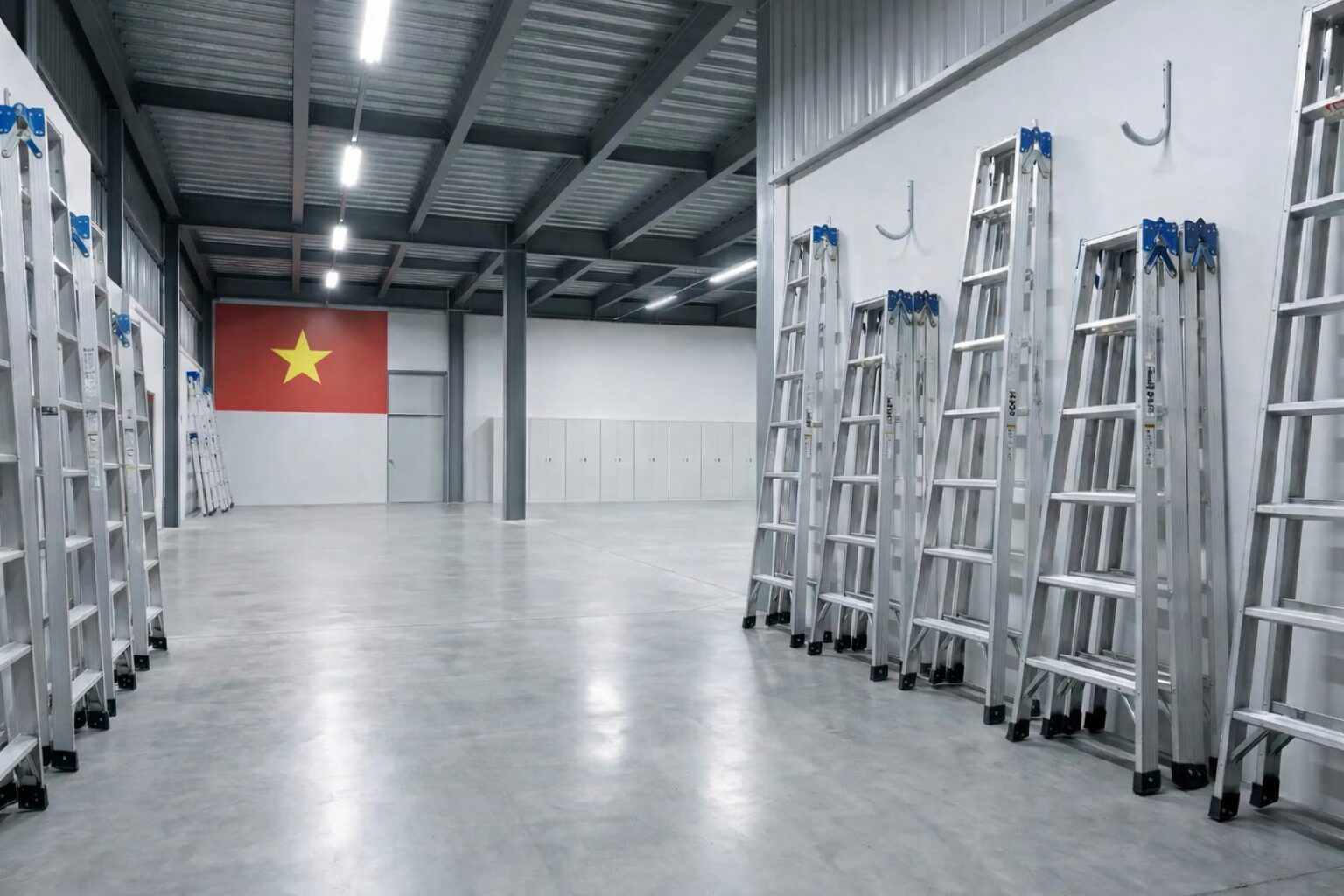
The basic principle of storage is “utilizing dead space.” By installing specialized brackets (mounting fixtures) on high wall positions or in gaps between pillars, you can reduce floor space usage to zero.
- Selection of Specialized Hooks: Use specialized J-shaped brackets designed for the rung width of the ladder instead of general S-hooks. This completely prevents sideways slipping.
- Thorough “Visualization”: When storing on a wall, painting the outline (shadow management) of the ladder in its “fixed position” allows workers to see the return location at a glance and prevents loss.
- Height Optimization: Place the most frequently used ladders based on shoulder height (approximately 1.5m above ground) to reduce the strain on the lower back when taking them out.
Case Study: Warehouse Improvement at a Japanese Precision Equipment Manufacturer (Ho Chi Minh City)
Before:
In a factory warehouse near Ho Chi Minh City, more than 40 stepladders were placed haphazardly along the aisles. Forklift turning space was restricted, and contact accidents between stepladders and lifts occurred twice a month. This resulted in equipment damage worth approximately 300,000 yen annually.
Action:
Based on consulting from Hasegawa Vietnam, “specialized storage rails for ladders” were installed across 20 meters of wall space. All stepladders were fixed vertically, suspended 20cm off the floor.
After:
25 square meters of floor space were recovered, making it possible to add storage shelves for spare parts. Forklift contact accidents were reduced to zero, and morning inspection time was shortened by 30 seconds per unit.
The Reliability of Hasegawa
Quality Control and Certification: Durability Meeting TCVN, JIS, and A14 Standards
Hasegawa Vietnam’s products comply not only with Japanese JIS standards but also with the Vietnamese national standard TCVN 12261 and the internationally rigorous American ANSI A14 standards. The strength of the hook joints and stiles, which bear the load during storage, is designed through tens of thousands of attachment and detachment tests. The act of “storing by hanging” itself is only possible because of the reliability of the product.
Customized Support: Proposing Storage Brackets Tailored to Local Sites
Factories in Vietnam have diverse structures, such as steel-frame or reinforced concrete (RC). At Hasegawa, we do more than just sell products; we diagnose the wall strength of the customer’s warehouse and propose the optimal mounting method. If necessary, we also undertake the design and construction of “made-to-order storage racks” tailored to specifically sized stepladders.
Conclusion
Improving warehouse storage is more than just “cleaning up.” It is an “investment” to extend the life of expensive equipment, protect the lives of workers, and minimize space costs. By introducing wall-hanging storage and vertical management, it is possible to keep ladders and stepladders in top condition at all times, even in Vietnam’s harsh environments.
Hasegawa Vietnam consistently supports your safety, from product supply to storage solution proposals. Why not start transforming the dead space sleeping in your warehouse into a “valuable asset” today?