
Introduction
Ladders and stepladders are indispensable tools in Vietnam’s manufacturing and construction industries. However, while site safety management often focuses on “ladder inspections,” the selection of “footwear” for the workers, specifically safety shoes is frequently overlooked. According to reports from the Vietnam Ministry of Labour, Invalids and Social Affairs (MOLISA), many falls and accidents are caused by “slips” or “missed steps” due to inappropriate footwear. From the perspective of Hasegawa Vietnam, this article introduces how to select safety shoes specialized for ladder work and specific standards to drastically reduce occupational accidents, supported by extensive statistical data.
Current Status and Background of Occupational Accidents
Market Data: Reality of Fall Accidents in Vietnam
With Vietnam’s rapid industrialization, ensuring safety in high-altitude work has become an urgent priority. According to 2023 statistical data, the number of casualties from occupational accidents in Vietnam reached approximately 7,500, with the construction and manufacturing sectors accounting for about 60%. Of particular note is the fact that approximately 35.5% of fatal accidents are due to “falls from heights.”
Key Data: Statistics on High-Altitude Work and Safety Shoes in Vietnam
- #1 Cause of Fatal Occupational Accidents in Vietnam: Falls from heights (35.5%)
- Causes of Accidents During Ladder Work: Slips and missed steps account for approximately 42%
- TCVN 7652 (ISO 20345 equivalent) Acquisition Rate: Over 90% in large-scale factories, less than 40% at small-to-medium sites
- Safety Shoe Over-usage Rate: Approximately 25% of site workers use the same shoes for more than 1.5 years
- Reduction in Friction Coefficient due to Sole Wear: Up to 60% decrease compared to new shoes (when oil is present)
Risk Disclosure: Why “Ordinary Shoes” Are Not Enough
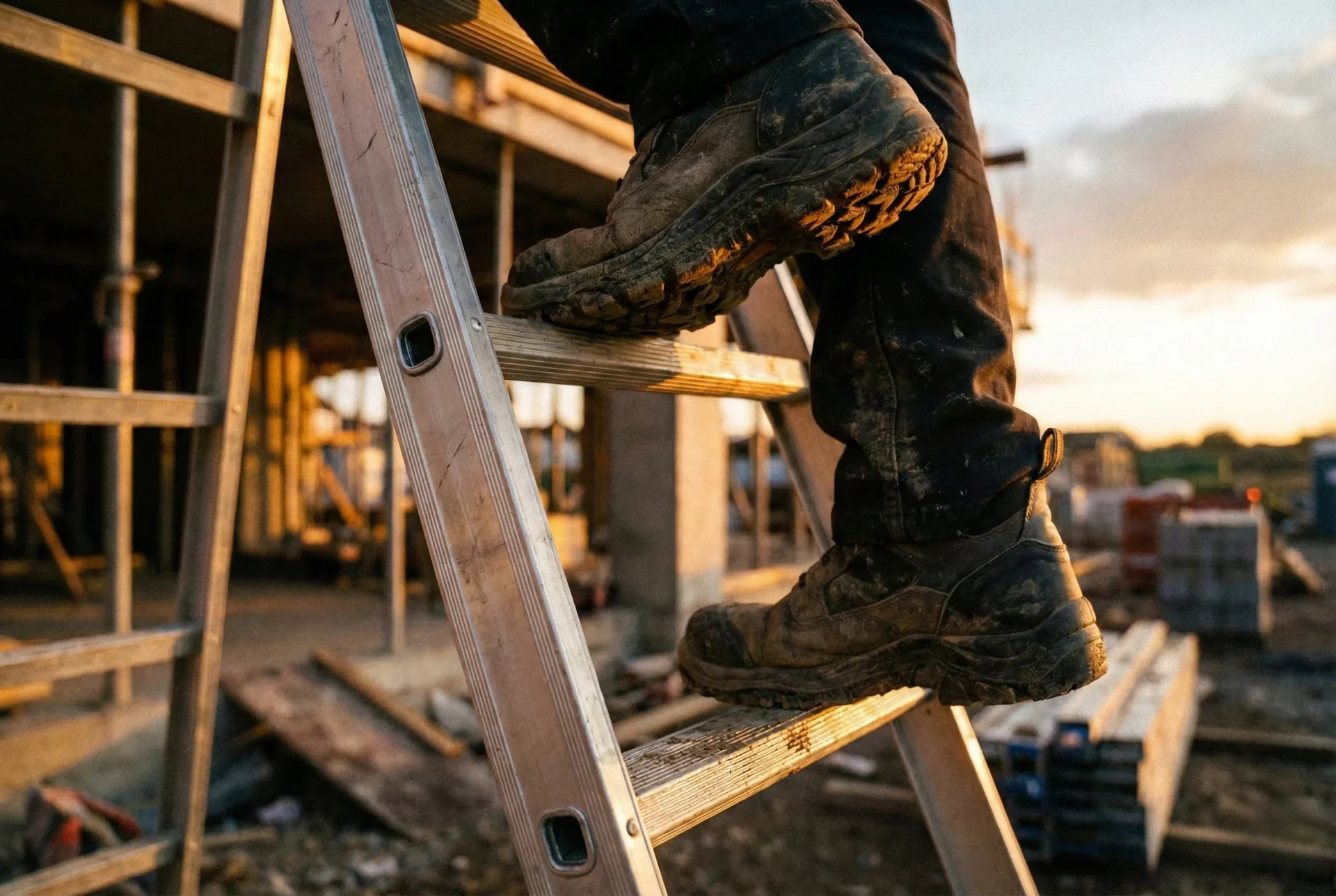
At many sites, workers are seen ascending and descending in canvas sneakers or, in some cases, sandals. The “rungs (steps)” of a ladder have a contact surface area of only 30mm to 60mm. With general footwear, when the load is concentrated in this narrow area, the sole deforms, causing the arch of the foot to collapse and leading to fatigue, as well as triggering sudden “slips.” Especially during Vietnam’s rainy season, moisture and mud adhere to the rungs, causing the friction coefficient to drop below 0.15, which drastically increases life-threatening risks.
Requirements for Shoes Suitable for Ladder Work
Features: Three Technical Elements Supporting Safety
To perform ladder work safely, simply having “hard toes” is insufficient. The following three points are essential requirements:
- Slip Resistance (SRC Standard):
The SRC standard (SRA + SRB) defined by ISO 20345 certifies slip resistance on both detergent solutions on ceramic tiles and glycerin (oil) on stainless steel plates. This ensures powerful grip even if the ladder rungs are wet. - Shank Rigidity:
The “Shank” inserted into the arch of the shoe prevents the shoe from bending into a “V-shape” when stepping on a narrow ladder rung. This reduces the burden on foot muscles by 30% and minimizes the risk of missing a step even during long working hours. - Flexibility and Fitting:
The action of climbing a ladder involves complex movements centered on the toes. When the toecap does not interfere with the foot and the ankle is moderately held, “three-point contact” (supporting the body with both hands and one foot, or one hand and both feet at all times) can be reliably maintained.
Case Study: Before → Action → After
[Case Study: Foreign-Owned Auto Parts Factory in Binh Duong Province]
- Before: Previously used inexpensive general-purpose safety shoes. Three “near-miss” slip incidents from ladders occurred annually, and workers complained of foot fatigue.
- Action: Based on advice from Hasegawa Vietnam, the factory switched company-wide to models compliant with SRC slip resistance standards and equipped with high-rigidity shanks. Simultaneously, ladder inspection training was conducted.
- After: Zero ladder-related slip accidents occurred in the year following implementation. Concentration levels in the afternoon improved due to reduced fatigue accumulation, and overall work efficiency increased by 12%.
Hasegawa’s Reliability: “Total Safety for High-Altitude Work” Supported from the Ground Up
Quality Control, Certification, and Original Safety Standards
Hasegawa Vietnam reflects the expertise cultivated over many years in Japan as a “specialized manufacturer of ladders and stepladders” into the criteria for shoe selection. The equipment we recommend is selected under strict quality control, cross-referenced with both Japanese Industrial Standards (JIS T 8101) and Vietnam National Standards (TCVN 7652:2007).
In particular, we conduct original friction tests regarding the “compatibility” between the aluminum alloy surface of the ladder and the rubber sole of the safety shoe. We have confirmed that sufficient braking force is obtained not only in dry conditions but also in Vietnam’s unique high-temperature and high-humidity environments (humidity above 85%).
Customized Support and Service System
We are not just a product supplier. Japanese technicians and specialized staff visit sites within Vietnam directly to provide the following support:
- On-site Diagnosis: Selecting the most suitable shoes based on the working environment (presence of oil, water, or dust).
- Safety Training: Practical instruction on the correct leaning angle for ladders (75°) and which part of the shoe should grip the rung.
- Customization: Size optimization proposals tailored to special floor environments and both Japanese and Vietnamese foot shapes.
Conclusion
To “not fall from a ladder,” using a high-quality ladder is essential, but so are the “safety shoes” that draw out 100% of its performance. In Vietnam’s harsh site environments, compromising with cheap equipment can result in immense occupational accident costs (averaging losses of hundreds of millions of VND per case).
- Choose shoes with Slip Resistance (SRC).
- Prevent fatigue during ladder work with Shank Rigidity.
- Choose a reliable supplier backed by TCVN/JIS standards.
By strictly following these three points, the safety level of your site will certainly improve. Hasegawa Vietnam is fully committed to supporting the safety of all workers through both products and knowledge, ensuring everyone can “return home safely tomorrow.”