
Introduction
For interior finishing professionals who perform a lot of work near ceilings, such as painting, wallpaper installation, and electrical wiring, “leg fatigue” is a serious concern that could almost be called an occupational disease. The work of maintaining balance on a rung only a few centimeters wide while looking upward places an unimaginable burden on the calves and lower back.
In Vietnam’s construction and manufacturing sites, the balance between efficiency and safety is being demanded more than ever before. However, many sites still use ladders with narrow step widths that prioritize price alone. This has become an “invisible risk” leading to the accumulation of worker fatigue and, in the worst cases, fall accidents.
In this article, from the technical perspective of “Hasegawa Vietnam,” which delivers Japanese quality safety standards from Da Nang, Vietnam to the world, we will explain why “wide steps (60mm or more)” can dramatically change productivity in the interior and painting industries, covering the ergonomic reasons and on-site benefits.
On-Site Challenges: The “Invisible Risks” Invited by Narrow Steps
The Reality of Occupational Safety at Construction Sites in Vietnam
At construction sites in Vietnam, fall accidents during high-altitude work remain one of the leading causes of occupational disasters. While safety regulations such as the Vietnam Construction Standards (TCVN 5308:1991) require strict management to ensure the health and safety of workers, the risk of accidents due to unstable footing is constantly present at actual small-scale interior finishing or renovation sites.
Especially during ceiling work, it becomes difficult to maintain a sense of equilibrium because the gaze is directed upward. In this state, if the support surface (step) underfoot is narrow, the body unconsciously uses extra muscles to try to maintain balance, falling into a state of extreme fatigue in a short period.
The Mechanism of Physical Fatigue Due to Long Working Hours
The mainstream step width for general stepladders is around 40mm to 50mm. When the entire body weight is placed on this narrow area, pressure concentrates on specific parts of the sole (the arch or the ball of the foot). From an ergonomic perspective, it is known that the narrower the ground contact area of the sole during standing work, the more easily blood flow is obstructed, increasing the feeling of fatigue.
For painters and interior workers, this “instability underfoot” is fatal. If the body is not stable, the movement of the brush or roller will waver slightly, causing quality degradation such as uneven painting or misalignment of wallpaper seams. In other words, choosing a stepladder is both a “safety measure” and “quality control” itself.
Solution: Hasegawa’s “Wide Step” Technology
The Overwhelming Stability Created by 60mm
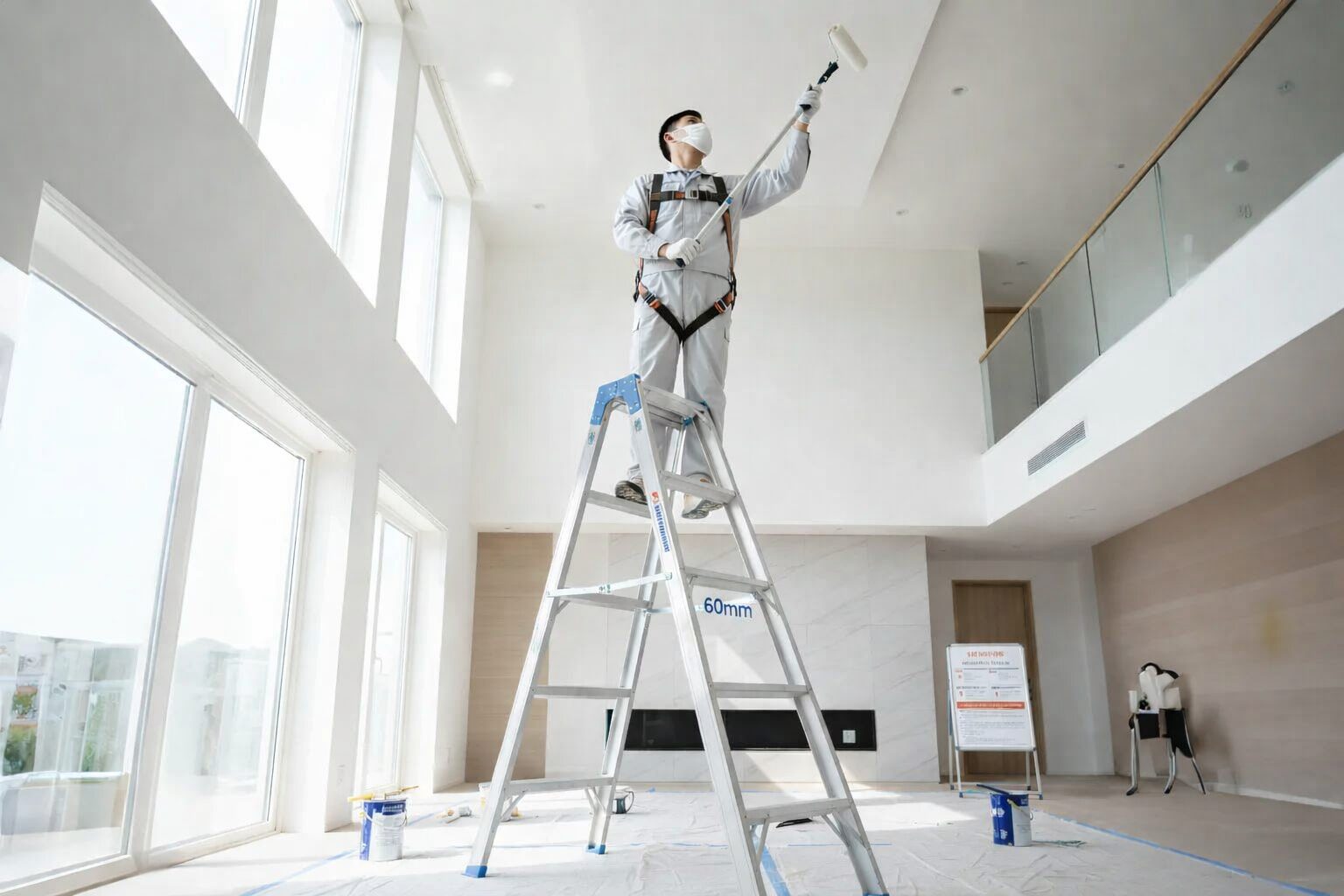
The main product groups manufactured by Hasegawa Vietnam (e.g., the “Ashigaru” series) are designed with a step width of 60mm (some models are even wider), prioritizing the reduction of user fatigue.
It may seem like a difference of only about 20mm, but this difference dramatically changes the physical experience of the worker.
- Dispersion of Pressure: By widening the contact area, the pressure per unit area on the sole of the foot is significantly reduced.
- Heel Stability: With a width of 60mm, the sole of the shoe rests firmly on the step, freeing the user from unstable states like standing on tiptoes.
Hasegawa’s brand message, “Noriba wakaru, tanomoshisa” (Reliability you understand when you step on it), is not just a promotional slogan. This is the result of thoroughly pursuing sensory quality from the design stage, such as the “lack of swaying” and the “grip on the sole” that actual craftsmen feel the moment they step on the product.
Case Study: “I Can’t Go Back to Narrow Stepladders”
Here is a case study of a local construction company undertaking hotel renovation work (interior/painting) in Da Nang city.
Before:
Previously, they used cheap general-purpose aluminum stepladders (step width approx. 40mm) purchased at the market. During ceiling painting work, workers had to get off the ladder every 15 minutes to rest their feet, and by evening, there were complaints that their “calves hurt and were trembling.”
Action:
They experimentally introduced stepladders with wide step specifications (equivalent to products exported to Japan and the US) manufactured at Hasegawa Vietnam’s Da Nang factory.
After:
Workers voiced their surprise, saying, “There is a stability like standing on the ground.” With the anxiety about their footing gone, they were able to concentrate on the detailed painting of the ceiling, and the frequency of breaks was optimized. As a result, the construction time per room was reduced by approximately 15%, and the quality of the finish was stabilized.
World-Class Quality from Da Nang, Vietnam
Quality Standards That Withstand “100,000 Ascents and Descents”
Hasegawa Vietnam’s products are not simply “wide.” Their strength is designed assuming harsh professional worksites.
The Hasegawa Group, including the Da Nang factory, not only clears standards such as JIS (Japanese Industrial Standards) and SG (Consumer Product Safety Association) but also sets even stricter internal standards. For example, in the development of the “Tough Series,” durability tests exceeding 100,000 cycles are conducted, assuming 100 ascents and descents per day, 5 days a week, for 3 years.
This means that once purchased, it can be used safely for a long period, and since there is no need for frequent replacement, it contributes to cost reduction in the long run.
“Non-Swaying” Design That Resonates with a Craftsman’s Sensibilities
The true value of Hasegawa Vietnam lies in the pursuit of “sensory quality” that does not appear in data.
Designers themselves actually stand on the stepladders and conduct “sensory evaluations” to verify “swaying,” “deflection,” and “squeaking sounds” that cannot be captured by data alone.
In delicate work like interior finishing, even a slight “clunk” or sway of the stepladder can throw off one’s hand. Hasegawa’s stepladders are manufactured at the Da Nang factory in Vietnam (established in 2013) by skilled Vietnamese staff who have inherited the Japanese craftsman spirit, and their quality is highly rated by professionals in Japan and the United States.
Conclusion
In the interior and painting industries, a stepladder is not just a “climbing tool” but an important “partner” that determines a craftsman’s performance. Choosing a wide step of 60mm, just 20mm wider, can be said to be the most certain investment for reducing fatigue during work, lowering the risk of fall accidents, and improving construction quality.
Hasegawa Vietnam’s products, packed with about 70 years of know-how from Hasegawa Kogyo Co., Ltd. (founded in 1956), provide “Japanese safety” and “comfort” to Vietnamese worksites. Please experience the difference that you will “understand when you step on it.”