
Introduction
In the rapidly developing infrastructure and factory construction sites across Vietnam, aluminum ladders and stepladders are indispensable tools. However, many site supervisors and procurement officers are troubled by “product damage” and “abnormal noise (rattling)” during transportation. When transporting ladders from urban centers like Hanoi and Ho Chi Minh City to rural sites with inadequate paving, vehicle vibrations cause more damage to products than one might imagine.
A loading method of “just stacking and tying with rope” not only shortens product life but also risks causing serious falling accidents. In this article, based on years of expertise, Hasegawa Vietnam provides a thorough explanation of “rattling” countermeasures that consider the characteristics of aluminum, as well as professional loading techniques to protect your ladders as valuable assets.
Challenges and Background: Why You Must Not Ignore “Rattling”
Market Data: Current Status of Transportation Risks
In Vietnam’s logistics and construction industries, damage due to improper cargo securing remains at a high level. According to reports from the Ministry of Transport (MOT), violations related to overloading and improper securing of freight vehicles account for approximately 15% of annual enforcement cases. Aluminum products, in particular, are lightweight but sensitive to localized impacts and repeated vibrations.
Risk Assessment: The Terror of Invisible “Metal Fatigue”
The “clicking” and “rattling” sounds generated during vehicle transport are signs that aluminum components are colliding with each other or with the vehicle’s cargo bed. If left unaddressed, the following three risks will emerge:
- Metal Fatigue: Unlike steel, the fatigue limit of aluminum accumulates even with repeated micro-vibrations. Driving vibrations repeated hundreds of times per minute can cause cracks in joints within a few months.
- Wear of Joints: Connection pins in the telescopic parts or rungs (steps) of the ladder wear down due to vibration, causing “rattling” during use and increasing the risk of workers falling.
- Destruction of Surface Oxide Film: Anodized coatings peel off due to friction, accelerating corrosion in Vietnam’s uniquely high-humidity and salt-damaged regions.
Steps for Correct Loading and Securing
To minimize damage during transport, securing based on physics is required.
Basic Principles of Loading: Utilizing Protective Materials
When placing a ladder on a cargo bed, the first thing to do is to support it with a “surface” rather than a “point.”
- Placement of Cushioning Material: Insert rubber mats or urethane foam with a thickness of 10mm or more where the vehicle’s side panels and the ladder come into contact.
- Loading Direction: To minimize the influence of wind pressure, it is fundamental to load parallel to the direction of travel.
Practical! Professional Securing Techniques
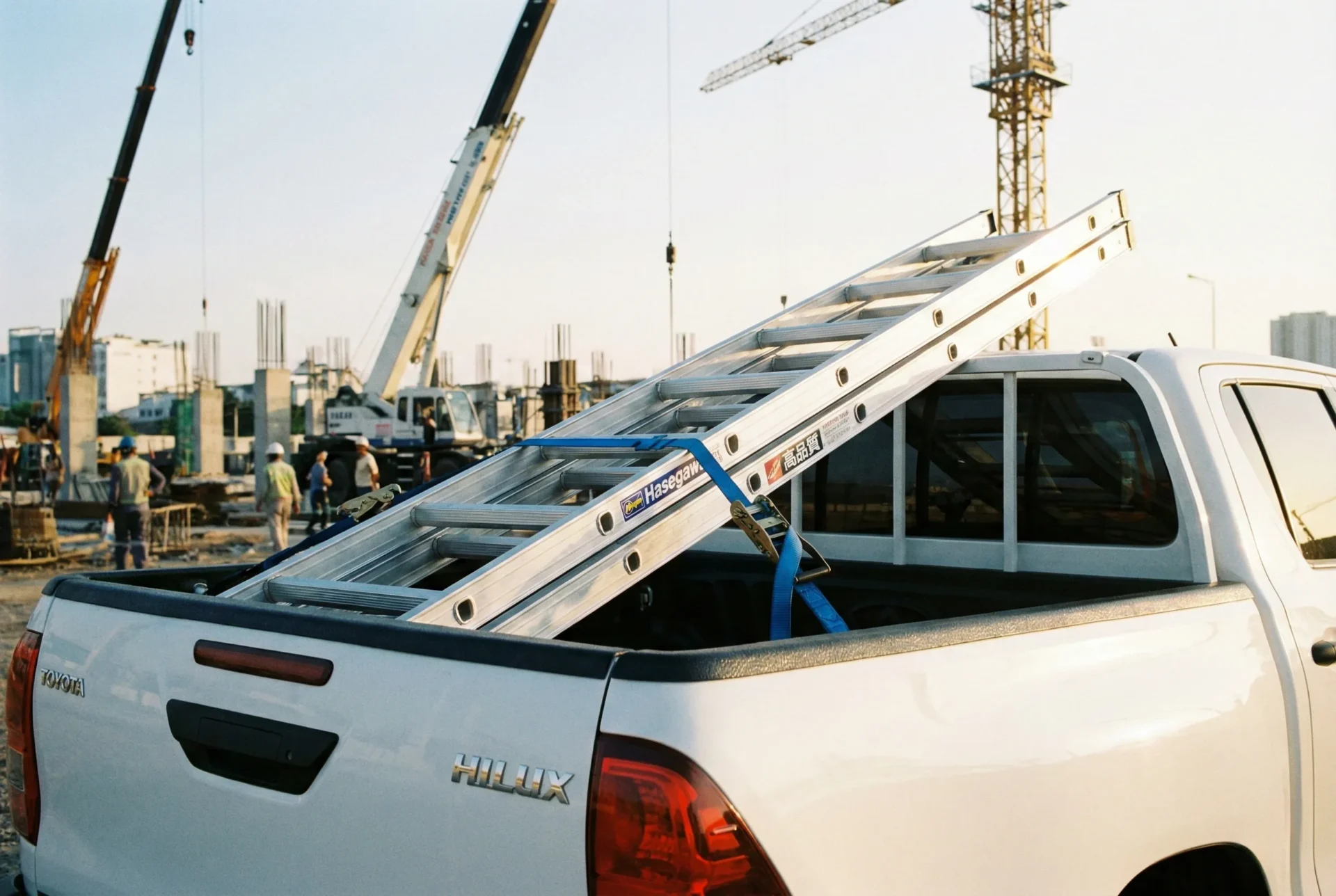
Because securing with rope is prone to “loosening,” Hasegawa strongly recommends the use of ratchet straps.
- Thorough 3-Point Support: By securing at three points—front, center, and rear—you simultaneously suppress pitching (front-back sway) and rolling (left-right sway).
- Management of Tightening Torque: Over-tightening can distort the aluminum rails. The ideal state is when the belt deflects about 10mm when pressed with a finger.
- Checking Telescopic Locks: For telescopic ladders, always visually confirm that the locks are fully engaged before driving.
Hasegawa Products & Services: A “Partner on Site” Resistant to Vibration
Features: Overwhelming Rigidity and Durability
The products provided by Hasegawa Vietnam are not simply lightweight.
- High-Rigidity Frame: Utilizes high-quality aluminum alloys also used in aircraft. Compared to other companies’ products, torsional rigidity is improved by approximately 20%.
- Anti-Vibration Design: By using precision fitting technology at the joints of parts, wear caused by micro-vibrations is drastically reduced.
Case Study: Telecommunications Construction Company A (Danang, Vietnam)
- Before: Ladder joints wore out during vehicle transport, leading to replacement every year on average. Over 100 units were disposed of annually.
- Action: Switched to Hasegawa’s “High-Durability Models” and introduced dedicated vehicle mounting brackets. Conducted “Loading Training” for site staff.
- After: Two years after implementation, there have been zero disposals due to damage. Successfully reduced annual maintenance costs by approximately 60%.
Hasegawa’s Reliability: Bringing Japanese Quality to Vietnam’s Sites
Quality Control and Certification
At Hasegawa Vietnam’s Binh Duong factory, we perform strict quality control in accordance with Japanese JIS (Japanese Industrial Standards).
- Strength Testing: Only products that pass 100,000-cycle repetitive load tests are shipped.
- TCVN Compliance: Our products also comply with Vietnam National Standards (TCVN), comfortably clearing safety standards for government projects and foreign-affiliated factories.
Customization and Support System
In response to needs such as “loading on special vehicles” or “transporting a large number of ladders more efficiently,” we also design custom securing jigs. Furthermore, Japanese engineers or trained local staff visit sites across Vietnam to provide after-sales services, including safety handling guidance.
Summary
Suppressing the “rattling” of ladders during transport is not just a noise countermeasure. It is an important professional responsibility to extend the life of expensive work tools, protect workers’ lives, and prevent accidents during transportation.
- Prevent friction by using cushioning materials.
- Control vibration with 3-point securing using ratchet straps.
- Maximize long-term cost performance by choosing high-quality Hasegawa products.
To achieve the highest level of safety in Vietnam’s harsh environments, please consider Hasegawa Vietnam’s solutions. Please feel free to contact us via the link below to request product catalogs or consultations regarding loading methods.