
Introduction
In Vietnam’s construction and manufacturing sites, fall accidents during work at heights remain a serious issue. According to the latest data from the Ministry of Labour, Invalids and Social Affairs (MOLISA), the number of deaths due to occupational accidents reached 727 in 2024, an increase of 28 from the previous year. The construction industry, in particular, is cited as one of the industries with the most fatal accidents, with approximately 46.9% of the main causes attributed to “poor safety management by employers.”
“It is just a stepladder, yet it is a stepladder.” For site managers and safety officers, correct knowledge and appropriate tool selection are nothing less than an investment to protect the lives of employees. In this article, based on Hasegawa Kogyo’s 70 years of safety expertise, we will answer “frequently asked questions” from the field from a professional perspective. A must-read for site managers in Vietnam. From how to choose ladders and stepladders, the physical reasons why you should not stand on the top plate, to guidelines for replacement timing, professionals answer your common questions. Let’s prevent accidents during work at heights with knowledge based on JIS standards and Hasegawa’s unique safety standards. Hasegawa Vietnam Official. 【Selection Edition】 How to choose the best product for the site?
Q1: What are the criteria for distinguishing between “ladders” and “stepladders”?
Basically, distinguish them according to the situation and height of the work location. A “Stepladder” has a self-supporting structure and can be used even in places without walls. On the other hand, a “Ladder” is used by leaning it against a wall, so it is suitable for accessing higher places, but strict adherence to the installation angle (75 degrees) is required.
In JIS standards (Japanese Industrial Standards) and Hasegawa standards, there is a major principle that for stepladders, “you must not stand on the top plate (the very top step).” Therefore, it is necessary to select a size where the height of the top plate has sufficient margin relative to the required working height.
Q2: Which size of stepladder should be chosen for the working height?
Choose based on “effective height.” The size indication on the stepladder (top plate height) differs from the height at which work can actually be done safely (effective height).
Since standing on the top plate is prohibited, the second step from the top (approximately 60cm down) becomes the substantial highest working floor.
- Calculation formula: Required working height – Worker’s height + Margin = Required effective height
For example, when working in a place with a ceiling height of 3m, if the worker is 170cm tall, it is safe to select a stepladder with an effective height of about 1.5m to 1.8m (top plate height 2.1m to 2.4m class).
Q3: What is the difference between safety standards in Vietnam (TCVN) and Japan (JIS/SG)?
Although the national standard TCVN exists in Vietnam, many cheap products that do not meet the standards are circulating in the market. On the other hand, Hasegawa Vietnam’s products are manufactured in compliance with Japan’s JIS S 1121 (Aluminium alloy ladders and stepladders) and the SG Mark (Safety Goods) standards, which are considered globally strict.
Products manufactured at the Da Nang factory are exported to demanding markets such as Japan, the United States (ANSI standards), and Hong Kong, accounting for approximately 99% of total production. In other words, choosing a Hasegawa product within Vietnam means introducing global-standard safety directly to your site.
【Safety & Usage Edition】 What is the correct usage to aim for zero accidents?
Key Data: Occupational Accidents in Vietnam and Hasegawa’s Quality Standards
- 2024 Vietnam workplace accident deaths: 727 (+28 YoY)
- Employer liability ratio in accident causes: 46.9%
- Hasegawa Vietnam establishment: December 2, 2013
- Export ratio to Japan: 40.89%
- Quality test frequency: Over 250 times/month (Group-wide)
Source: VietnamPlus, Hasegawa Vietnam Report
Q4: Why must you not stand on the top plate (the top step) of a stepladder?
It is a matter of physics regarding “center of gravity” and “balance.” When standing on the top plate, the worker’s center of gravity becomes too high, becoming unstable relative to the stepladder’s base of support (the spread of the feet). In this state, if you lean out sideways even slightly, a tipping moment acts, drastically increasing the risk of falling over together with the stepladder.
Hasegawa’s “Shagaman” series and others avoid this risk at the design stage, such as by equipping a bar that serves as a knee support so that work can be done easily without standing on the top plate.
Q5: What specifically is the “3-point contact” state?
When ascending or descending, please strictly observe the rule of “Three Points of Contact,” keeping three of your four limbs in contact with the ladder or stepladder at all times.
- OK: Both hands and one foot, or one hand and both feet in contact.
- NG: Climbing with luggage in both hands (no support points), rushing up and down (tends to become 2-point contact).
It is an iron rule to use a tool belt or pull up luggage with a rope, and always keep your hands empty for ascending and descending.
Q6: Is it necessary to always lock the spreader bars (opening stopper) of the stepladder?
Yes, please always lock it. The “spreader bar (opening stopper)” is an important structural component that prevents the legs of the stepladder from opening too wide or, conversely, closing. If you forget to lock it, the stepladder may close unexpectedly due to vibration during ascent/descent, leading to a fall accident. Hasegawa products adopt visually easy-to-understand hardware to prevent forgetting to lock, and safety mechanisms such as the One-Touch Bar.
【Maintenance & Management Edition】 Product Lifespan and Maintenance
Q7: Do ladders/stepladders have a “lifespan”? What is the guideline for replacement timing?
The lifespan of aluminum ladders and stepladders depends on the usage environment and frequency, but it is generally said to be about 5 to 10 years under proper maintenance. However, deterioration may accelerate in Vietnam’s high temperature and high humidity climate, or in hard outdoor usage environments.
In addition to the number of years, if the following symptoms are seen, it is a sign for “immediate replacement.”
- Deformation or bending of stiles (frame) or steps.
- Looseness or wobbling of rivets (joints).
- Wear or loss of anti-slip end caps (rubber feet).
Q8: What should be checked during daily inspections?
In the pre-work inspection, please check the “feet” and “joints” in particular. If the anti-slip rubber is worn and the rivets are exposed, it causes slipping and falling.
The Hasegawa Group conducts durability tests assuming 100 ascents/descents per day for 5 days a week, totaling over 100,000 cycles, ensuring durability that clears this rigorous test, but daily inspection remains the last fortress of safety.
Hasegawa Kogyo’s (Hasegawa) Commitment to Quality
Q9: Why are Hasegawa stepladders said to “not wobble”?
That is because we incorporate “human senses” into the verification process, not just numerical data. Hasegawa has a manufacturing philosophy of “Reliability you understand when you step on it.”
Clearing the JIS standard load test is the minimum requirement. In addition to that, at four testing centers worldwide including the Da Nang factory, developers actually step on the products to thoroughly eliminate minute “wobbling,” “sounds,” and “deflection” that do not appear in numerical values. This “sensory quality” is the reason why we have been chosen by Japanese professional craftsmen for many years.
Q10: What is the product lineup available for purchase in Vietnam?
Hasegawa Vietnam offers a wide range of products, from tough lineups for professionals to models that emphasize design.
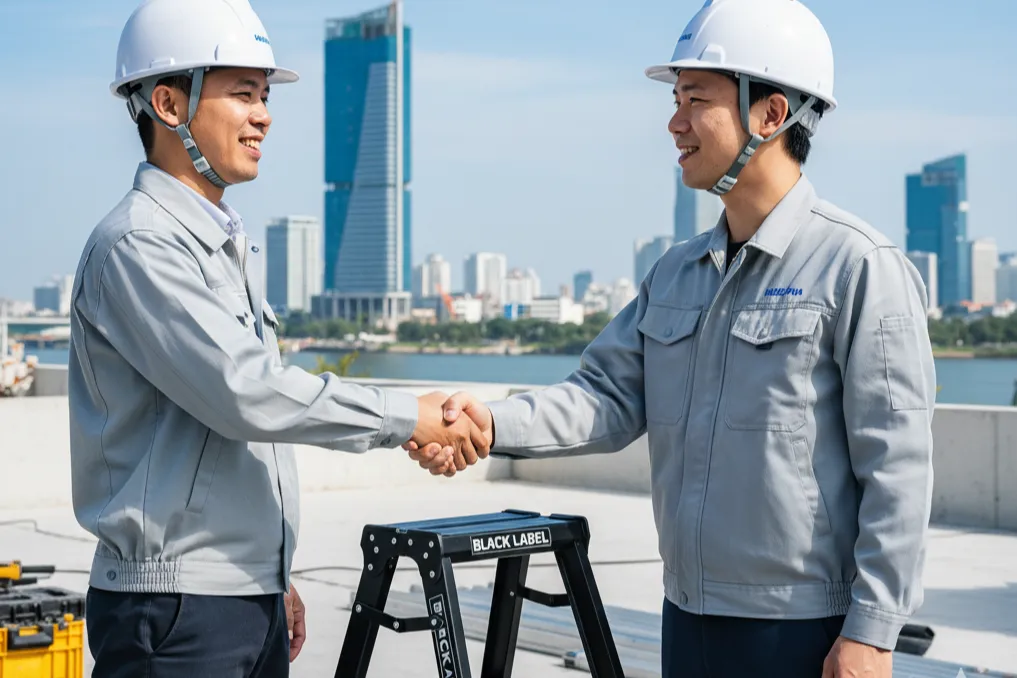
- BLACK LABEL: The highest peak series for professionals, boasting unshakable strength.
- Ashigaru: Embodying “light and strong,” reducing the burden of carrying.
- lucano: A design award-winning series that blends into the interior of living rooms and stores.
All of these are manufactured at the Da Nang factory in Vietnam under the same strict quality control as the mother factory in Japan.
Summary
Ladders and stepladders are not just tools, but “scaffolding” that supports workers’ lives in dangerous high places. As shown by the 2024 occupational accident data, the cost of neglecting investment in safety is immense.
Hasegawa products, manufactured in Vietnam and honed in the tough sites of Japan and the United States, provide “peace of mind” and “safety” to your sites. Let’s follow the correct selection and usage methods to realize accident-free sites.
Please feel free to contact Hasegawa Vietnam for product introduction consultations or requests for specific safety training.