
Introduction
“Telescopic ladders” are exposed to harsh environments daily at construction sites and factories in Vietnam. Due to the convenience of compact storage, they are valued at electrical work and interior finishing sites. However, within half a year of purchase, do you encounter troubles such as “it won’t retract,” “it gets stuck when extending,” or “the lock is stiff”?
“Because movement is poor,” you might spray anti-rust lubricant (oil-based spray) you have on hand—actually, this is the biggest cause of shortening the ladder’s lifespan. In sites with Vietnam’s unique humidity and fine dust, incorrect maintenance turns the product into a “dangerous tool.”
This article explains the correct maintenance method for telescopic ladders based on Hasegawa Vietnam’s quality control standards. We will introduce why “oil” is strictly prohibited and the scientific superiority of “silicone spray” loved by professionals, using specific data.
Why do telescopic ladders “stop moving”?
Vietnam’s site environment and structural risks
For a telescopic ladder to extend and retract smoothly, a precise “clearance (gap)” is required between the pipes. However, construction sites in Vietnam are a very harsh environment for this gap.
- Intrusion of fine dust: The average particle size of dust generated when cutting cement or gypsum board is 10µm to 20µm (micrometers). This is a fraction of the thickness of human hair (about 80µm) and easily penetrates even the slightest gaps in the ladder.
- “Sludge formation” of oil-based lubricants: General anti-rust lubricants (petroleum-based oils) and grease have high viscosity and strongly attract this dust. As a result, the oil and dust mix inside to generate a black, sticky “sludge (abrasive-like mixture).” This increases frictional resistance inside the pipes and causes seizing.
Risk of “lock failure” caused by forced operation
Absolutely avoid forcing a ladder that moves poorly or trying to retract it by kicking it. There is a risk that internal plastic parts or lock pins will deform, leading to “lock failure” where the ladder suddenly retracts during use.
According to data from the U.S. Bureau of Labor Statistics (BLS), there were 161 fatal occupational injuries related to ladders in 2020, many occurring during construction and maintenance work. Also, about 43% of ladder-related accidents have led to fatal falls over the past decade. Equipment malfunction due to poor maintenance is one of the factors that dramatically increases these accident risks.
【Practical Edition】 Maintenance procedures to keep it smooth
Here, we introduce the correct procedures to break bad habits and restore the ladder’s original performance.
What to prepare (with NG item list)
The most important thing is “what not to use.”
- 【OK】 Recommended Items:
- Silicone spray (solvent-free type): Does not attack plastic or rubber and forms a dry film after drying. It has a high heat resistance temperature of about 180-200°C and has the characteristic of not easily deteriorating even in Vietnam’s high-temperature environment.
- Air duster (or compressor): Blows away debris in the gaps.
- Dry clean cloth: For wiping off dirt.
- 【NG】 Absolutely Prohibited Items:
- Oil-based lubricants (CRC 5-56, standard WD-40, etc.): Leave a sticky residue and attract dust.
- Machine oil/Grease: Viscosity is too high and solidifies inside.
3-Step Cleaning Technique (Before → Action → After)
- Step 1: Air Blow (Dust Removal) With the ladder fully extended, blow air into the pipe joints (around resin parts). The purpose is to force out the fine dust of 10µm class that has entered inside.
- Step 2: Dry Wipe (Oxidation Film Removal) If the surface of the aluminum pipe is black, it is a mixture of dirt and aluminum oxide. Wipe it off firmly with a dry cloth. Avoid washing with water as it causes internal mechanisms to rust.
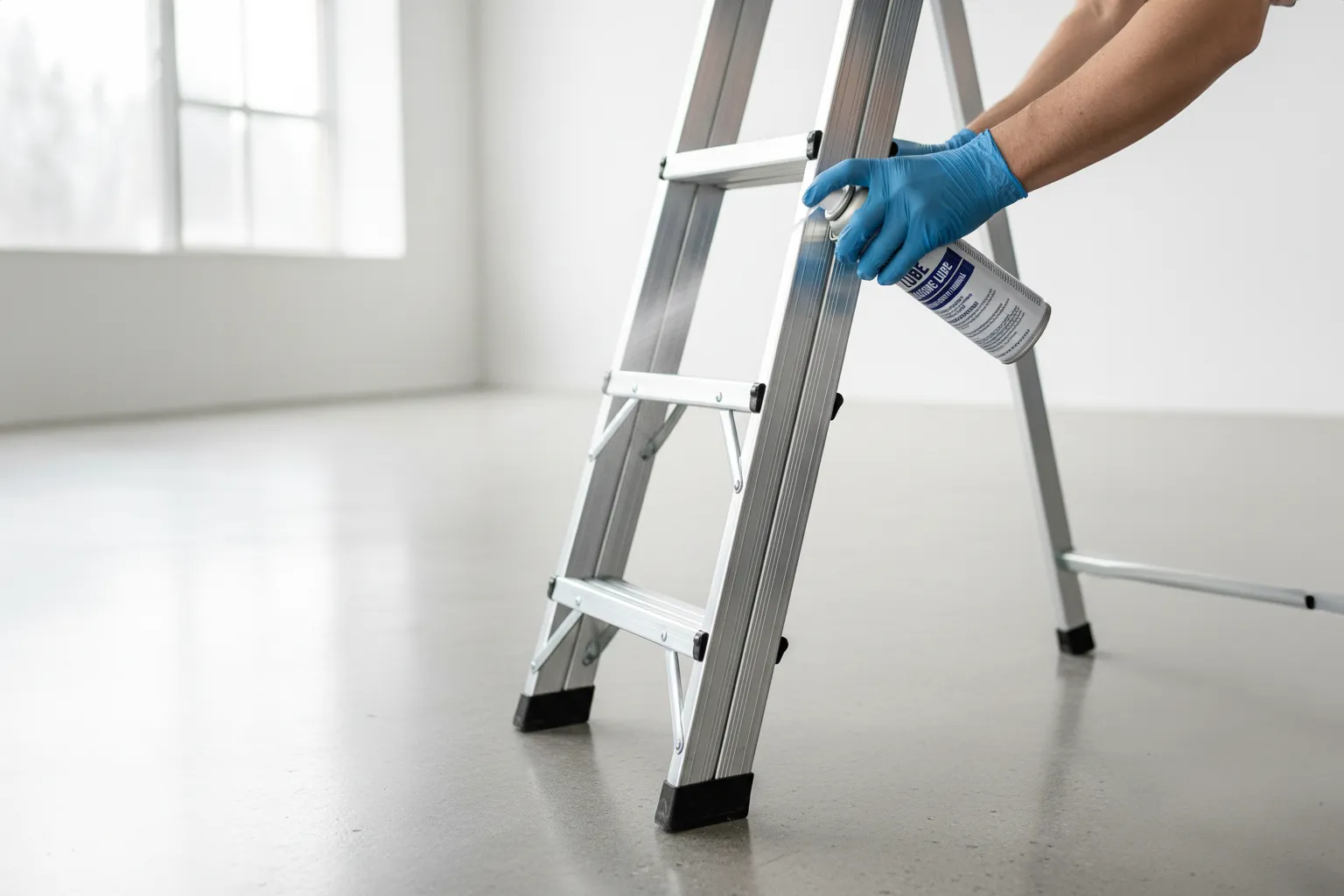
- Step 3: Silicone Application and “Wiping Off” Spray silicone spray thinly on the sliding parts (overlapping parts) of the pipes. What is important here is “always wipe dry after spraying.” Silicone exerts sufficient lubrication effect (reduction of friction coefficient) if there is an extremely thin film. If enough remains to drip, it conversely becomes a cause for attracting dirt. The friction coefficient between aluminum parts after silicone film formation improves dramatically in a dry state, restoring smooth movement.
Secrets of Hasegawa’s quality and longevity
Precise “clearance” design and durability
Why does Hasegawa’s telescopic ladder require such care in maintenance? It is because of the “precise design” that suppresses wobbling to the limit. Products manufactured by Hasegawa Vietnam (established December 2, 2013) are exported to strict markets in Japan and the United States. In these markets, no compromise on safety is allowed.
Hasegawa conducts repeated lifting tests exceeding 100,000 cycles at the product development stage. This is to prove that the design can withstand long-term use even if a professional craftsman uses it 100 times a day, 5 days a week. To maintain this durability, keeping the frictional resistance as designed—that is, correct maintenance—is essential.
To maintain “Reliability you can feel when you step on it”
The new message “Reliability you can feel when you step on it,” announced in December 2024, represents Hasegawa’s philosophy of emphasizing “sensory peace of mind” that cannot be measured by numerical data alone. Hasegawa stepladders and ladders that are well-maintained minimize the “sway” and “squeaking” peculiar to high-place work. Conversely, using a ladder that moves poorly due to incorrect maintenance is nothing but abandoning this “reliability” yourself and working with anxiety.
Summary
The points to extend the life of the telescopic ladder and use it safely are the following three.
- Eliminate Oil-based Oils: High-viscosity oil and grease attract dust and cause breakdowns. Absolutely do not use them.
- Use Silicone Spray: Use non-sticky, heat-resistant silicone spray, and always wipe off after application to create a thin film.
- Post-use Habit: Establish a habit of performing air blow and dry wiping before storage so as not to carry over site dust (10µm class particles).
Hasegawa Vietnam delivers world-standard safety from the Da Nang factory. If movement does not improve even after maintenance, or if damage to parts is seen, do not force disassembly and please consult the official support window. Safety begins with the correct care of tools.