
Introduction | For Everyone Unsure About Ladder and Stepladder Height
Ladders and stepladders are widely used for everything from light home tasks to professional construction sites. However, many people are unsure about “what height is appropriate.” This is a critical choice that directly impacts safety and work efficiency. In Vietnam’s manufacturing, construction, logistics, and equipment sectors, accidents and inefficient work due to incorrect height selection have become a significant issue.
For example, it’s a common experience to feel “just a little bit short” or “wobbly and scared” when changing a light bulb or cleaning an air conditioner. Such unstable situations can actually lead to accidents like falls and slips.
This article provides a practical guide to selecting the optimal ladder or stepladder size by calculating the safe working height based on the user’s height and the task at hand. We have covered essential information for the job site, including recommended sizes for different tasks, safety standards, and material differences. Please use this as a valuable guide for both first-time buyers and professionals.
Why Is Choosing the Right Height Important?
Risks and Statistics of Elevated Work
Among industrial accidents in the ASEAN region, including Vietnam, “falls from height” consistently rank high each year, particularly in construction, equipment, and logistics workplaces. According to data from Japan’s Ministry of Health, Labour and Welfare, the majority of accidents involving stepladders and ladders are caused by “inappropriate height selection,” “standing on the top platform,” or “unstable setup.”
Legally, the Industrial Safety and Health Act mandates the use of a safety harness (full harness) and safety training for elevated work at heights of 2m or more. This is a critical point that also complies with TCVN (Vietnam National Standards) and ISO international standards.
Common Accidents and Their Causes
Accidents at work sites often result from “just a little bit of a stretch.” For example, we frequently see cases where people lose their balance by standing on the top platform or where a stepladder shakes and falls over due to an unstable setup on an uneven surface. Accidents caused by working on slippery floors or tiles without a proper stepladder have also been reported in homes.
Furthermore, when using a ladder, there are cases where the contact point with the building shifts, causing the entire ladder to fall. The absence of a helper can be a contributing factor. Choosing the correct size and structure is the first step toward significantly reducing these risks.
Types of Ladders and Stepladders and Tips for Selection
Differences in Types, Sizes, Materials, and Selection Criteria
When selecting a stepladder or ladder, the key is to choose the type and size based on “where, who, and what you are doing.”
The following types of stepladders are available:
- Dedicated Stepladder: A-frame type, focused on stability
- Dual-Purpose Stepladder: A 2-in-1 model that functions as both a stepladder and a ladder
- Tripod Stepladder: Offers high stability on uneven ground
- Platform Type: Has a wide top platform, suitable for long-duration work
- Adjustable Stepladder: Can handle uneven steps and narrow spaces
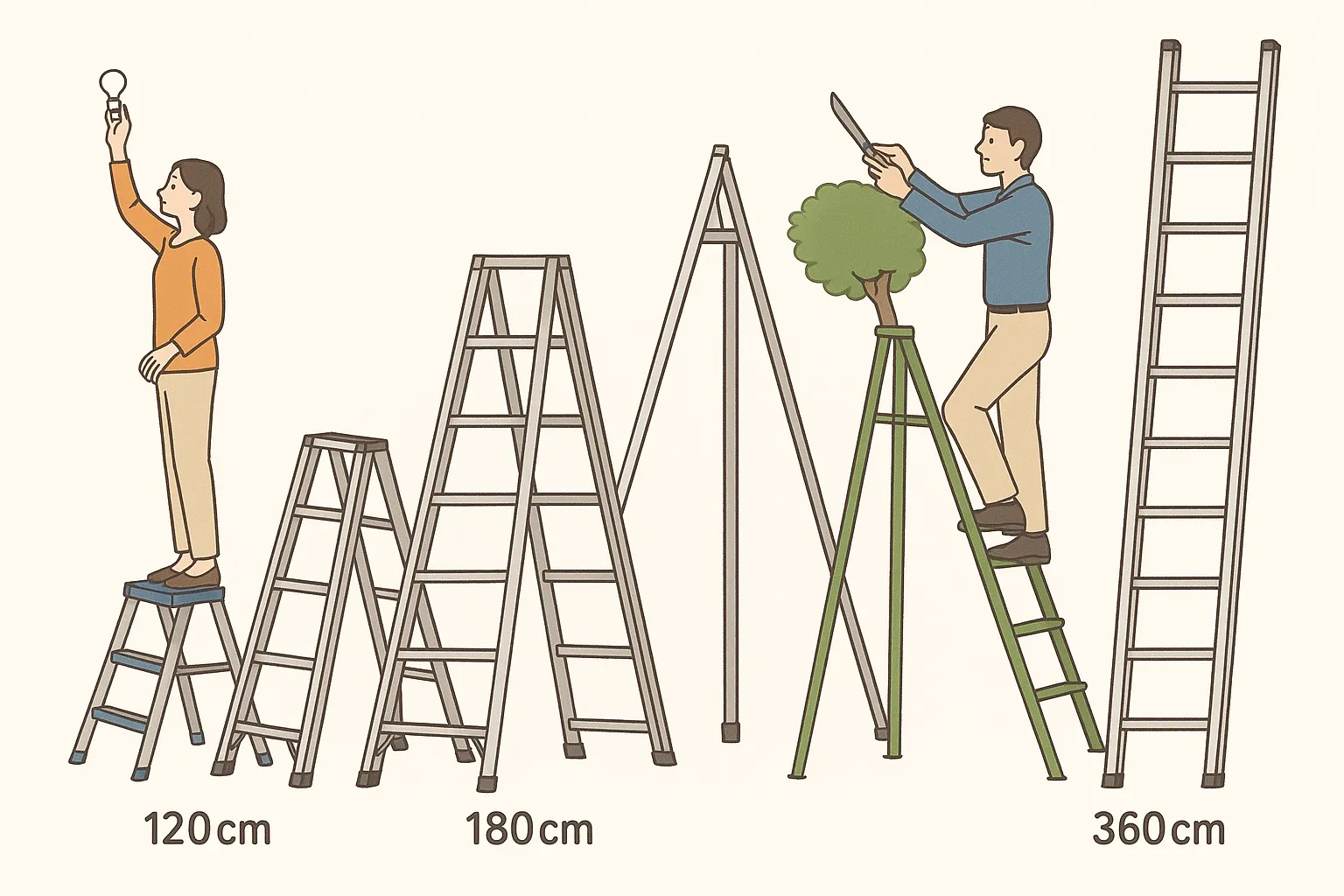
The optimal size also varies depending on the purpose. For example, when changing a light fixture in a room with a 2.5m ceiling, a stepladder height of 120-150cm is a good guide. A worker who is 160cm tall can reach a height of about 2.0m, allowing for safe work without standing on the top platform.
Material selection is also important. Aluminum is lightweight and easy to handle, while FRP (with its insulation and corrosion resistance) is ideal for electrical equipment. For load capacity and safety, choosing products with the SG Mark, JIS standard, or A Mark display increases reliability.
Effects and Improvements Seen in Case Studies
- Factory (Before): Work is slow due to instability on uneven ground.→ Action: An adjustable stepladder was deployed.→ After: Stability was ensured by compensating for the unevenness, reducing work time by 25%.
- Warehouse (Before): Workers habitually perform tasks in dangerous postures because they can’t reach high shelves.→ Action: A dual-purpose stepladder was used in ladder mode.→ After: Workers can reach safely, improving work efficiency and reducing accident risk.
- Home (Before): Using an unstable platform to wash an SUV.→ Action: A stepping stool with anti-slip features was deployed.→ After: Can wash the car in a stable posture, and it is also easy to store.
Why Is Hasegawa Chosen?
Quality Assurance Based on International Standards
Hasegawa Kogyo strictly enforces quality management to guarantee product reliability. We have acquired ISO 9001 certification and conduct our own strength and load capacity tests on all products. Furthermore, our stepladder and ladder products are designed to meet domestic and international safety standards such as the SG Mark, JIS certification, and A Mark.
Products that have cleared these standards are widely adopted as “safe-to-use” ladders for factories, construction sites, and home use.
Local Support in Vietnam and After-Sales Service
In the Vietnamese market, Hasegawa provides solutions tailored to local needs, not just products. Our Vietnam subsidiary can directly handle everything from product selection advice based on purpose and work environment, to custom orders, product demonstrations, and on-site consultations.
Furthermore, we have a system in place to supply consumable and replacement parts, as well as provide inspection and maintenance support, ensuring peace of mind for long-term use.
Data Box | Stepladder and Ladder Selection Guidelines (for a person 160cm tall)
| Purpose | Required Working Height | Recommended Stepladder/Ladder Size | Points of Caution |
|---|---|---|---|
| Replacing indoor light fixture | Approx. 230cm | 120cm stepladder | Do not stand on the top platform |
| Cleaning an air conditioner | Approx. 250cm | 150cm stepladder | Must prevent wobbling |
| Washing a car (SUV) | Approx. 210cm | 60-90cm step stool | Wide top platform type is safer |
| Pruning garden trees | Approx. 270cm | 180-210cm stepladder | Tripod stepladder is also an option |
| Repairing a 2nd-floor exterior wall | Approx. 400cm | 360cm ladder | Fall prevention measures and a helper are required |
Sources:
Summary | Balancing Safety and Efficiency with Proper Height Selection
Selecting a ladder or stepladder is not just about “being able to reach.” It requires a strategic decision to maximize safety and work efficiency. By choosing the optimal product based on the user’s height, work purpose, and installation environment, you can significantly reduce the risk of falls and slips.
Hasegawa’s ladders and stepladders are widely supported by professionals and home users, not only for their compliance with safety standards but also for their design, materials, and responsiveness that reflect the needs of the job site. In the Vietnamese market, in particular, a local subsidiary provides support, ensuring peace of mind from pre-purchase consultation to after-sales service.