
Introduction
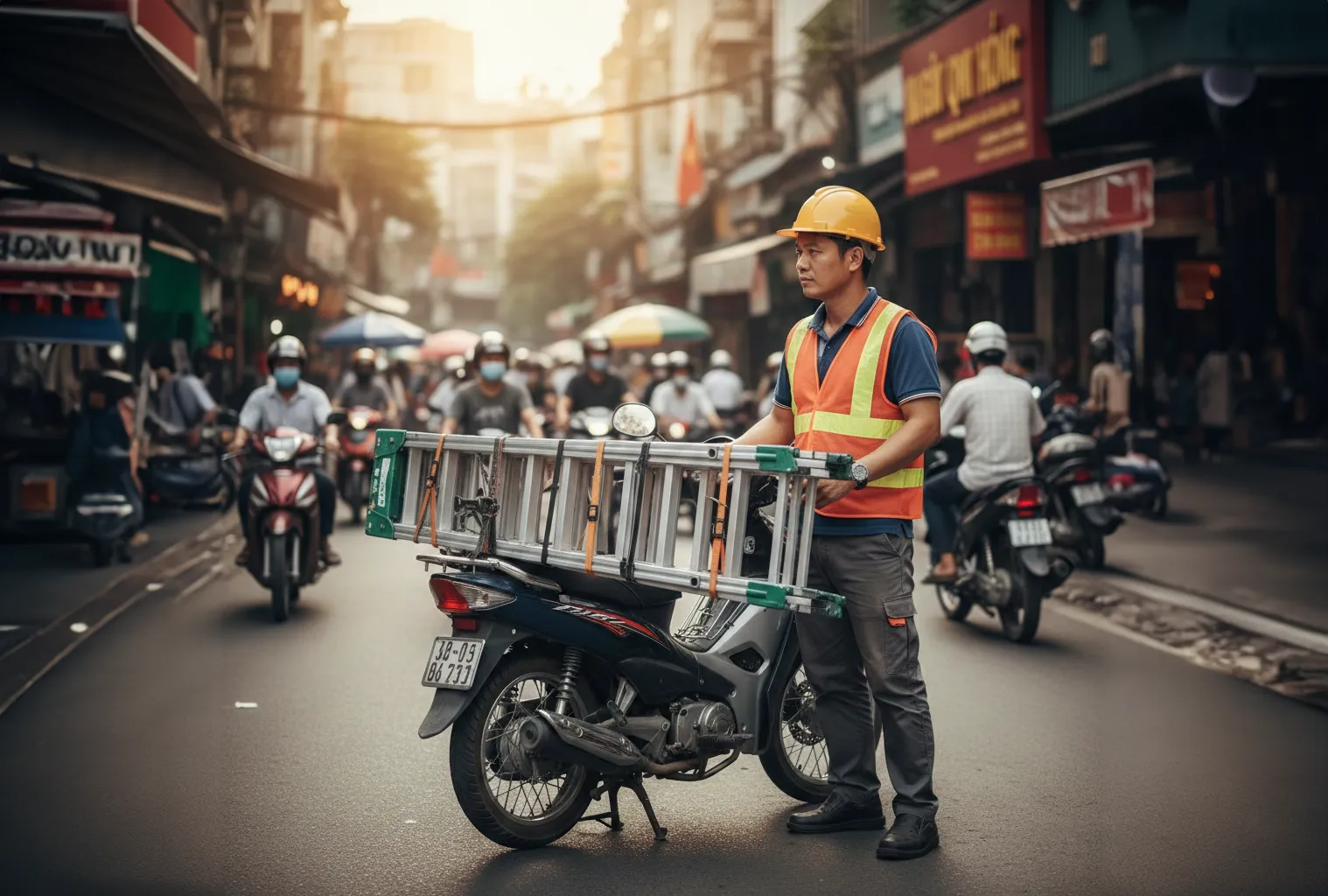
If you look around the streets of Vietnam, you will see the sight of motorbikes flowing like a river. In fact, two-wheelers account for 93% of registered vehicles in the country, with a total exceeding 77 million. For you, the professionals in construction and interior finishing, a motorbike is likely not just a means of commuting, but an important “partner” for transporting materials and tools to the site.
However, have you ever had a close call when transporting long items like “ladders” or “stepladders” on a motorbike? A stepladder tied unstably to the back of a bike can easily throw off your balance, becoming a major cause of falls and collision accidents. In fact, 90% of traffic fatalities in Vietnam are related to motorbike accidents, many of which stem from unsafe driving or loading practices.
In this article, we will change the traditional mindset of “as long as it gets there, it’s fine,” and explain “correct transportation knowledge” to protect your safety and the safety of those around you, along with Hasegawa (Hasegawa Kogyo) solutions that support this.
“3 Risks” Lurking in Motorbike Transportation and Legal Regulations
Transportation methods you perform unconsciously while moving to a site might actually be violations of the law and carry significant accident risks. Here, we organize the three risks that craftsmen working in Vietnam need to know.
1. Loading Limits under Road Traffic Law (Circular 46/2016/TT-BGTVT)
Article 19 of “Circular 46/2016/TT-BGTVT” issued by the Ministry of Transport of Vietnam clearly defines loading limits for motorbikes (two-wheeled vehicles). Exceeding these makes you a target for enforcement by traffic police.
- Width Limit: Must not protrude more than 0.3 meters (30cm) from the left and right edges of the cargo rack (or handlebars).
- Rear Limit: Must not protrude more than 0.5 meters (50cm) from the rear end of the cargo rack.
- Height Limit: Must not exceed 1.5 meters from the ground.
If you load a standard long ladder sideways or load it so it protrudes excessively to the rear, a fine of 400,000〜600,000 VND may be imposed (based on Decree 100/2019/ND-CP and Decree 123/2021/ND-CP). You should consider not only the cost of the fine but also the risks of temporary vehicle confiscation or license suspension.
2. Physical Risks: Balance and Visibility
Physical dangers cannot be ignored either. Long items like stepladders are strongly affected by the wind.
- Impact of Crosswinds: When hit by crosswinds on bridges or wide streets, lightweight motorbikes can easily lose their balance.
- Moment of Inertia: If you load a heavy stepladder in a high position or towards the rear, the center of gravity rises, making the motorbike prone to becoming uncontrollable when turning curves or braking.
- Danger of Filtering (Weaving): In the congested traffic conditions unique to Vietnam, accidents where stepladders protruding sideways make contact with other bikes or pedestrians occur frequently.
3. Damage to the Product
There are also cases where “tools break while being transported.” Shocks from motorbike vibrations and uneven road surfaces can damage the joints (rivets) and movable parts of a stepladder if it is not properly secured. Even if it looks undamaged at a glance, metal fatigue accumulates, and there is a fear that it could break when used on-site, leading to a fall accident.
“Pro Fixing Techniques” for Safe and Secure Transportation
Understanding the risks, if you absolutely must transport by motorbike, there are fixing techniques you should practice as a professional.
How to Choose and Tie Fixing Tools
Many people tend to make do with just rubber cords (Dây thun), but this is insufficient. Because rubber stretches, the load shifts due to vibrations while driving, causing a loss of balance.
- Combined Use of Lashing Belts: Use non-stretching “lashing belts (tie-down straps)” to fix the stepladder completely tight against the cargo rack. This integrates the stepladder with the bike, stabilizing its behavior.
- Principle of 2-Point Fixation: Secure it at a minimum of two points, front and rear, to prevent rotation (shifting).
- Curing (Protection): Sandwich cloth or rubber sheets where the stepladder contacts the cargo rack. This is effective not only for preventing scratches on the stepladder but also for anti-slip purposes.
Manners and Points to Note When Driving
- Lower the Center of Gravity: Load as low as possible. Instead of piling high behind the seat, utilizing specialized side carriers to bring the center of gravity closer to the ground is the key to stable driving.
- Indication of “Overhang”: If it unavoidably protrudes to the rear, it is good manners and a safety measure to attach a red cloth or reflective material to the tip of the stepladder to alert following vehicles.
Hasegawa Solutions Ideal for Motorbike Transport
Safe transportation begins with “selecting the appropriate tools.” Hasegawa (Hasegawa Kogyo) products possess qualities suitable for Vietnamese means of transportation, in addition to quality forged in demanding Japanese worksites.
“Lightness” is Safety Performance: Ashigaru Series
Hasegawa’s “Ashigaru” series overturned the common sense that “stepladders are heavy things.”
- Overwhelming Lightweight: For example, the 3-shaku type (RZ-09c) weighs only 3.4kg, and even the 4-shaku type (RZ-12c) is 4.2kg. This is up to 30% lighter compared to standard stepladders.
- Contribution to Bike Handling: A light load means the bike’s center of gravity shifts more smoothly, dramatically reducing the risk of wobbling or falling during low-speed driving. The lightness that allows it to be easily held with one hand also reduces the burden of loading and unloading, preserving the craftsman’s stamina.
Maximizing Mobility: Telescopic and Folding Models
To clear legal regulations (length and height limits), models that can be stored compactly are ideal.
- Telescopic Stepladders: Telescopic ladders like the “Ashigaru” series and “RYZB” are tall when in use but compact when moving. This minimizes “overhang” when loaded on a bike, reducing the risk of police enforcement and contact accidents.
- Stylish Options: Design-oriented series like
lucanohave a flat and beautiful shape when folded, making them easy to stack and secure.
Hasegawa Reliability: “Dependability” During Transport and On-Site
The reason Hasegawa products are chosen is not just for their specs. Behind the brand message “You’ll know it when you step on it: Dependability” lies rigorous quality testing.
Durability Tests That Withstand Vibration
At four testing centers worldwide, including the factory in Da Nang, Vietnam, rigorous tests based on JIS (Japanese Industrial Standards) and SG (Safe Goods) standards are conducted.
- Repetition Tests: Over 100,000 ascent/descent repetition tests are conducted to verify the durability of rivets and fittings.
- Resistance to Vibration: This sturdy structure demonstrates high durability even against the severe vibrations received when traveling on Vietnamese rough roads by motorbike. With cheap products, wobbling may occur due to vibration during transport, but Hasegawa stepladders maintain their “strength” and provide unchanged safety after arriving at the site.
Summary
In Vietnamese worksites, transporting materials by motorbike is an unavoidable reality. However, ignoring those risks is synonymous with putting your career as a professional in danger.
- Legal Compliance: Adhere to loading limits (width 30cm, rear 50cm) to prevent fines and accidents.
- Secure Fixing: Use not just rubber cords, but lashing belts to fix it so it “doesn’t move.”
- Optimal Tools: Ensure driving stability by choosing lightweight and compact products like Hasegawa’s “Ashigaru.”
“Safety” is not something to be observed only at the site; it begins on the way to the site. Hasegawa products are a reliable partner that supports even the safety of your journey.