
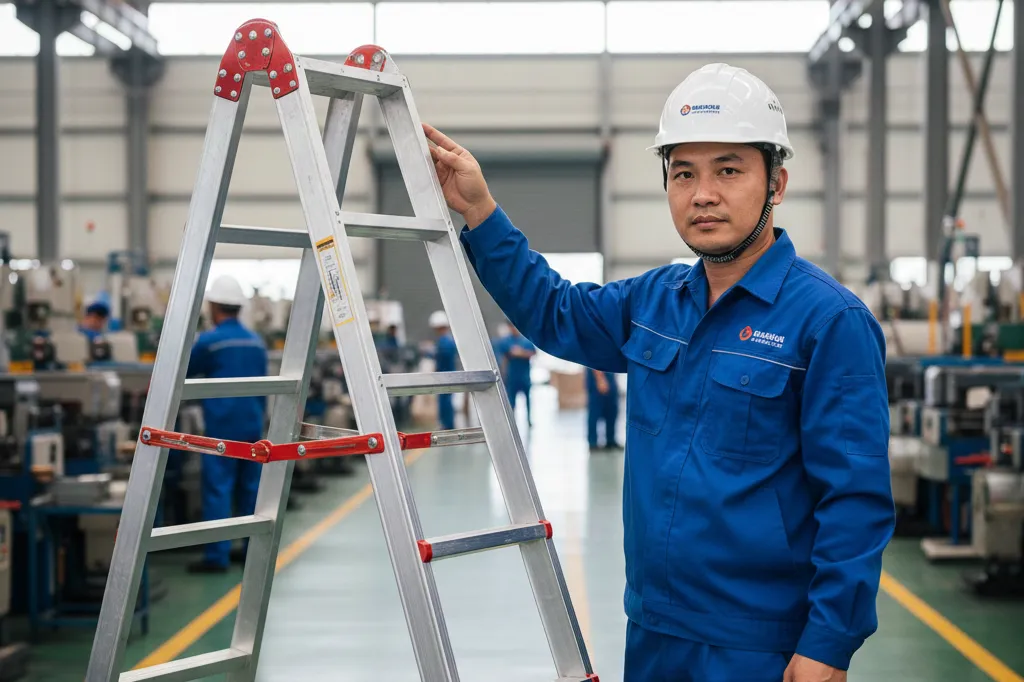
Introduction
“At that moment, I almost fell…” Have you ever had such a spine-chilling experience at a construction site or factory in Vietnam? With Vietnam continuing its rapid economic growth, construction rushes and the expansion of production lines are everyday scenery. However, behind this speed, there is a reality where worker safety is threatened by “familiarity” and “overconfidence.”
Just because an accident didn’t happen doesn’t mean you should overlook the dangerous warning signs. These are called “Hiyari-Hatto” (Near-misses / Sự cố suýt bị), and they are precursors to serious accidents. In this article, we will unravel the risks of high-altitude work actually occurring at sites in Vietnam using statistical data, and propose specific solutions based on Hasegawa Kogyo’s (Hasegawa) safety philosophy.
Issues and Risks at Sites in Vietnam
The Reality of Occupational Accidents Seen in Data
According to data from the Ministry of Labour, Invalids and Social Affairs (MOLISA) and others, occupational accidents remain a serious social issue. In the 2024 statistics, 8,286 occupational accidents occurred nationwide, with the number of victims reaching 8,472. Compared to the previous year, the number of accidents increased by 892.
Of particular note is the high risk in the construction industry. A survey on construction accidents in Vietnam shows that “falls from height” account for an overwhelming 60.4% of fatal accident causes. Furthermore, the economic loss caused by these accidents is estimated to be over 43 trillion VND (approx. 1.68 billion USD) in 2024 alone.
Why Are “Near-Misses” Overlooked?
In the world of safety management, there is a famous rule of thumb known as “Heinrich’s Law.” This states that behind 1 major accident, there are 29 minor accidents, and beneath those lie 300 “near-misses” (abnormalities that did not result in an accident).
What is often overlooked at sites in Vietnam is this “300” part. The psychology of “I do this all the time, so it’s fine” or “It’s just a quick job” normalizes the use of unstable footing and unsafe behaviors. However, as the statistics show, no one can predict when that negligence will turn into the reality of a over 60% risk of falling from heights.
Common “Near-Miss” Examples and Countermeasures
Let’s look at three typical patterns of mistakes that frequently occur at sites in Vietnam and their associated risks.
Case 1: Forced Installation on Steps or Sloped Ground
- Situation: When setting up a stepladder on uneven ground, such as unpaved surfaces at construction sites or stairway landings, workers try to force a balance by wedging wood, books, or bricks under the feet.
- Risk: There is an extremely high risk that the “wedge” will shift due to slight weight movements during work, causing the entire stepladder to tip over. This case is commonly seen in Vietnamese construction sites where organization and tidiness are often insufficient.
Case 2: Straddling or Leaning Out from the Top Plate
- Situation: Because a stepladder of the appropriate height is not available, or because moving it is troublesome, workers stand on the top plate (the highest step) of the stepladder or lean out significantly to reach distant work areas.
- Risk: Under Japanese safety standards (JIS/SG), riding on the top plate is basically prohibited (except for products specifically designed for it). The center of gravity shifts away from the base of support, becoming a major cause of losing balance and falling.
Case 3: Use of Substitutes (Chairs, Drums)
- Situation: Thinking “it’s a job that will finish in a few minutes,” workers pile up nearby plastic chairs, empty drums, or wooden crates to use as scaffolding.
- Risk: These substitutes are not designed to withstand human weight or work movements. Accidents involving breakage or slipping leading to falls are incidents that are 100% preventable if proper tools are used.
“Preventive Safety” Solutions Proposed by Hasegawa Kogyo
The surest way to prevent accidents is not through sheer willpower, but by using “safe tools.” Hasegawa Kogyo develops products that enhance safety as a result of eliminating “usability issues” on site.
Solutions with “Ashigaru” and “Shagaman”
Why do site workers use unnatural postures or substitutes? It is because conventional stepladders are “heavy and troublesome to carry” or “take time to set up.”
- Solution 1: Preventing “Laziness” with Overwhelming Lightness The professional stepladder
Ashigaruseries has achieved a weight reduction of up to 30% compared to conventional products. Because it can be carried lightly with one hand, workers are less likely to feel burdened and will move the stepladder to the appropriate position. Additionally, the “One-Touch Bar” feature, which allows folding just by lifting the bar, reduces the stress of moving. - Solution 2: Creating “Level” Ground Anywhere The
Shagamanand other telescopic stepladder series allow leg length adjustment in centimeter units. This ensures a 100% reliable level even on steps or slopes common in Vietnamese sites, without needing to wedge bricks underneath.
Implementation Case: Improved Work Efficiency Through Peace of Mind
At an interior construction site, when unstable scaffolding was used, workers were overly cautious due to fear, causing the work pace to drop. However, introducing Hasegawa’s telescopic stepladders created a sense of security that “it doesn’t wobble.” As a result, not only did near-miss falls drop to zero, but the time to reset scaffolding was shortened, contributing to adherence to the overall construction schedule. The philosophy of “Reliability you can feel when you step on it” is not just a catchphrase, but a function for improving productivity.
Hasegawa Vietnam’s Reliability and Quality Standards
From Da Nang to the World: Japanese Quality
Hasegawa Vietnam Co., Ltd. has been practicing Japanese manufacturing in Da Nang, Vietnam, since its establishment in December 2013. The Da Nang factory is not merely an overseas production base. 40.89% of the products manufactured here are exported to Japan, and 16.89% to the United States, which has strict quality standards. This is proof that products made in Vietnam meet the world’s highest safety standards.
Thorough Quality Control
In addition to tests based on international standards such as JIS (Japanese Industrial Standards), the company independently conducts repeated ascending/descending tests of over 100,000 cycles (for the Tough Series, etc.). Furthermore, beyond mechanical data, they enforce sensory evaluations where actual humans step on the products to check for “wobbling” and “squeaking sounds,” eliminating anxiety factors that do not appear in numerical values. Only products that clear rigorous testing of over 250 times a month are delivered to your sites.
Summary
“Near-misses” in high-altitude work are an SOS from the field. As MOLISA statistics show, over 8,000 occupational accidents occur annually in Vietnam, many of which are preventable. Not overlooking the 300 precursors behind one major accident and introducing the appropriate tools is not a cost, but an “investment in life and the company’s future.”
Hasegawa Vietnam fuses Japanese technology with Vietnamese manufacturing power to continue supporting the safety of working people from the ground up. Why not review the footing at your site right now?