
Introduction
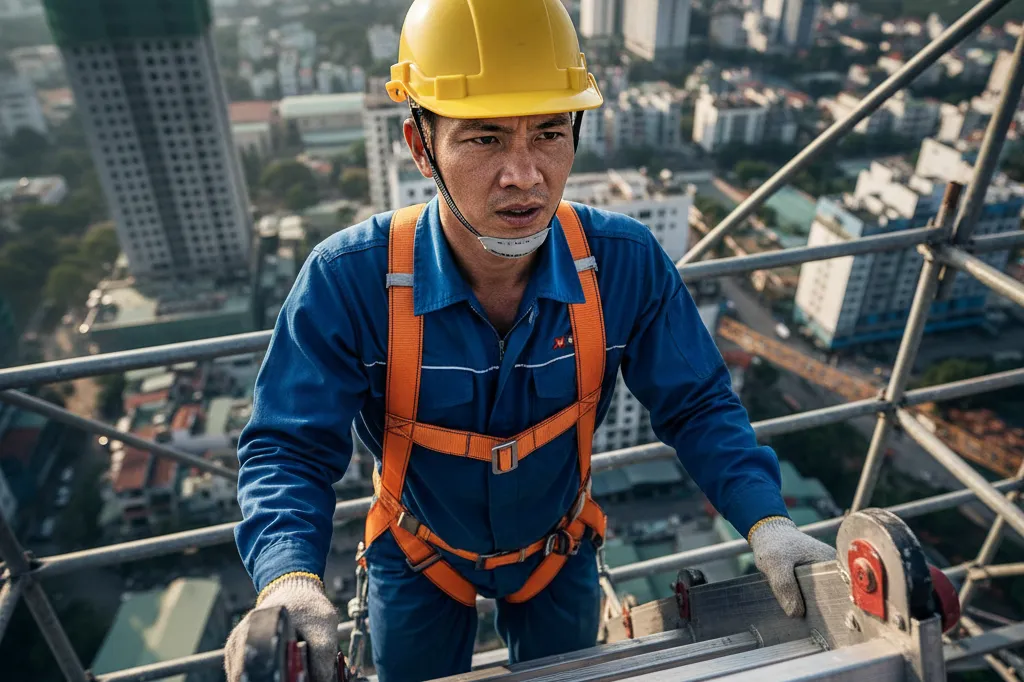
“Work carefully.” No matter how many times this is said during morning assemblies, “near-miss” incidents never seem to disappear from the site. Occupational accidents at construction and manufacturing sites in Vietnam, especially “falls” from heights, have long remained the top cause of fatal accidents.
Many site managers tend to dismiss this as “worker carelessness” or a “lack of safety awareness.” However, unless we deeply understand the psychological mechanisms of why experienced Vietnamese workers break basic rules, tragedies will only be repeated.
This article focuses on “human psychological errors” that cannot be prevented by sheer willpower or penalties alone. Based on data and theory, we will explain how Hasegawa’s manufacturing philosophy of “Reliability you can feel when you step on it” removes psychological burdens from workers and, as a result, serves as a physical bulwark to prevent accidents.
Challenges and Background: “Invisible” Risks Lurking at the Site
Market Data: The Severity of Fall Accidents by the Numbers
The reality of construction sites in Vietnam becomes clearer when looking at statistical data. According to research based on reports from MOLISA (Ministry of Labour, Invalids and Social Affairs), a staggering 60.4% of fatal accidents in the construction industry between 2014 and 2022 were caused by “falls from heights.”
Furthermore, in 2024 data, the construction industry continues to account for a high percentage of fatal occupational accidents, with approximately 20% of the causes attributed to the workers’ own actions (violations of safety procedures or failure to use protective equipment). This suggests that not only equipment deficiencies but also human behavioral characteristics are major factors in accidents.
Risk Presentation: Environmental Factors Unique to Vietnam
Vietnam’s sites have unique risk factors different from Japan. The high temperature and humidity reduce concentration, and the tight schedules accompanying rapid urban development create “impatience” in workers. In such an environment, even the slightest psychological lapse can be fatal.
Why Are Experienced Vietnamese Workers More at Risk? (Psychological Factors)
The Mechanism of Fear: “Normalcy Bias” and “Habituation”
“I’ll be fine.” Everyone thinks this somewhere in their mind. In psychology, this is called “normalcy bias.” Experienced Vietnamese workers, in particular, develop a “habituation” to high-altitude work due to their years of experience. This habituation numbs their sense of fear and makes them feel that essential safety checks are “useless tasks.”
The Instinct to Omit and “Shortcut Behavior”
Humans have an “instinct to omit” in an attempt to save effort. “Moving the stepladder is a hassle, so I’ll just lean out to work,” or “It’s a waste of time to put on a harness.” Such “shortcut behaviors” are more likely to occur at sites using heavy and difficult-to-handle tools. In other words, poor usability of tools indirectly induces unsafe behavior in workers.
Solutions Proposed by Hasegawa: Preventing Psychological Errors with Hardware
There is a limit to fighting human instinct with sheer willpower. That is why Hasegawa takes the approach of preventing psychological errors through the power of “tools (hardware).”
“Reliability you can feel when you step on it”: Eliminating Impatience Caused by Fear
When a stepladder wobbles at a height, people instinctively feel fear and their bodies stiffen. This stress leads to fatigue and scatters attention. Hasegawa Vietnam’s products not only pass standard tests like JIS and SG but also undergo thorough “sensory evaluation” where people actually step on them to verify. By thoroughly eliminating “shaking” and “flexing” that cannot be quantified, workers can forget their anxiety about their footing and concentrate on their work. “Not shaking” is not just about comfort; it is a psychological safety device.
“Ashigaru”: Eliminating the “Hassle” of Moving
The psychology that “carrying a heavy stepladder is a hassle” causes work in unreasonable postures (unsafe behavior). Hasegawa’s “Ashigaru” series, as the name suggests, achieves revolutionary lightness. Because it can be easily carried with one hand, workers will move the stepladder to the appropriate position without hesitation. “Lightness” consequently promotes behavior that adheres to safety rules.
“Leg Extension (Shagaman)”: Eliminating Unstable Footing
Construction sites in Vietnam often have uneven ground. The act of forcibly balancing using blocks or similar items is extremely dangerous. The “Leg Extension (Shagaman)” series is equipped with a “one-touch bar” that allows extension operation while standing, keeping it reliably horizontal even on steps or slopes. This fundamentally prevents unstable installation.
Hasegawa’s Reliability: The Basis for “Peace of Mind” That Cannot Be Quantified
Global Standard Quality Control
Hasegawa Vietnam’s Da Nang factory is not merely an overseas production base. It is the core of a global supply chain that supplies products to the most quality-strict markets such as Japan, the US, and Hong Kong. Strict quality control similar to that in Japan is conducted here. For example, the “Tough Series” undergoes durability tests exceeding 100,000 cycles (assuming 100 ascents/descents per day, 5 days a week). The fact that products made in Vietnam are chosen by professionals around the world is proof of that quality.
The Strength of Domestic Support in Vietnam
Many imported products take time for parts replacement and maintenance. However, since Hasegawa Vietnam has a factory in Da Nang, rapid support is possible. Having a system in place to use products safely for a long time is also a major reassurance for site managers.
Summary
Many causes of fall accidents lie in “habit” and “carelessness” lurking in the workers’ “minds.” However, attributing this solely to individual responsibility will not stop accidents.
What is important is to stand on the premise that “humans are creatures that make mistakes” and to prepare an environment and tools that do not induce mistakes.
- Eliminate fear and impatience with stepladders that do not shake.
- Eliminate the hassle of moving (the urge to slack off) with light stepladders.
- Eliminate unstable installation with adjustable stepladders.
Choosing Hasegawa products is not simply buying tools. It is an “investment in safety” to eliminate “psychological accident factors” from the site and protect workers’ lives and corporate trust.