
Introduction
Stepladders and ladders are used daily at manufacturing and construction sites in Vietnam. While attention is paid to distortion or damage to the main body, how many sites actually check the condition of the “feet” in detail?
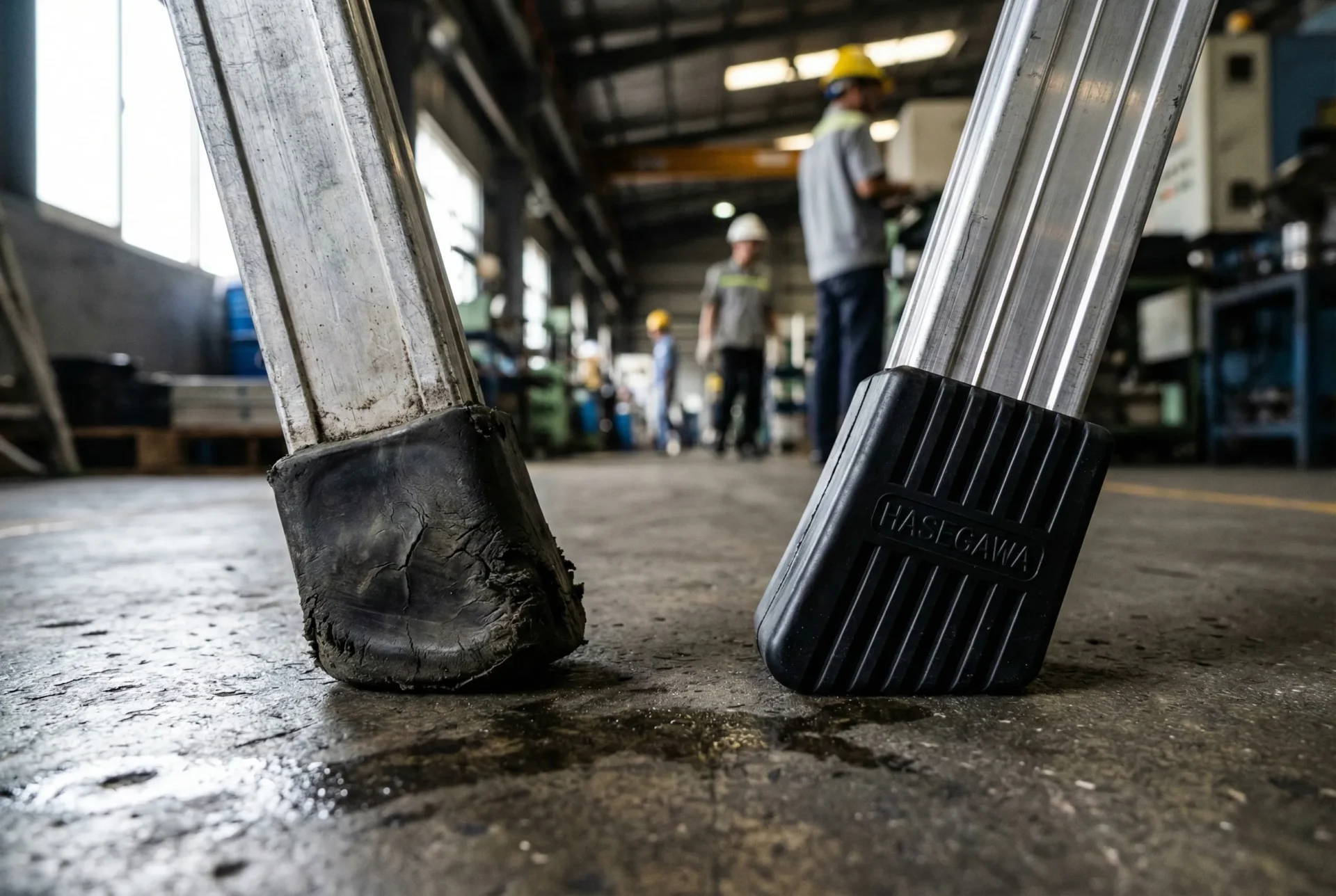
The “anti-slip rubber (official name: end cap)” attached to the bottom of the stepladder is an extremely important safety component, equivalent to “tires” or “brake pads” on a car. No matter how robust the aluminum stepladder is, if these few centimeters of rubber in contact with the ground lose their function, it leads directly to serious industrial accidents such as tipping over or falling.
Particularly in the environment of Vietnam, which is hot and humid and where some factories have a lot of oil and dust, rubber tends to degrade faster than in Japan. Before the overconfidence of “it’s still usable” invites an irreversible accident, this article explains the replacement standards for end caps, the mechanism of deterioration, and the importance of maintenance proposed by Hasegawa Vietnam from a professional perspective.
Why managing “end caps” is important
The reality of industrial accident data and the fear of “slipping”
In industrial accidents, crash and fall accidents always account for a high percentage. According to industrial accident statistics (2022 edition) published by Japan’s Ministry of Health, Labour and Welfare, about 40% of fatal accidents in the construction industry are caused by crashes and falls. Also, in reports by the Vietnamese Ministry of Labour, Invalids and Social Affairs (MOLISA), the risk of working at heights in construction and manufacturing sites is still considered the biggest challenge.
When analyzing the causes of accidents related to stepladders and ladders, they can be broadly divided into “losing balance,” “missing a step,” and “the stepladder itself slipping.” Especially when using a ladder, the cause of it slipping from the set angle of 75 degrees is often due to insufficient friction with the floor surface, in other words, the wear and deterioration of the end caps.
New end caps are designed to ensure a coefficient of friction based on JIS standards (JIS S 1121, etc.), but their performance certainly declines with use. A rubber sole that has worn down and become smooth becomes like being on ice on wet epoxy floors or concrete where cutting oil has splattered, making it impossible to support the worker.
Risks specific to the Vietnamese environment: Factors that accelerate deterioration
What we particularly want everyone operating in Vietnam to recognize is “rubber deterioration due to the environment (hydrolysis/hardening).”
- Hydrolysis due to high temperature and humidity: Vietnam’s average humidity is around 80% throughout the year, and it is not rare to exceed 90% in the rainy season. Rubber and resin products have an increased risk of “hydrolysis,” where they react with moisture and chemically decompose. As a result, the rubber may crumble or become sticky.
- Cracks due to ultraviolet rays (UV): When used for outdoor work, Vietnam’s strong ultraviolet rays cut the main chain of the rubber, generating “cracks” on the surface. Cracked rubber loses flexibility and its ability to bite into minute irregularities on the floor surface weakens, significantly reducing grip force.
- Oil and chemicals on factory floors: If the floor contains oil in processing factories, general rubber absorbs oil and swells, causing a decrease in strength or deformation. Although Hasegawa products use materials that consider oil resistance, use beyond the limit is dangerous.
Don’t miss the danger signs! Timing for replacement and inspection methods
So, specifically “when” should you replace them? Establishing clear standards that anyone on site can judge is the first step in safety management.
3 signs that require immediate replacement
If any one of the following applies, stop using that stepladder immediately and replace the end caps.
- [Wear] The grooves on the bottom surface (slip sign) have disappeared: Just like car tires, “grooves” are carved into the bottom of the end caps to prevent slipping. If these grooves, which are several millimeters deep when new, wear down and become flat (smooth), it is the end of their life. When the grooves are gone, the “drainage effect” to remove films of water or oil is lost, making it easy to slip like the hydroplaning phenomenon.
- Standard value: Replacement is recommended when the groove depth becomes 1mm or less.
- [Hardening/Damage] There are cracks or chips: This is when the rubber feels hard with no elasticity when pressed with a fingernail, or there are cracks on the surface. Hardened rubber has reduced adhesion to the floor surface. Also, a state where part of the rubber is chipped and the internal metal or plastic is visible not only damages the floor but requires immediate replacement because the anti-slip effect is practically zero.
- [Wobbling] Looseness of the attachment part: End caps are fixed to the stepladder body with rivets or screws. If the end cap moves loosely or rotates when the stepladder is lifted, the fixtures may be loose or the rivets may be corroded.
“10-Second Check” implementation case study that anyone can do
At a Japanese automotive parts factory in Vietnam, a “stepladder sole check” was introduced for the pre-work inspection every morning, continuing a record of zero fall accidents. The method is extremely simple.
- Step 1: Lay the stepladder on its side.
- Step 2: Look at the back of the 4 end caps.
- Step 3: Touch with your finger to confirm if there are grooves or if foreign objects (chips or pebbles) are caught.
It takes only 10 seconds. At this factory, the safety manager inspects the wear status all at once every six months, and orders genuine Hasegawa parts to replace those showing wear in bulk. The shift from “buy a new one if it breaks” to “replace parts and keep using” contributes not only to cost reduction but also to improving workers’ safety awareness.
Why Hasegawa is chosen
Although many cheap ladders are distributed in the Vietnamese market, most are premised on being “disposable,” and in most cases, replacement parts are not available. The reason Hasegawa is chosen by professionals in Vietnam lies in this “after-sales support” and “quality.”
Quality and standards that support safety
The end caps adopted for Hasegawa stepladders and ladders are created with a design philosophy that clears strict Japanese safety standards (JIS standards, SG mark standards, etc.).
For materials, special compound rubber or elastomers with excellent weather resistance and wear resistance are used. The shape also adopts a unique pattern that allows water and dust, which cause slipping, to escape while maximizing the contact area with the floor surface. For example, the end caps of the popular “Ashigaru” series are pursued for a shape that stabilizes easily even on uneven ground.
Parts supply system in Vietnam
“I only want the end caps, but they aren’t sold, so I have to buy a whole new stepladder.”
This is a major loss for both corporate expenses and the environment (waste reduction).
At Hasegawa Vietnam, we supply not only the main body but also genuine end caps (including those with left/right designations).
By holding stock within Vietnam, we have established a system to deliver parts quickly when needed. Replacing parts for a cost of several thousand yen extends the life of a stepladder costing tens of thousands of yen by several years, and above all, protects priceless human life. This can be said to be maintenance with extremely high return on investment.
Summary
It is no exaggeration to say that the safety of stepladders and ladders is held by the “end caps” in contact with the ground.
- Risk: Worn rubber invites fatal slip accidents in Vietnam’s hot, humid, and oily environments.
- Standard: Replace immediately if groove depth is 1mm or less, or if cracks or hardening are observed.
- Measure: Establishment of a “10-second check” before work starts and a periodic parts replacement cycle.
- Solution: Hasegawa Vietnam can supply replacement parts.
To protect safety at the site, please turn over the stepladder you have now and check its “feet” first. If wear is seen, it might be a countdown to an accident. Please feel free to consult Hasegawa Vietnam anytime regarding the arrangement of replacement parts or appropriate maintenance methods.