
Introduction
To all safety managers, factory managers, and purchasing staff who work hard every day at manufacturing, construction, and logistics sites in Vietnam: thank you for your daily dedication to safety management. The slogan “Safety First (An Toàn Là Trên Hết)” is displayed at every site, but hasn’t it become just an empty catchphrase?
Protecting site safety is the most critical issue that directly affects not only the lives of employees but also a company’s productivity and brand value. However, due to cost-cutting pressures and strict construction deadlines, investment in “hardware” such as work scaffolding and stepladders is constantly postponed. In this article, based on primary data such as the latest occupational accident statistics published by the Ministry of Labour, Invalids and Social Affairs of Vietnam (MOLISA), we will highlight the reality of “fall from height accidents,” which are the most likely to be fatal. Furthermore, we will explain specific risk countermeasures by industry and the reliable solutions provided by Hasegawa Vietnam.
Challenges and Background
Market Data
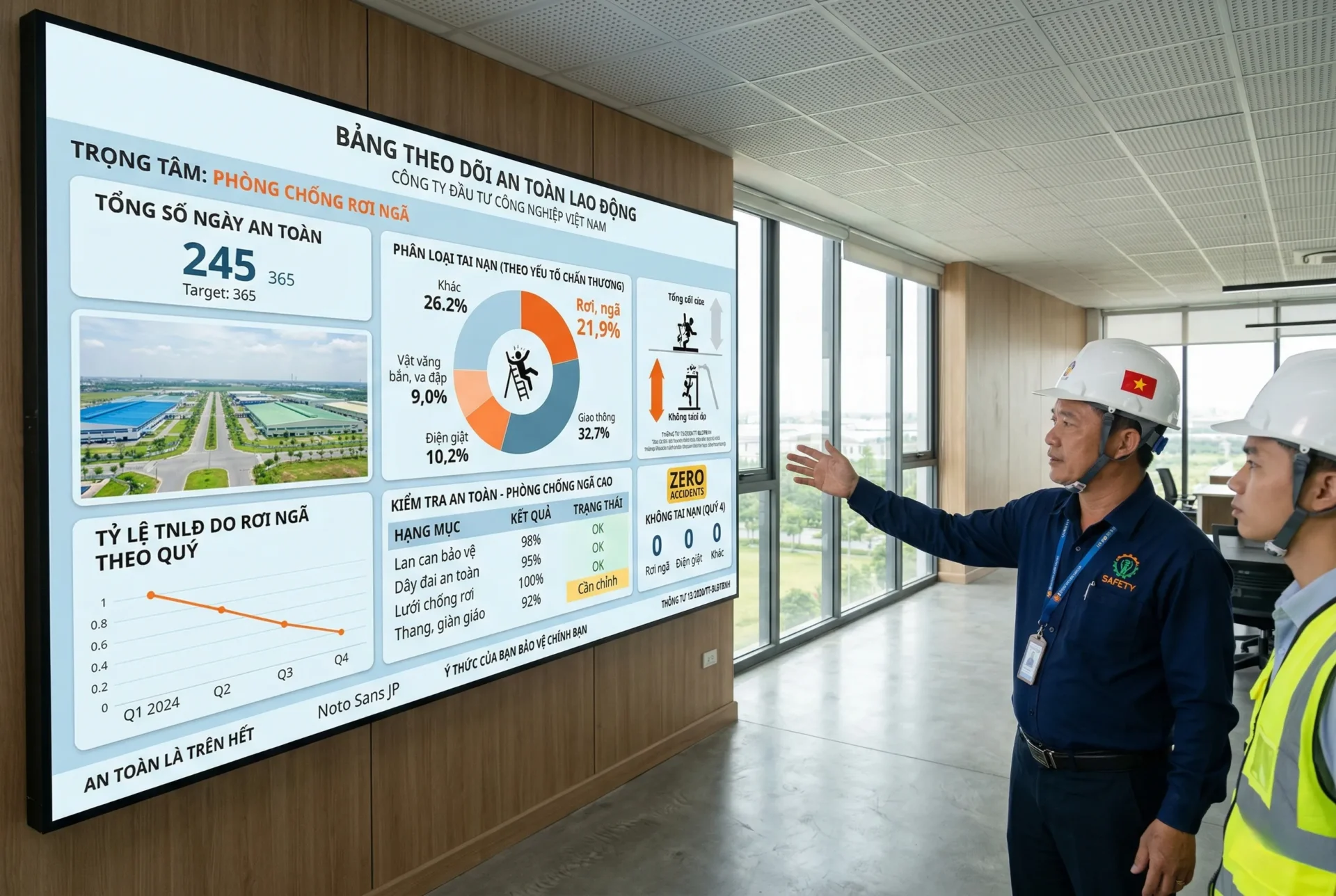
Along with the rapid growth of the Vietnamese economy, factory construction, infrastructure development, and the expansion of logistics hubs are progressing all over the country. However, behind this development, the number of occupational accidents remains at a high level.
According to the latest official report from MOLISA, the total number of occupational accidents reported nationwide in 2023 was 7,394, and the number of affected workers reached 7,553. Among these, 662 fatal accidents occurred, representing a serious situation that can never be overlooked. What is even more noteworthy is the breakdown of these fatal accidents by cause. Accidents caused by “falls from heights” account for 28.5% of the total, ranking first among all accident causes.
Key Data: Statistics on Occupational Accidents and Fall Accidents in Vietnam (FY 2023)
- Indicator 1: Total number of occupational accidents nationwide: 7,394 (A slight decrease from the previous year, but still remaining high) (Source: MOLISA)
- Indicator 2: Total number of victims from occupational accidents: 7,553 (Source: MOLISA)
- Indicator 3: Percentage of “falls from heights” among all fatal accidents (662 people): 28.5% (The highest) (Source: MOLISA)
- Indicator 4: Total economic loss due to occupational accidents: Approximately 16.3 trillion VND (Source: MOLISA / GSO)
- Indicator 5: The accident rate due to the use of unsuitable scaffolding in high-altitude work (2 meters or more above the ground) accounts for about 40% of the total (Source: VOSHA)
The damage an accident inflicts on a company goes beyond worker injuries and loss of life. According to estimates by MOLISA and the General Statistics Office of Vietnam (GSO), the combined economic loss from medical expenses, leave compensation, equipment damage, and opportunity costs due to work stoppages reaches approximately 16.3 trillion VND (Vietnamese Dong) annually. When a major accident occurs, it is estimated to cost an average of about 200 million VND in direct costs. If the accompanying loss of the company’s social credibility (reputation risk) is factored in, the damage is immeasurable.
In the world of safety management, there is a famous empirical rule called “Heinrich’s Law.” This states that “behind every major accident, there are 29 accidents with minor injuries, and behind those, there are 300 near-misses (events that cause a scare but no injury).” In other words, if you ignore 300 near-misses where a cheap, unstable stepladder “wobbled a little” on site, it will inevitably lead to one fatal fall accident (death or severe injury).
Risk Presentation
Under Vietnam’s Law on Occupational Safety and Health and related decrees (such as Decree 39/2016/ND-CP), work performed at a height of 2 meters or more from the ground is generally defined as “work at height,” and strict safety measures are mandated. However, the manifestation of these risks varies depending on the industry.
1. Risks in the Construction Industry
Construction sites are the environments with the highest risk of falls. Work at heights exceeding 2 meters, such as assembling and dismantling scaffolding, exterior wall painting, and roof construction, occurs on a daily basis. At local sites in Vietnam, it is still common to see the use of bamboo scaffolding or cheap iron scaffolding whose strength has deteriorated due to rust. The safe working load (weight capacity) standards for these are ambiguous, and they can easily lose balance due to strong winds or uneven weight distribution by workers, leading to large-scale fall accidents.
2. Risks in the Manufacturing Industry
In manufacturing plants, there is a common misconception that “there is no work at height because our factory is a single-story building.” However, in reality, work at “awkward heights” of about 1.5 to 3 meters, such as daily inspections of huge press machines and molding machines, maintenance of overhead cranes, and replacement of piping and lighting, occurs frequently. This height makes workers prone to carelessness. Performing tasks without wearing helmets or safety harnesses (belts), using folding chairs or unstable stools as substitutes, frequently results in serious accidents where workers fall and strike their heads hard.
3. Risks in the Logistics Industry
Due to the development of e-commerce, large-scale logistics warehouses are being built all over Vietnam. To increase storage efficiency in limited spaces, racks (shelves) are becoming taller, and high racks of 5 meters or more are not uncommon. When picking workers handle heavy items while climbing up and down unstable ladders with one hand, the risk of falls due to missing a step or the ladder itself sliding sideways is rapidly increasing. In warehouses where the floor is coated with epoxy resin or similar materials, the quality of the stepladder’s rubber feet (anti-slip) becomes a lifeline.
Product and Service Introduction
Features
Fundamentally and physically solving the fall risks at these diverse work sites is the product lineup of Hasegawa (Hasegawa Kogyo), which has supported Japanese work sites for many years. Rather than urging workers to be careful through willpower alone, we build an “accident-free environment” by improving the quality of the hardware.
Absolute Robustness Compliant with JIS Standards and SG Marks
Hasegawa’s main stepladders and work platforms are made with design concepts that clear or are equivalent to the strict Japanese national standards of JIS (Japanese Industrial Standards) and the SG (Safe Goods) mark set by the Consumer Product Safety Association. For example, many of our professional stepladders boast a maximum weight capacity of 130 kg or more, ensuring high rigidity that won’t budge even when a large worker holds heavy tools.
Rust Resistance and Durability to Withstand Vietnam’s Harsh Climate
Vietnam’s unique hot and humid climate rapidly accelerates metal corrosion. Hasegawa’s products use high-quality aluminum alloys and feature an alumite treatment (anodic oxide coating) on the surface, achieving overwhelming rust resistance compared to iron products. This allows them to be safely used for long periods without strength degradation, even at outdoor construction sites or in food and beverage factories where steam is generated.
Functional Beauty that Enhances On-site Work Efficiency
Safety does not have to come at the expense of workability. Hasegawa’s products are designed with wide rungs (steps) to reduce the strain on the soles of the feet, thereby preventing worker fatigue. In addition, a one-touch folding mechanism and the use of lightweight aluminum materials significantly reduce the burden of carrying them around factories and large warehouses. Ingenious designs to prevent human error are incorporated throughout, such as a visual indicator to intuitively see the optimal leaning angle of 75 degrees when used as a ladder.
Case Studies (Before → Action → After)
[Case Study: Manufacturing Industry (Auto Parts Manufacturer)]
- Before: In the maintenance of large equipment within the factory, heavy, locally procured welded iron stepladders were used. They weighed over 20 kg, making them difficult to move, and the welded parts were rusted and wobbly. Workers complained, saying, “I’m too scared to concentrate on the work.”
- Action: A total of 15 units of Hasegawa’s folding work platforms (Safety Step) and dedicated stepladders with wide top plates were introduced at once.
- After: They are now lightweight aluminum (about 10 kg), making them easy for even female workers to move. The wide top plate and handrails allow workers to work safely with both hands free, reducing equipment maintenance time to 50% of what it used to be. For two years after introduction, both fall accidents and near-miss reports reached zero.
[Case Study: Logistics Industry (Major Foreign-affiliated 3PL Company)]
- Before: Aluminum stepladders with typical narrow steps were used for picking operations. Workers would lose their balance on the slippery epoxy floor, resulting in several accidents a month where products were dropped and damaged. There were also three workers per year who suffered minor injuries from falls.
- Action: Hasegawa’s work platforms, which have a gentle ascent angle and are equipped with large anti-slip feet (rubber feet) with high grip effectiveness, were introduced.
- After: A strong grip on the floor surface was secured, completely eliminating side-slipping during ascent and descent. The stable footing increased the speed of picking operations, improving the overall work efficiency of the warehouse by 15%. Losses from product damage accidents were also significantly reduced.
[Case Study: Construction Industry (Japanese General Contractor)]
- Before: During interior finishing work, local subcontractors brought in poor-quality wooden or homemade scaffolding. It received warnings every time the Occupational Safety and Health Bureau conducted an inspection, becoming a source of stress for the site supervisor.
- Action: Hasegawa’s telescopic scaffold boards and portable work platforms were designated as standard equipment for the site. Subcontractors were also mandated to use them.
- After: The safety standards of the site were raised to a level equivalent to Japan, and inspections were cleared smoothly. The time required for assembling and dismantling scaffolding was reduced by 30%, greatly contributing to strict adherence to the construction schedule. The overall “safety awareness (safety culture)” of the site improved dramatically.
Hasegawa’s Reliability
Quality Control and Certification
The “peace of mind” that Hasegawa provides is backed by rigorous testing. During the product development stage, load tests that far exceed the expected usage environment are conducted. For example, on stepladder rungs, continuous load tests up to 100,000 times (durability tests simulating ascending and descending) and stability tests against tipping are thoroughly performed within our own factory. Unlike cheap imitations distributed in the Vietnamese market, the true value of Hasegawa products lies in their durability (low life-cycle cost) that allows them to be used for a long period of more than 10 years.
Customization and Support System
Work sites in Vietnam often involve factories renovated from existing buildings or facilities with complex line layouts, meaning standard commercial products frequently do not fit in terms of dimensions. At Hasegawa Vietnam, in collaboration with the Japanese development team, we flexibly handle the design and manufacture of “customized products” tailored to the specific local environment.
Whether it’s work scaffolding for uneven areas or crossover stairs dedicated to specific equipment, we precisely measure the site dimensions and propose the optimal solution. Furthermore, we provide guidance on regular inspection methods after purchase and have a support system for replacing consumable parts (such as rubber feet), promising a long-term partnership rather than a “sell and forget” approach.
Conclusion
As seen in this article, “fall from height accidents” in Vietnam are the most alarming risk, accounting for approximately 30% of all fatal accidents. Considering the economic loss of hundreds of millions of VND caused by a single accident, the loss of human resources, and the damage to the corporate brand, investing in safe scaffolding and stepladders is not a “cost” but a highly cost-effective “insurance” and a “forward-looking investment.”
The initial cost of Hasegawa products may seem higher than local products. However, due to significant improvements in work efficiency, reduction in maintenance costs, and above all, the peace of mind that “accidents will absolutely not happen,” they will surely bring a positive ROI (Return on Investment) over a period of several years.
Is the stepladder you are using at your site truly of a quality worthy of entrusting your employees’ lives and your company’s future?
To raise the safety standards of your site to the next level and realize an accident-free workplace, please consult with Hasegawa Vietnam. Our Japanese and local expert staff will promptly assist you, from proposing the optimal products tailored to your site layout to sending catalogs and lending out demo units.