
Introduction
In construction sites and factory maintenance, electricians are always working side-by-side with “invisible dangers.” Especially in Vietnam’s hot and humid environment, it is no exaggeration to say that the insulation performance of equipment determines the lives of workers. However, lightweight and inexpensive “aluminum ladders” are still used for electrical work at sites, leading to endless cases of serious electric shock accidents.
In this article, we explain to electrical work professionals, safety managers, and purchasing managers operating in Vietnam why “FRP (Fiberglass Reinforced Plastic) ladders” are essential for electrical work, along with the scientific grounds and the strict safety standards established by Hasegawa Kogyo (Hasegawa). Choosing the right tools is an investment that protects not only work efficiency but also the lives of you and your team.
The “Invisible Risks” Lurking in Electrical Work Sites
Market Data and Current Status of Electric Shock Accidents
Occupational accidents in Vietnam are on the rise. According to estimated data for 2024, the number of occupational accidents reached approximately 8,000, of which 600 to 700 led to fatal accidents. The construction industry has a particularly high accident rate, making it a dangerous sector accounting for about 10% of the total.
Among these, electricity-related accidents have a high fatality rate, and many originate from the “use of inappropriate equipment” or “lack of insulation protection.” Even in US statistics, falls from ladders are one of the leading causes of death in the construction industry, including electrocution from contact with power lines. With the rapid urban development in Vietnam, demand for electrical installation work is surging, making a review of safety standards an urgent task.
The Danger of “Short Circuits” Caused by Aluminum Ladders
While aluminum ladders are popular at many sites for being lightweight and easy to handle, they carry the fatal risk of having extremely high electrical conductivity.
If an aluminum ladder accidentally comes into contact with live parts (exposed wires or terminals) during electrical work, it causes the following two serious accidents:
- Electric shock to the worker: Current passes through the ladder and through the worker’s body to the ground, causing severe burns or cardiac arrest.
- Arc flash (Short circuit): The ladder short-circuits between two electrical potentials, causing an explosive arc discharge. This not only destroys equipment but also subjects surrounding workers to blast waves and thermal burns.
The only solution that can physically block these risks is switching to materials with insulating properties.
Why “FRP (Fiberglass Reinforced Plastic)”?
Overwhelming Insulation Performance and Voltage Resistance Data
FRP (Fiber Reinforced Plastics) is a composite material of plastic reinforced with glass fibers. The greatest feature of this material lies in its “non-conductivity,” possessing an electrical resistance value of 10^15 ohms or more in a dry state.
The electrical work ladders developed by Hasegawa Kogyo (e.g., RSG series) use this FRP as the main material and boast an extremely high withstand voltage performance of 20,000V (20kV). This is a spec designed to reliably protect workers in the event of accidental contact, not only with general household voltage (220V) but also during maintenance work on factory power supplies or high-voltage equipment. Compared to aluminum, the weight increases by 30-50%, but this weight can be rephrased as the thickness of a “shield that protects life.”
“Durability” Suited to Vietnam’s Climate
Vietnam’s climate is characterized by high temperature, high humidity, and strong ultraviolet rays. Wooden ladders are prone to rotting due to moisture, and iron ones are prone to rusting. On the other hand, FRP is ideal for Vietnam’s environment due to the following characteristics:
- Corrosion resistance: It does not rust and does not easily deteriorate even in coastal areas or inside chemical plants.
- Weather resistance: Strength does not easily decrease even when exposed to ultraviolet rays or drastic temperature changes (from scorching outdoors to air-conditioned indoors).
- Thermal insulation: Since it does not conduct heat easily like aluminum, the ladder itself does not become hot enough to cause burns even during outdoor work under the blazing sun, allowing for safe gripping.
Case Study: From a Factory Maintenance Site
【Before】
A manufacturing factory in an industrial park near Hanoi was using general-purpose aluminum stepladders for lighting replacement and wiring inspections. One day, during wiring work in the ceiling, the stepladder contacted the coating of an aging cable, causing an accident where the breaker tripped. Although the worker was not injured, the factory line stopped for 2 hours, resulting in significant losses.
【Action】
The safety management department completely banned the use of aluminum ladders in electrical work areas and introduced Hasegawa Kogyo standard FRP ladders (RSG series, etc.) across the board.
【After】
After introduction, electrical contact accidents became zero. Additionally, because the rigidity of FRP ladders is high, “wobbling” during high-altitude work was reduced, and unexpected benefits such as improved speed in precision wiring work were also reported.
Key Data: Selection Criteria and Risks for Electrical Work Ladders
- Number of occupational accidents in Vietnam: Approx. 8,000/year (2024 estimate), Construction industry approx. 10%
- Hasegawa RSG Series Withstand Voltage: 20,000V (20kV)
- Maximum Load Capacity: 110kg (Professional grade sturdiness)
- Material Properties (Aluminum): Conductive (High electric shock risk), High thermal conductivity
- Material Properties (FRP): Non-conductive, Excellent corrosion and weather resistance
The “World-Class Trust” Provided by Hasegawa Vietnam
Japanese Quality Safety Standards and “Anti-Wobble” Technology
Hasegawa Vietnam’s strength is not just that it is “made in Vietnam.” It lies in the point that it is “made in Vietnam with Japanese quality standards.” The parent company, Hasegawa Kogyo, not only clears JIS (Japanese Industrial Standards) and SG (Consumer Product Safety Association) standards but also sets even stricter internal standards.
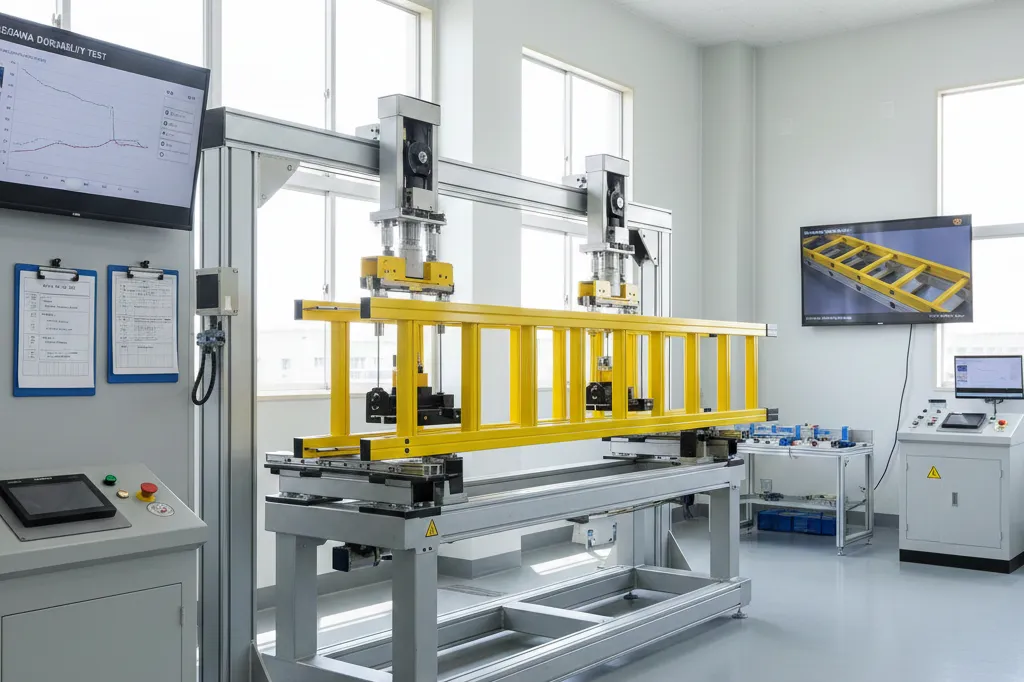
Noteworthy is the ascending/descending durability test spanning 100,000 cycles. This calculates to not breaking for about 4 years even if climbed up and down 100 times a day, 5 days a week. Furthermore, the Da Nang factory functions as one of four testing centers worldwide, with a quality control system equivalent to that of Japan in place.
Hasegawa Kogyo’s brand message, “Reliability you can feel when you step on it,” is alive and well in FRP ladders too. Although FRP material has a property of being flexible, Hasegawa’s design technology suppresses lateral swaying and twisting at heights. For electricians who require detailed work at hand, the stability of their footing is directly linked to work quality.
Support System Within Vietnam
When introducing high-end overseas ladders, concerns often lie in “availability” and “after-sales support.” Hasegawa Vietnam has a manufacturing base in Da Nang (established in 2013, production started in 2014) and is a global hub supplying products to major markets such as Japan and the United States.
This establishes a system that can stably supply high-quality products to construction projects and factories within Vietnam. Even in terms of support such as handling replacement parts and training on correct usage, the speed unique to a local subsidiary can be expected.
Summary
Choosing a ladder for electrical work is not a target for cost reduction, but an investment target for safety. FRP ladders with a withstand voltage performance of 20,000V are the only physical barrier that protects workers from the invisible threat of electricity.
Hasegawa Kogyo’s FRP ladders combine durability that can withstand Vietnam’s harsh environment with the “non-wobbling” quality recognized by Japanese craftsmen. To raise the safety level of your site by one step, please consider reviewing your equipment now. Safety takes priority over everything.