
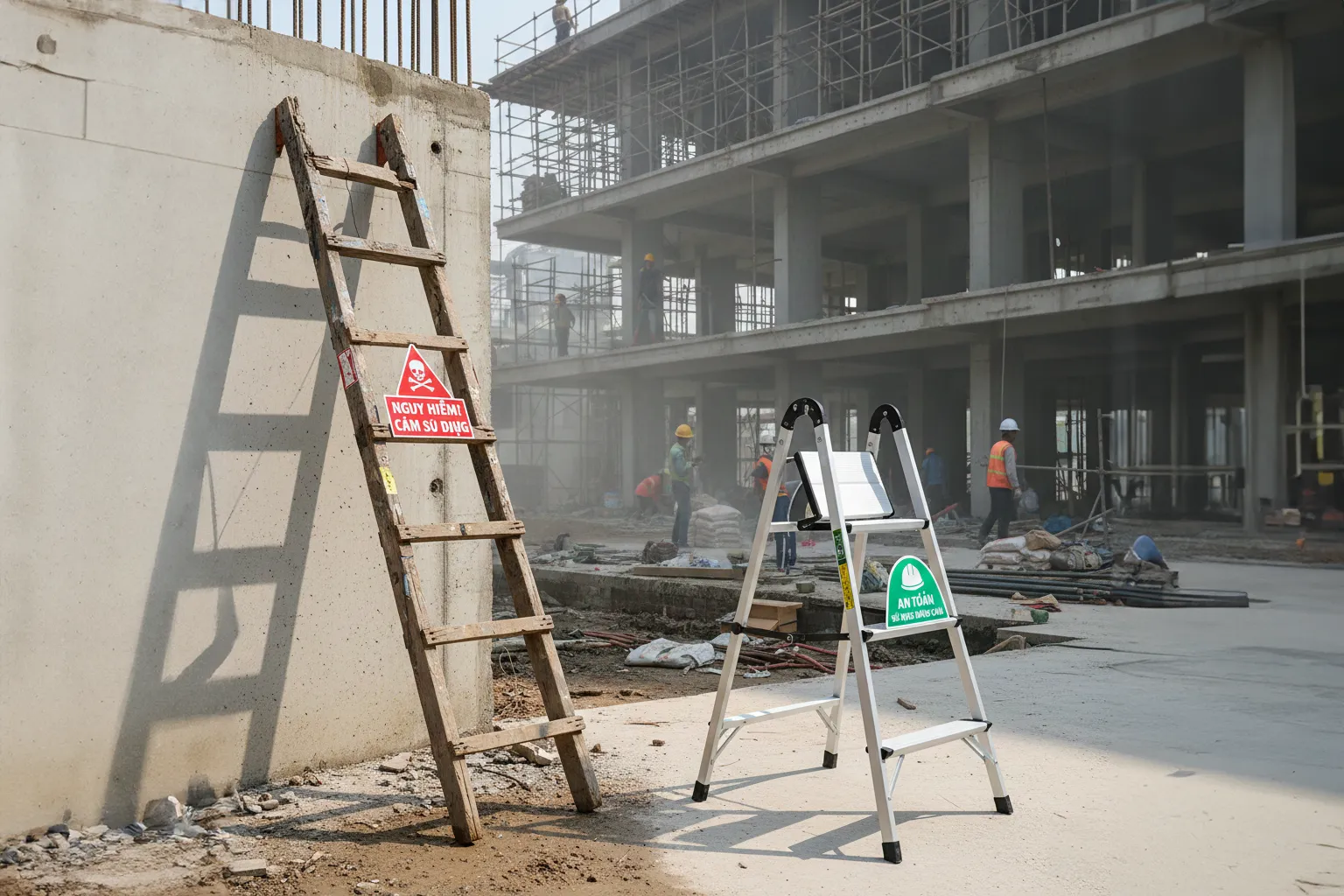
Introduction
In Vietnam’s construction and manufacturing sites, are stepladders and ladders often considered items to be used “until they break”? However, even if they look clean, metal fatigue and deterioration of parts are certainly progressing. In fact, economic losses due to occupational accidents are on the rise in Vietnam, and countermeasures are an urgent task.
Hasegawa Vietnam aims to be not just a provider of tools, but a partner that protects “lives” and “safety” at the worksite. In this article, based on international safety standards and the latest market data, we explain the “5 Signs for Disposal/Replacement” that professionals must absolutely not overlook. Updating equipment at the appropriate timing is not a cost, but an investment in the future.
Risks and Current Status Lurking in Vietnamese Worksites
Increasing Occupational Accidents and the Danger of “Working at Heights”
According to data from the Vietnam Ministry of Labour, Invalids and Social Affairs (MOLISA), the number of occupational accidents nationwide reached 8,286 in 2024, an increase of 892 from the previous year. Even more serious is the fact that fatal accidents increased to 675 (up 13 from the previous year) and the number of fatalities increased to 727 (up 28 from the previous year).
The construction industry, in particular, is considered one of the “high-risk industries” with the highest number of fatal accidents. According to past data analysis, a staggering 60.4% of fatal accidents at construction sites were due to “falls from heights.” This figure far outstrips electric shocks (38.5%) and being caught in machinery (1.1%).
The Price of “It’s Still Usable”
At many sites, stepladders tend to be used to their absolute limit. However, even in the US Occupational Safety and Health Administration (OSHA) violation rankings, violations related to Ladders are always high in the top 10 (3rd place in fiscal year 2022), highlighting the current situation where appropriate management is not being carried out.
If an accident occurs, massive “invisible costs” arise, such as site shutdowns and construction delays, in addition to medical expenses and compensation costs. Comparing the price of one new stepladder with the amount of loss caused by an accident, the rationality of early replacement is clear.
Check Now! 5 Dangerous Signs Indicating the End of a Stepladder’s Lifespan
Site safety managers and workers should immediately stop using the equipment and consider disposal or replacement if even one of the following 5 signs is confirmed. This is a professional judgment criterion based on the concepts of OSHA (USA) and JIS (Japan).
Sign 1: “Wobbling” and “Abnormal Noises” at Joints
Looseness of rivets or bolts is definitive proof that the structural strength of the entire stepladder has decreased. If you hear a “creaking” sound when climbing up or down, or if the rungs (steps) wobble, it can be said to be a precursor to collapse. Hasegawa’s products thoroughly eliminate shaking and noise from the design stage, based on the philosophy of “You can tell when you ride it, reliability.” Please consider that a wobbly stepladder has already exceeded its safety margin.
Sign 2: “Deformation, Bending, or Dents” in Stiles or Rungs
Aluminum alloy is lightweight and strong, but once deformed, its strength drops significantly, and strength does not recover even if returned to its original shape. Even a small dent can cause stress concentration, creating a risk of sudden breakage (buckling) during use. Stepladders with bent stiles or rungs deformed into a bow shape are subjects for immediate disposal.
Sign 3: “Wear or Loss” of End Caps (Rubber Feet)
The most common cause of stepladder accidents is falls due to “slipping.” It is extremely dangerous if the grooves on the anti-slip end caps (rubber feet) at the base of the stepladder are worn away, or if the rubber itself is missing. This is the same as driving on a highway in a car with no tire tread. Especially on tiled or concrete floors in Vietnam, the grip of the end caps is a lifeline.
Sign 4: “Malfunction” of Spreader Bars or Locks
If the spreader bars or locking mechanisms do not move smoothly, or if it is difficult to engage the lock, there is a possibility that excessive force has been applied and the frame itself is distorted. Especially in the case of extension ladders, a malfunction of the locking device leads directly to fatal accidents (finger amputation or falls), so OSHA also issues strict warnings.
Sign 5: “Corrosion and Deterioration” due to Harsh Environments
In hot and humid Vietnam, especially in coastal areas like Da Nang, the progression of corrosion (rust) due to moisture containing salt accelerates. If white powdering (corrosion) on the aluminum surface or red rust on steel parts is significant, the strength has decreased. Also, in the case of fiberglass products, it is time for replacement if the “blooming phenomenon,” where the surface becomes fuzzy due to UV deterioration, is observed.
Why Do Professionals Continue to Choose “Hasegawa”?
“Japanese Quality” Delivered from Da Nang to the World
Since starting production in 2014, Hasegawa Vietnam has continued to supply products to markets with the strictest quality standards, such as Japan and the USA (Export ratio: Japan 40.89%, Hong Kong 41.33%, USA 16.89%). Our Da Nang factory is not merely a production base. It possesses one of the world’s four testing centers, along with Japan and China, and conducts rigorous quality tests exceeding 250 times per month.
Design Withstanding “100,000 Cycles” of Ascending and Descending
In addition to general standard tests, Hasegawa Kogyo conducts a 100,000-cycle ascending and descending repetition test for its “Tough Series,” assuming use 100 times a day, 5 days a week. This overwhelming durability reduces frequent replacement costs and maximizes cost performance from a long-term perspective.
Next-Generation Safety Standards “BLACK LABEL” and “Ashigaru”
The BLACK LABEL series developed for professionals and the lightweight specialized stepladder Ashigaru achieve both strength and ease of use at a high level. Additionally, the design series lucano pursues functional beauty and proposes new value that blends into interiors.
Summary
Stepladders are not “things that last a lifetime.” They are important safety equipment entrusted with lives. The 5 signs of “Abnormal noise, Deformation, Rubber wear, Lock malfunction, Corrosion” introduced this time are an SOS from the worksite. As indicated by Vietnam’s occupational accident statistics, the risk of falling from heights is always close at hand.
When you hesitate, thinking “it’s still usable,” that is precisely the timing for replacement. Hasegawa Vietnam fuses the Japanese craftsman spirit with Vietnamese manufacturing technology to deliver top-quality products that support worksites around the world. If you feel any anxiety about your current equipment, please consult us. Investment in safety protects the future of your worksite.